
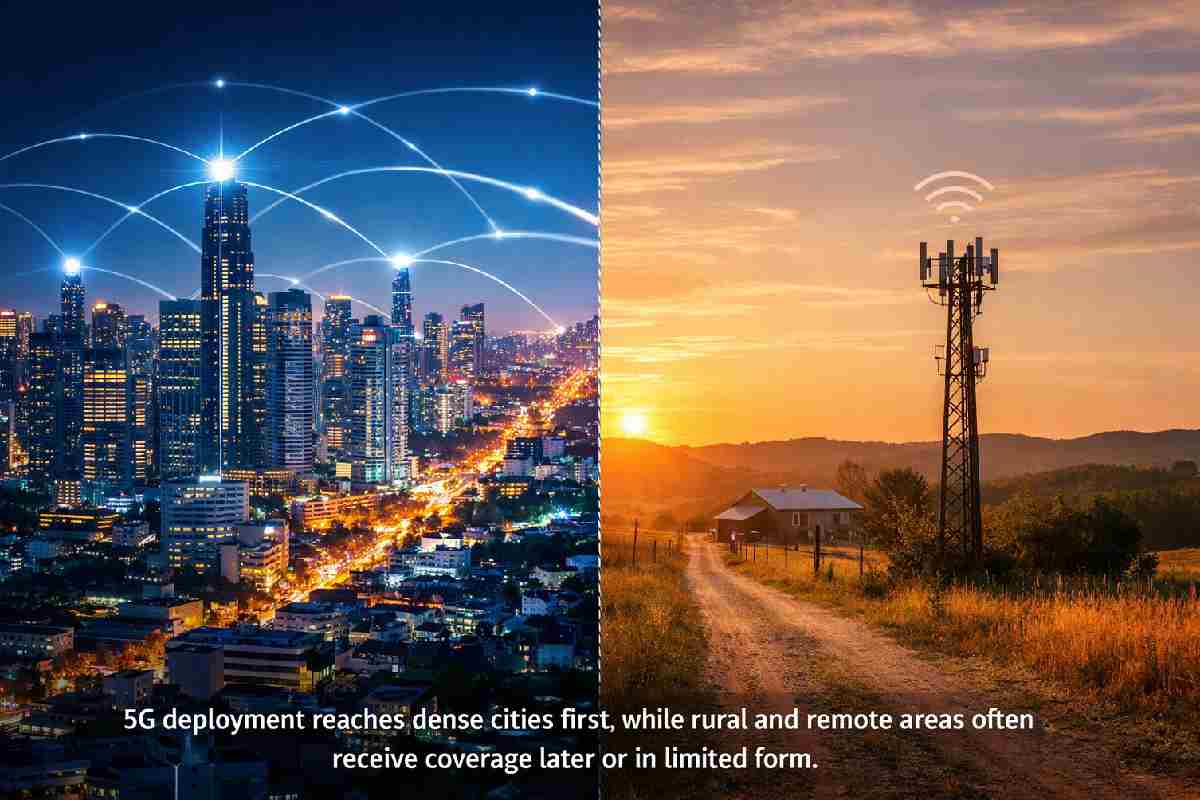
5G isn’t arriving everywhere at once—and not everyone will feel it the same way. Some cities are jumping to multi‑gigabit speeds, while other places barely see a new icon on their phone. This article explains who actually gets 5G first, who waits longer, and the real‑world factors—money, infrastructure, policy, geography, and even your own device and plan—that decide your place in the rollout.
Table of Contents
Quick Answer
5G reaches large cities and high‑density regions first because networks are expensive to build and need strong infrastructure and clear returns. Rural, remote, and low‑density areas usually receive 5G later or only limited versions. Who gets 5G depends on population density, existing networks, government spectrum policy, geography, and whether users have a compatible device and mobile plan—not demand alone.
Key Takeaways
-
5G rollout is uneven by design, not by accident.
-
Cities and wealthier regions get 5G first due to infrastructure and return on investment.
-
Rural and remote areas often receive slower or limited 5G coverage.
-
“5G available” does not mean the same speeds or performance everywhere.
-
Policy, spectrum access, geography, and user‑side readiness (device + plan) all matter.
What Does “Getting 5G” Actually Mean?
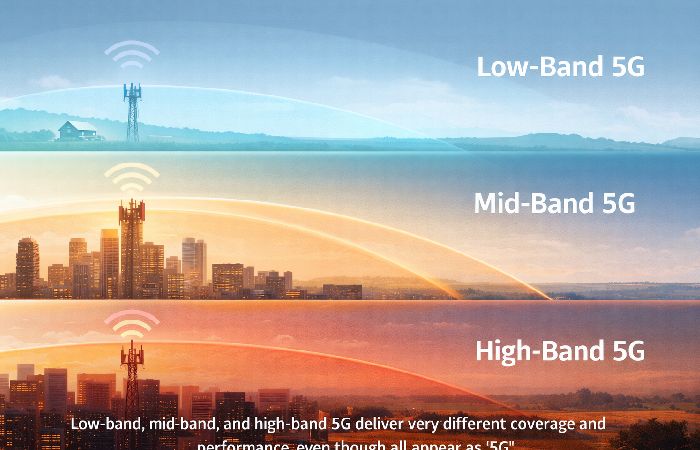
Getting 5G does not mean everyone receives the same experience, because 5G is defined as a family of technologies and frequency bands under common standards set by bodies such as the 3rd Generation Partnership Project (3GPP).
-
Low‑band 5G covers large areas but offers modest speed gains over 4G.
-
Mid‑band 5G balances coverage and performance and delivers the most noticeable improvements.
-
High‑band (mmWave) 5G offers extreme speeds but only works over very short distances and requires dense infrastructure.
This is why two areas can both be labeled “5G” while delivering very different real‑world performance.
Who Gets 5G First?
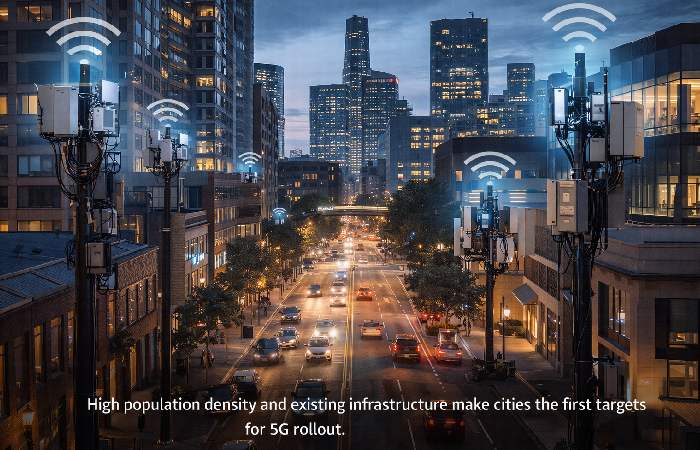
Large Cities and Dense Urban Areas
Urban areas are prioritized because many users can be served with fewer towers. This lowers cost per user and accelerates returns on infrastructure investment.
Countries and Regions Leading in 5G
Regions such as North America, parts of East Asia (for example, South Korea and China), and much of Western and Northern Europe have moved fastest on 5G because they invested early in spectrum, fiber, and urban networks. Within these regions, major metropolitan areas and transport hubs usually get first access.
Countries With Early Spectrum Allocation
Governments that release 5G spectrum early and design clear rules for its use enable faster rollout, as highlighted by the International Telecommunication Union’s guidance on 5G spectrum and standards. Delays in licensing or auctions slow deployment regardless of how ready operators are from a technical standpoint.
High‑Income Regions With Strong Infrastructure
Regions with existing fiber backbones, modern towers, and stable power systems adopt 5G faster because upgrades are cheaper and quicker. Where 4G networks are already strong, upgrading sites to 5G is often more straightforward.
Real‑World 5G Examples in 2026
India: Fast‑Growing 5G Market
By early 2026, India has become one of the world’s largest 5G markets, with wide population coverage in major cities and districts. Users in metros such as Delhi, Mumbai, and Bengaluru are very likely to see 5G, but the quality they experience still depends on the operator, the band in use, and the plan they pay for.
United States and Europe: Easy Access, Tiered Experience
In the US, UK, and much of Europe, getting some form of 5G is now relatively easy in cities, but getting consistently fast 5G usually requires a higher‑tier contract. Budget “unlimited” plans often come with lower priority, so speeds can drop to 4G‑like levels at busy times, while premium users keep higher performance.
China and East Asia: Small Cells and Higher Speeds
China, South Korea, and a few other East Asian markets lead on dense urban 5G, supported by heavy small‑cell deployment and strong fiber backhaul. Users in these regions often see higher median speeds and more stable performance because networks are designed around many closely spaced sites rather than only tall, widely spaced towers.
Who Gets 5G Later?
Rural and Remote Areas
Low population density makes 5G infrastructure expensive relative to potential revenue. Operators may take years to justify upgrades, prioritize only main roads or town centers, or rely on lower‑band 5G that favors coverage over speed.
Low‑Density or Mountainous Regions
Challenging terrain increases costs and reduces signal reliability, especially for higher‑frequency 5G bands. This makes dense, high‑speed 5G hard to justify outside specific corridors or tourist zones.
Developing Markets
In many developing countries, limited capital, spectrum access challenges, and competing infrastructure priorities delay large‑scale 5G investment. Some markets focus first on strengthening 4G and fiber before widespread 5G rollout.
The Main Factors That Decide 5G Rollout
| Factor | Why It Matters |
|---|---|
| Population density | More users per tower lowers the cost per user. |
| Existing infrastructure | Fiber backhaul and modern towers speed upgrades. |
| Spectrum availability | Without licensed spectrum, rollout cannot progress. |
| Government policy | Regulation, auctions, and incentives shape deployment. |
| Geography | Terrain affects signal reach, quality, and cost. |
Who Actually Gets to Use 5G? (Devices and Plans)
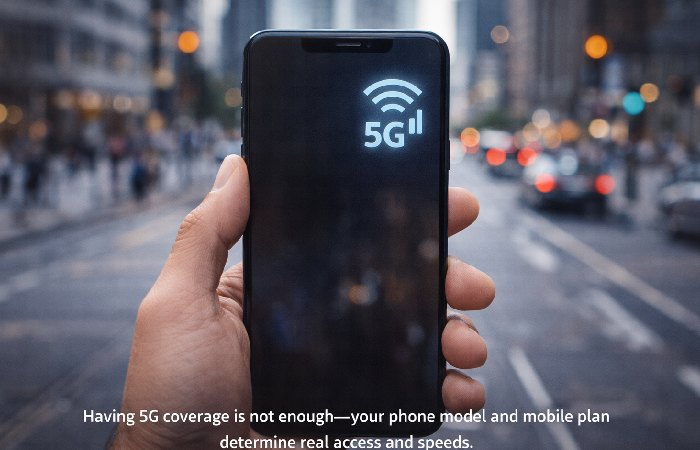
Even if 5G is “available” in your area, you only benefit if your phone and mobile plan are ready for it.
Device Requirements
Most modern flagship phones from recent years support 5G, but many older or budget models do not. You need a phone with the right 5G radio bands for your local networks.
How to check your phone:
-
Open Settings.
-
Go to Connections or Network & Internet.
-
Tap Mobile Networks or Cellular.
-
Look for Network Type or Preferred Network Type.
-
Check whether 5G appears as an option.
A “5G‑capable” phone has the hardware to use 5G. Some carriers also label specific models as “5G‑ready” once they are fully tested for that network.
Plan and SIM Requirements
Many carriers only enable 5G on certain plans or tiers. You may see 5G coverage on maps but remain on 4G if your plan is not eligible.
-
Some plans include 5G by default, while others require an upgrade.
-
In some cases, you may need a newer SIM or to have 5G explicitly activated on your account.
If you are unsure, check your carrier’s app or customer support pages for 5G eligibility details.
In 2026, Who Gets the Best 5G Experience?
By 2026, many markets have moved from “everyone gets free unlimited 5G” to “you pay more for priority.” Unlimited data no longer always means unlimited speed, especially during peak hours.
How Plan Tiers Change Your 5G Experience
| Plan type | Typical price band (monthly) | What you usually get |
|---|---|---|
| Budget 5G | Lower‑priced or entry plans | Unlimited data but lower priority in crowds |
| Standard 5G | Mid‑range plans | Good speeds, some hotspot, normal priority |
| Premium 5G | Higher‑tier plans | Highest speeds, priority, best consistency |
Budget “unlimited” plans often sit on lower‑priority slices, so speeds can drop sharply at busy times even if a 5G icon is visible. Premium tiers tend to keep higher speeds and lower latency in crowded places like stations, stadiums, and city centers.
5G, Battery Life, and Signal Strength
Modern 5G phones are more efficient than early models, but battery life still depends heavily on signal strength. When your phone has only one or two bars of 5G, it works harder to stay connected and can drain faster than on 4G. If you are indoors with weak 5G and don’t need top speed, switching to 4G‑only mode can noticeably improve battery life.
How to Tell If You’re Likely to Get 5G Soon
You are more likely to get 5G sooner if:
-
You live in or near a large city or a fast‑growing suburb.
-
Your area already has strong 4G coverage and recent tower upgrades.
-
Your country or region has publicly announced 5G rollouts and spectrum auctions.
-
Local carriers actively advertise 5G plans and coverage in your postcode or ZIP code.
Practical steps to check:
-
Use your carrier’s online coverage map and enter your address.
-
Check your phone settings to see if it can connect to 5G.
-
Run a speed test at different locations; if you see a “5G” icon with higher speeds in certain spots, your area is being upgraded.
A technical breakdown of how these systems differ is explained in this guide to 5G technology.
Why Some Areas May Never Get “Full” 5G
High‑band 5G requires very dense tower placement and fiber backhaul, which is impractical and uneconomical in many regions. As a result, some areas will rely on low‑band or mid‑band 5G long‑term, trading peak speed for better coverage and lower cost.
This is a design trade‑off, not a temporary gap. Network planners balance performance, coverage, and affordability when deciding how far to extend high‑speed 5G.
5G Home Internet vs Fiber: Which Makes More Sense?
In many countries, 5G is now offered as a home internet option through Fixed Wireless Access (FWA). It can be a good alternative where fiber is slow to arrive or hard to install.
| Aspect | Better with fiber | Better with 5G home internet (FWA) |
|---|---|---|
| Speed stability | Very consistent | Can fluctuate with signal and congestion |
| Latency (ping) | Lower and more stable | Higher and more jittery |
| Setup effort | Requires installation visit | Usually self‑install in minutes |
| Best for | Online gaming, heavy remote work | Streaming, browsing, quick setup, renters |
If you mainly stream video and want a simple, flexible setup, 5G home internet can work well. If you rely on real‑time gaming or frequent large uploads, fiber still offers a more stable experience.
Common Myths About 5G Rollout
-
Myth: 5G replaces 4G everywhere quickly.
Reality: 4G and 5G coexist for many years, and 4G remains the fallback in most places. -
Myth: Rural areas catch up soon after cities.
Reality: Economics and geography often slow or limit rollout outside dense urban zones. -
Myth: All 5G is ultra‑fast.
Reality: Real‑world performance depends on band type, site density, and backhaul quality. -
Myth: If my phone says “5G,” I always get the best speeds.
Reality: The icon only tells you the network type, not how much capacity or spectrum is actually available. - Myth: 5G networks are responsible for recent disease outbreaks.
Reality: Health experts and regulatory bodies have repeatedly found no evidence that 5G causes viral illnesses or pandemics, a position reflected in international reviews of mobile network safety by organizations such as the World Health Organization. - Rumors that 5G triggered recent health crises led some people to vandalize towers instead of focusing on real medical issues, even as Covid has robbed us of precious time with loved ones and pushed researchers to better understand how such diseases actually spread.
Beyond Phones: 5G for Wearables and Devices
In 2026, a “lighter” form of 5G called RedCap is starting to connect wearables and sensors that do not need full gigabit speeds. This lets smartwatches, health trackers, cameras, and industrial sensors stay online using less power and cheaper chips. For users, this means more devices that can connect directly to mobile networks and still last several days on a single charge.
What Happens After the Initial 5G Rollout?
After the first wave focuses on big cities and busy corridors, coverage gradually fills in surrounding areas. Early deployments often relieve congestion in crowded locations; later phases extend better service to suburbs, smaller towns, and key transport routes.
Meaningful improvements happen over years, not months. As equipment prices fall and more spectrum becomes available, operators can justify expanding 5G to more people and places.
Is Upgrading to 5G in 2026 Right for You?
You are more likely to benefit from 5G if you live in or near a major city and rely heavily on mobile data. Upgrading makes the most sense if you stream a lot on the go, tether your laptop, use cloud gaming, or work while commuting through busy hubs. If you mostly use Wi‑Fi at home and work, or live in an area where 5G uses low‑band spectrum with 4G‑like speeds, a solid 4G or budget 5G plan may feel almost the same in daily use.
Frequently Asked Questions
Do I need a new phone to use 5G?
You need a 5G-capable phone to use 5G networks because older 4G-only devices cannot connect to 5G signals.
Most smartphones released after 2020 include 5G support, but many older or budget models do not. Even with active 5G coverage, your device must support the correct frequency bands used by your carrier. Always confirm 5G compatibility in the phone’s technical specifications.
Is upgrading to 5G worth it for everyday users?
Upgrading to 5G is worth it mainly for users who rely heavily on mobile data in busy or congested areas.
5G can deliver faster speeds, lower latency, and better performance during peak usage in cities, stadiums, and transport hubs. If your daily usage is light or mostly happens on home or office Wi-Fi, the improvement over 4G may feel minimal.
Why does my 5G sometimes feel slower than 4G?
5G can feel slower when your phone connects to low-band 5G or when local network capacity is limited.
Not all 5G deployments prioritize speed; some focus on wider coverage instead. Signal strength, building penetration, distance from towers, and congestion all influence performance. In some cases, a strong 4G connection can outperform weak or overloaded 5G.
How do I know if paying extra for a 5G plan is right for me?
Paying extra for a 5G plan makes sense if you live in a strong 5G area and depend heavily on mobile data.
Frequent streaming, hotspot use, remote work, and travel in dense urban zones benefit most from 5G. If most of your usage happens on Wi-Fi and your current speeds are reliable, a lower-cost 4G plan may deliver similar everyday results.
About Author:
TechnologyFord covers gadgets, technology, and automation with clear, practical guides for everyday readers. Our content is based on publicly available information and peer‑reviewed sources, with AI assistance used in drafting and editors reviewing each article to keep it current, accurate, and easy to understand.
Disclaimer:
This article is based on publicly available information and peer‑reviewed sources, with AI assistance used in drafting. While we aim to keep the content accurate and up to date, it is provided for general informational purposes only and should not be relied on as professional, legal, financial, or technical advice. Readers should verify critical details with official carrier documentation or qualified experts before making decisions.