
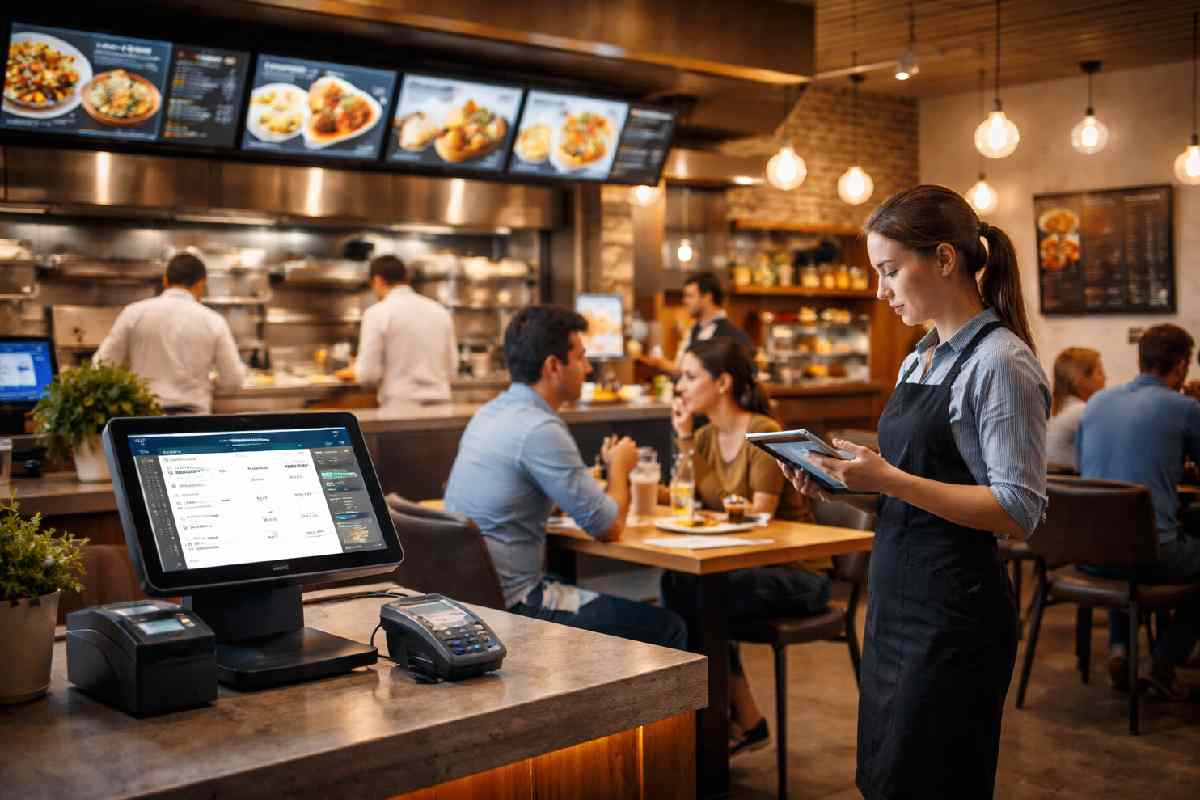
The restaurant industry is experiencing one of its most dramatic shifts since the invention of the modern cash register. From artificial intelligence that predicts what guests want to order before they sit down, to robotic kitchens assembling meals with millimeter precision, technology is no longer a luxury for restaurants — it is the foundation of survival.
But here is what most trend reports miss: technology adoption is not one-size-fits-all. A neighborhood café has fundamentally different needs than a 200-location fast-casual chain. The technology impact on the restaurant industry depends less on which tools exist and more on which tools fit your operation.
This guide breaks down the technologies reshaping restaurants, their measurable impact on operations and customer experience, and a practical adoption framework based on restaurant size and budget. Whether you run a single-unit bistro or manage a multi-unit franchise, you will find actionable guidance — not just buzzword lists.
Table of Contents
key Takeaways
- What technologies are transforming restaurants? → AI, cloud-based POS systems, digital ordering, kitchen automation, and IoT-driven analytics are the core pillars.
- What is the real impact? → Reduced labor costs, faster service, improved food safety, and data-driven decision-making.
- Who should adopt what? → Depends on restaurant size, budget, and operational pain points — a framework is provided below.
- What are the risks? → Over-automation, cybersecurity threats, high upfront costs, and implementation failure.
- What is the ROI reality? → Only a small share of restaurant brands report meaningful impact from AI so far — execution matters more than selection.
What Is Restaurant Technology?
Restaurant technology refers to the digital tools, software platforms, and automated systems that restaurants use to streamline operations, enhance the customer experience, and improve profitability. It spans everything from cloud-based point-of-sale systems and AI-powered analytics to kitchen robotics and contactless payment solutions.
The scope has expanded rapidly. A decade ago, “restaurant technology” meant a basic POS terminal and an online reservation system. Today, according to the National Restaurant Association’s 2025 industry outlook, 21% of operators are increasing their technology spending — and the investments are moving far beyond basic tools into AI, automation, and integrated data ecosystems.
Key Technologies Reshaping the Restaurant Industry
AI and Machine Learning in Restaurant Operations
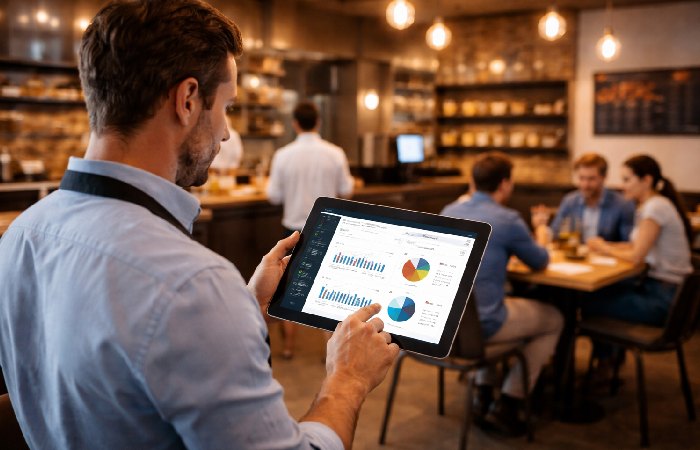
Artificial intelligence has moved from experimental pilot programs to core restaurant infrastructure. AI now powers predictive demand forecasting, automated inventory ordering, dynamic staffing schedules, and personalized marketing campaigns.
A survey reported by Restaurant Business Online found that 51% of limited-service brands are currently investing in AI, with another 22% planning investment by late 2025. The most common applications include marketing personalization (53%), predictive analytics (40%), and voice-powered ordering (39%).
That said, the reality check matters. The same research found that Industry reports suggest that while AI use is growing, only a minority of restaurants say it has delivered major impact so far, often due to fragmented systems and data challenges. Fragmented systems and poor data quality — cited by 37% of brands — remain the biggest barriers. AI works best when it connects to a unified data layer, not when it sits as a standalone tool.
Point-of-Sale (POS) and Cloud-Based Systems
Modern POS systems have evolved from simple cash registers into comprehensive restaurant operating platforms. Cloud-based POS solutions now integrate order management, payment processing, inventory tracking, labor scheduling, and real-time reporting into a single dashboard.
The shift to cloud-based systems is significant. Unlike legacy POS terminals, cloud platforms enable multi-location management, automatic software updates, and real-time access from any device. For multi-unit operators, this means centralized visibility across every location without manual data consolidation.
Digital Ordering and Delivery Platforms
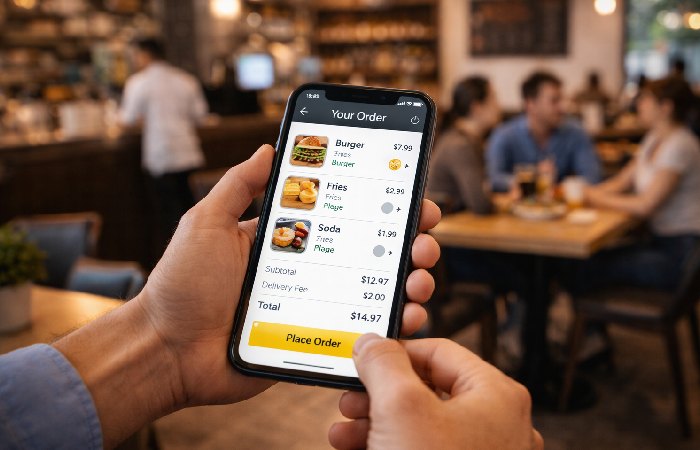
Online ordering — through first-party apps, third-party platforms like DoorDash and Uber Eats, and QR code table ordering — now accounts for a growing share of restaurant revenue. Self-service kiosks reduce wait times and increase average order value by prompting upsells.
The key shift is ownership. Restaurants increasingly invest in first-party ordering channels to avoid third-party commission fees (which can reach 15–30% per order) and to retain customer data for future marketing. First-party ordering also provides direct control over the customer experience and brand interaction.
Kitchen Automation and Robotics
Kitchen automation ranges from simple tools like Kitchen Display Systems (KDS) — which replace paper ticket printers — to advanced robotic systems that handle food preparation tasks.
Automated assembly lines, robotic arms for repetitive cooking tasks, and smart kitchen equipment with IoT sensors are moving from pilot programs toward commercial availability. The primary value is consistency and speed rather than full labor replacement. A robotic system does not call in sick, does not rush during peak hours, and produces the same output every time.
However, current kitchen robotics are best suited for high-volume, standardized menus. Fine dining and chef-driven concepts see less benefit from automation and more value from technology that supports — rather than replaces — culinary creativity.
Contactless and Mobile Payments
Contactless payment options — tap-to-pay cards, mobile wallets (Apple Pay, Google Pay), and QR code payment systems — have moved from pandemic necessity to permanent standard. They reduce transaction times, improve table turnover, and eliminate common payment friction points.
Newer innovations include pay-at-table systems where guests scan a QR code, split the bill, tip, and leave without waiting for a server to run a card. The result is faster turnover, improved guest satisfaction, and reduced labor load at checkout.
IoT, Data Analytics, and Smart Operations
The Internet of Things (IoT) is the less visible but increasingly critical layer of restaurant technology. Smart sensors now monitor refrigeration temperatures in real time, track equipment performance to predict maintenance needs, and automate food safety compliance logging.
Data analytics platforms aggregate information from POS, ordering, inventory, and labor systems to surface actionable insights. Operators can identify their most profitable menu items, pinpoint staffing inefficiencies, and forecast weekly demand with increasing accuracy.
For multi-unit operators, IoT-connected dashboards provide centralized visibility into food safety compliance, energy usage, and equipment health across all locations — reducing the need for manual audits and site visits.
Real-World Impact of Technology on Restaurant Operations
Operational Efficiency and Cost Reduction
Technology’s most measurable impact is on operational costs. Automated inventory management reduces food waste by tracking stock in real time and triggering reorders at optimal levels. AI-powered labor scheduling matches staffing levels to predicted demand, cutting overstaffing costs during slow periods.
According to research from Auburn University’s Harbert College of Business, restaurants that implement integrated technology systems see measurable improvements in speed of service, order accuracy, and cost control — though the magnitude varies with implementation quality.
Enhancing the Customer Experience
From the customer perspective, technology translates to faster service, personalized recommendations, and frictionless payment. Mobile ordering eliminates waiting in line. CRM-integrated loyalty programs deliver offers tailored to individual preferences and visit history.
AI-powered chatbots handle reservations, answer menu questions, and process basic orders through messaging platforms — freeing staff to focus on in-person hospitality where human interaction matters most.
Solving the Labor Shortage Crisis
The restaurant industry faces a persistent labor shortage. Technology does not fully replace workers, but it redistributes tasks. Kiosks handle order entry. KDS systems replace manual ticket management. Automated scheduling optimizes shift coverage.
The result: existing staff can focus on higher-value activities — guest interaction, food quality, and problem-solving — while repetitive, time-consuming tasks are handled digitally. This also helps with employee retention: workers who spend less time on monotonous tasks report higher job satisfaction.
Food Safety and Compliance
Digital food safety systems automate temperature logging, expiration date tracking, and HACCP compliance documentation. Smart probes and IoT sensors eliminate the risk of missed manual checks, and automated alerts flag deviations before they become safety hazards.
This is not a glamorous technology category, but it is one of the highest-impact ones. A single food safety incident can cost a restaurant tens of thousands of dollars in fines, legal fees, and reputational damage. Automated compliance provides consistent protection at a fraction of the manual effort.
Technology Comparison by Impact Area
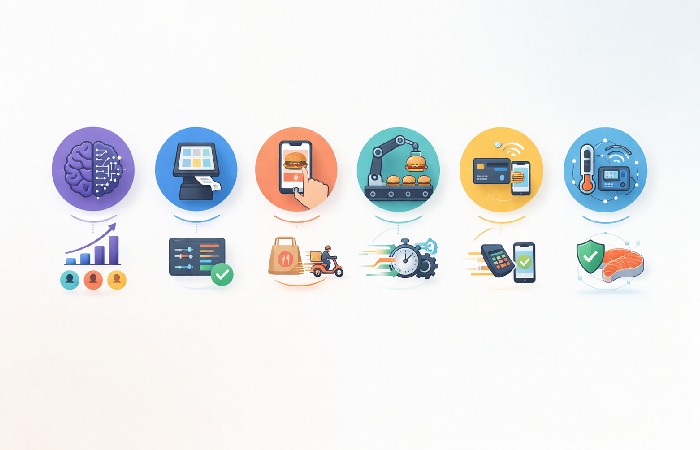
| Technology | Primary Impact | Cost Level | Implementation Difficulty | Best For |
|---|---|---|---|---|
| AI & Machine Learning | Demand forecasting, personalization | Medium–High | High | Multi-unit, data-rich operations |
| Cloud-Based POS | Unified operations, real-time reporting | Medium | Medium | All restaurant sizes |
| Digital Ordering | Revenue growth, customer convenience | Low–Medium | Low–Medium | QSR, fast-casual, delivery-focused |
| Kitchen Automation | Consistency, speed, waste reduction | High | High | High-volume, standardized menus |
| Contactless Payments | Speed, customer satisfaction | Low | Low | All restaurant sizes |
| IoT & Smart Sensors | Food safety, predictive maintenance | Medium | Medium | Multi-unit, compliance-heavy |
| CRM & Loyalty Platforms | Retention, personalized marketing | Medium | Medium | Brands building repeat customer base |
Technology Adoption Framework by Restaurant Size
Not every restaurant needs every technology. The biggest mistakes in restaurant technology come from adopting enterprise-grade solutions for small operations — or under-investing when scaling demands it.
Small and Independent Restaurants
Priority technologies: Cloud-based POS, first-party online ordering, contactless payments, basic digital food safety tools.
Small restaurants benefit most from tools that solve immediate operational pain points without requiring dedicated IT support. A modern cloud POS replaces the need for multiple disconnected systems. First-party online ordering eliminates dependence on expensive third-party delivery commissions.
For small operators worried about upfront costs, the best small business loans can be a way to finance essential technology upgrades without stalling growth. The key is to match any borrowed capital to tools that clearly improve efficiency, revenue, or guest experience
Skip for now: Full AI suites, kitchen robotics, and complex data analytics platforms. These require data volume and operational scale that most single-unit restaurants do not have.
Multi-Unit and Franchise Operations
Priority technologies: Integrated POS with multi-location management, AI-powered inventory and labor tools, centralized CRM and loyalty platforms, IoT-based food safety compliance.
At the multi-unit level, technology’s ROI compounds. Centralized dashboards expose inconsistencies across locations. AI scheduling optimizes labor costs across the system rather than store-by-store. Automated compliance monitoring reduces district manager workload.
Key decision: Build vs. buy — franchises should evaluate whether franchisor-provided tools meet their needs or whether supplemental technology is required.
Enterprise and Chain Restaurants
Priority technologies: End-to-end platform integration, advanced AI (dynamic pricing, predictive analytics, computer vision), kitchen automation, drone/robotic delivery pilots.
Enterprise operators have the data volume, capital, and IT infrastructure to deploy advanced technologies at scale. The focus shifts from individual tool selection to platform integration — ensuring that POS, ordering, inventory, labor, and customer data flow into a unified intelligence layer.
Watch for: Technology fragmentation. Enterprise chains often accumulate dozens of disconnected tools over time. A Deloitte analysis on AI in restaurants found that the biggest barrier to AI value is not the technology itself but fragmented data ecosystems that prevent systems from communicating effectively.
Common Mistakes in Restaurant Technology Adoption
- Buying technology without a clear problem to solve. Technology should address a specific operational bottleneck — not be adopted because competitors are doing it.
- Underestimating implementation and training costs. The software license is often the smallest expense. Staff training, workflow changes, data migration, and integration labor frequently exceed the tool’s sticker price.
- Ignoring cybersecurity. Restaurants process thousands of credit card transactions. POS breaches, unsecured Wi-Fi networks, and weak employee passwords create real exposure. Basic cybersecurity hygiene — encrypted payments, two-factor authentication, regular software updates — is non-negotiable.
- Over-automating guest-facing interactions. Hospitality is fundamentally human. Replacing every server interaction with a kiosk or chatbot can erode the experience that differentiates a restaurant from a vending machine. Use automation for transactional tasks; preserve human contact for hospitality moments.
- Treating technology as a one-time purchase. Restaurant tech requires ongoing updates, data monitoring, and optimization. A POS system implemented and never revisited will underperform within a year as menus, workflows, and customer expectations change.
Who Should Invest in Restaurant Technology — and Who Should Wait
Best for:
- Multi-unit operators seeking centralized visibility and consistency
- High-volume QSRs and fast-casual concepts where speed and throughput drive revenue
- Ghost kitchens and delivery-first brands where digital ordering is the business
- Restaurants experiencing labor shortages that technology can partially offset
Not for (or proceed with caution):
- Micro-restaurants with minimal transaction volume and no digital presence — the ROI may be negative
- Operators without basic infrastructure (reliable internet, modern hardware) to support cloud-based tools
- Restaurants with no internal capacity for implementation and ongoing management
The Future of Restaurant Technology (2025–2026 and Beyond)
Emerging Trends to Watch
- Voice-powered AI ordering is gaining traction in drive-throughs, where accuracy and speed directly impact revenue.
- Computer vision in kitchens and drive-throughs is emerging — 19% of brands surveyed are exploring drive-through computer vision and 16% are testing kitchen applications.
- Dynamic menu pricing — adjusting prices in real time based on demand, time of day, and inventory — is used by 13% of surveyed brands and growing.
- Sustainability-focused technology — smart composting systems, energy-monitoring IoT sensors, and waste-tracking platforms — is increasingly expected by environmentally conscious consumers and regulators.
- Augmented reality menus and virtual dining experiences remain experimental, though VR-based employee training programs are seeing faster adoption.
What the Data Says
The trajectory is clear: technology spending in the restaurant industry is increasing, and the gap between tech-forward operators and lagging ones is widening. However, the data also shows that execution quality matters far more than technology selection. The 9% meaningful-impact figure for AI underscores that the winners are not the first adopters but the best implementers.
Restaurants that invest in unified data platforms, train staff thoroughly, and iterate on their technology stack will outperform those that chase every new tool without a strategic foundation.
Final Verdict
The technology impact on the restaurant industry is real, measurable, and accelerating. AI, automation, cloud-based systems, and IoT are no longer future concepts — they are current operational requirements for restaurants that want to compete on efficiency, customer experience, and profitability.
But the critical differentiator is not which technology you buy. It is how well you implement it, how thoughtfully you match it to your operation’s actual needs, and how consistently you maintain and optimize it after launch.
Practical recommendation: Start with the technology adoption framework above. Identify your restaurant’s size category, prioritize the technologies that solve your most pressing operational bottleneck, and invest in implementation quality over feature quantity. The best restaurant technology is the one your team actually uses well.
Frequently Asked Questions
Q: How has technology changed the restaurant industry?
A: Technology has transformed nearly every aspect of restaurant operations — from AI-powered demand forecasting and automated inventory management to digital ordering, contactless payments, and IoT-based food safety monitoring. The result is faster service, lower operational costs, and data-driven decision-making across the industry.
Q: What are the most important technologies for restaurants in 2025?
A: Cloud-based POS systems, AI and machine learning tools, digital ordering platforms, contactless payment solutions, and IoT-connected smart operations are the five most impactful categories. The right priority depends on the restaurant’s size, volume, and operational pain points.
Q: How does AI help restaurants?
A: AI helps restaurants by predicting customer demand, optimizing staff schedules, personalizing marketing and loyalty offers, automating inventory ordering, and powering voice-activated ordering systems. However, AI requires clean, unified data to deliver meaningful results.
Q: What are the risks of using technology in restaurants?
A: Key risks include high upfront implementation costs, cybersecurity vulnerabilities (especially POS data breaches), over-automation that reduces the human hospitality experience, technology fragmentation from too many disconnected tools, and ongoing maintenance requirements.
Q: How much does restaurant technology cost?
A: Costs vary widely by category. A cloud-based POS system may cost $50–$200/month per terminal. AI and analytics platforms range from $200–$2,000+/month depending on scale. Kitchen robotics can require six-figure capital investments. The total cost of ownership — including training, integration, and maintenance — typically exceeds the software subscription price.
Q: Can small restaurants benefit from technology?
A: Yes. Small restaurants see the strongest ROI from cloud-based POS systems, first-party online ordering (to avoid third-party commission fees), contactless payments, and basic digital food safety tools. The key is prioritizing tools that solve specific operational pain points rather than adopting enterprise-grade solutions.