
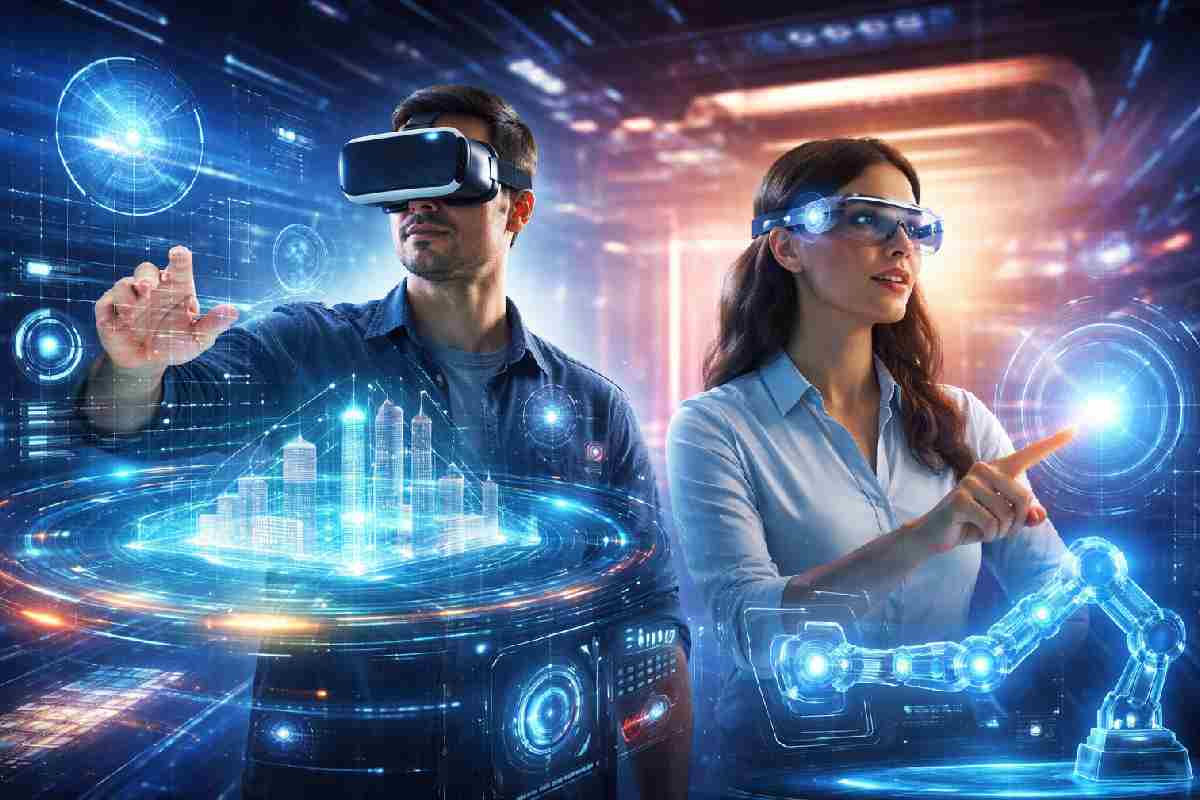
The metaverse is often described as a futuristic virtual universe powered by augmented reality (AR) and virtual reality (VR). That idea sounds compelling, but it’s also misleading. Years after the initial hype, many people are still unsure what the metaverse actually is, how AR and VR fit into it, and why adoption has been slower than promised.
Here’s the short, direct answer: The role of AR & VR in the development of the metaverse is not to replace the internet or physical reality. Their role is to make digital systems spatial, interactive, and usable in three dimensions — and this only works well in specific situations.
To understand where AR and VR genuinely add value, it’s necessary to separate realistic capabilities from earlier expectations.
Table of Contents
What the Metaverse Really Means Today (Not the Hype Version)
The metaverse is not a single virtual world, platform, or permanent VR environment. In its current form, it functions as a spatial computing ecosystem.
That ecosystem typically includes:
-
Persistent digital environments
-
Real-time 3D data
-
Cloud computing and networking
-
Artificial intelligence
-
Sensors, cameras, and connected devices
-
Interfaces such as AR and VR
In this structure:
-
The metaverse is the system
-
AR and VR are access technologies
They enable humans to interact with digital systems spatially, but they do not define the system itself. Confusing VR with the metaverse has been one of the main causes of failed or impractical implementations.
The Actual Role of AR & VR in the Development of the Metaverse
AR and VR are often mentioned together, but they serve very different functions. Treating them as interchangeable technologies has led to unrealistic expectations and inefficient deployments.
Augmented Reality (AR): The Practical Layer
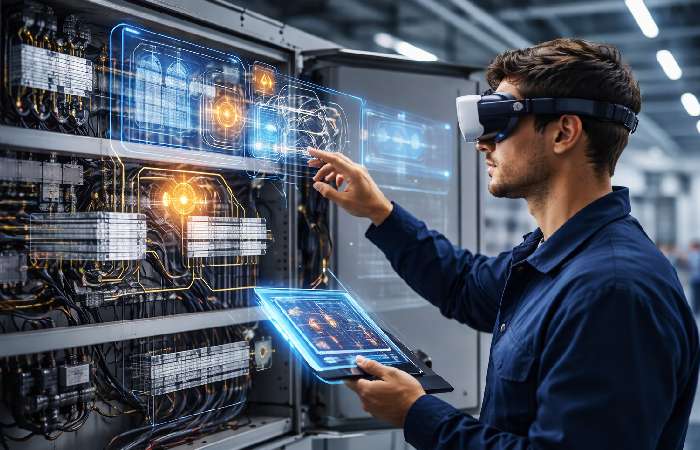
Augmented Reality adds digital information on top of the physical world instead of replacing it.
In metaverse development, AR is used to:
-
Anchor digital content to real locations
-
Overlay instructions, data, or visual elements onto physical spaces
-
Connect real-world environments to digital systems in real time
This makes AR especially effective in environments where situational awareness is critical.
Where AR works reliably today:
| Industry | Application | Typical Outcome |
|---|---|---|
| Manufacturing | Assembly guidance, quality inspection | 25-40% reduction in errors; faster training |
| Field Service | Remote expert assistance, repair overlays | Reduced technician dispatch, faster resolution |
| Healthcare | Surgical visualization, vein finding | Improved precision, reduced complications |
| Logistics | Warehouse picking, inventory management | Increased accuracy, reduced training time |
| Retail | Product visualization, virtual try-on | Modest conversion improvement (5-15%) |
Example: Boeing’s AR wiring guidance for 787 assembly reduced errors by 90% and cut training time per technician from weeks to days. The system uses tablets, not headsets—AR via familiar devices proved more scalable than immersive VR for this use case.
AR does not provide deep immersion, but it is accessible, scalable, and compatible with existing devices, which makes it one of the most usable technologies contributing to metaverse development.
Virtual Reality (VR): The Immersion Tool
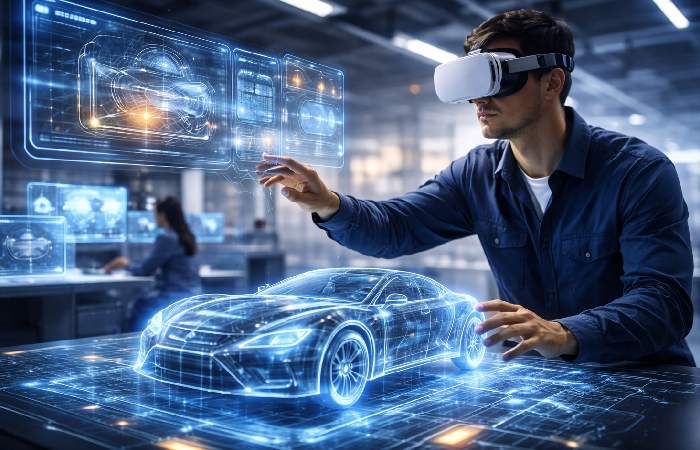
Virtual Reality places users inside a fully simulated digital environment, removing visual contact with the physical world.
In metaverse development, VR is used when:
-
Physical environments are dangerous, expensive, or impractical to access
-
Spatial scale and depth are essential
-
Distraction-free focus is required
Where VR is effective:
| Use Case | Application | Key Benefit |
|---|---|---|
| Safety Training | High-risk scenarios (chemical spills, electrical hazards) | Practice dangerous situations without consequences |
| Medical Training | Surgical procedures, emergency response | Repeatable practice, measurable skill improvement |
| Design Review | Architecture, automotive, aerospace | Spatial understanding at full scale |
| Research & Collaboration | Data visualization, remote expert presence | Shared immersive space for complex problem-solving |
Example: Automaker Stellantis uses VR design reviews for new vehicle interiors. Designers in Michigan, Italy, and China meet in shared virtual space, reducing physical prototype iterations from 12+ to 3-4 per project. Session duration is capped at 45 minutes due to headset comfort limits.
VR provides immersion, but it also introduces friction through hardware cost, physical discomfort, limited session duration, and isolation from the real world.
Why Most Metaverse Use Cases Don’t Require VR
Many metaverse-labeled applications do not actually benefit from full immersion. Instead, they require:
-
Context
-
Spatial awareness
-
Real-time data
-
Collaboration
In these cases:
-
AR is often sufficient
-
Standard screens may be more efficient
-
VR should only be used when immersion directly improves results
VR is a powerful tool, but it is not a default requirement for metaverse development.
When to Skip AR/VR Entirely
| Situation | Better Alternative | Why |
|---|---|---|
| Routine meetings | Video conferencing (Zoom/Teams) | Lower friction, better accessibility |
| Simple documentation | Text/video SOPs | Faster creation, easier updates |
| Standard social interaction | Existing social platforms | Higher retention, lower hardware barrier |
| Basic e-commerce | Traditional web/mobile | Proven conversion optimization |
How AR & VR Connect to the Metaverse Infrastructure
AR and VR experiences rely on backend systems that handle most of the computation and coordination.
Simplified data flow:
-
Devices capture motion, position, and environmental data
-
Data transmits to edge or cloud servers
-
AI systems process objects, behavior, and interactions
-
For complex, cross‑tool 3D scenes, many metaverse and digital twin pipelines rely on Pixar’s Universal Scene Description (USD) framework, which is designed for efficient, scalable scene interchange across applications.
-
Updates stream back to devices with minimal latency
Critical standards that determine interoperability:
| Standard | Function | Why It Matters |
|---|---|---|
| OpenXR | Cross-platform API for VR/AR apps | Build once, deploy to Quest, HoloLens, Magic Leap |
| WebXR | Browser-based immersive experiences | No app installation; lower user friction |
| USD (Universal Scene Description) | 3D asset interchange between platforms | Nvidia/Pixar standard for complex scenes |
| glTF | Efficient 3D file transmission | Critical for mobile AR performance |
Key limitation: Most current platforms (Meta Horizon, Microsoft Mesh, Decentraland) do not fully interoperate. AR/VR content built for one rarely ports directly to another.
To reduce this fragmentation, more vendors are adopting the Khronos Group’s OpenXR specification, a royalty‑free standard that lets XR applications target multiple VR and AR devices through a single API.
Platform Reality Check (2026)
| Platform | Best For | Key Limitation | Hardware Required |
|---|---|---|---|
| Microsoft Mesh | Enterprise training, Teams integration | Requires Microsoft ecosystem; limited consumer features | HoloLens 2 ($3,500) or VR headsets + PC |
| Meta Horizon Workrooms | Remote collaboration, brainstorming | Limited enterprise security; Meta data practices | Quest 3 ($500) or Quest Pro ($1,000) |
| Nvidia Omniverse | Industrial design, digital twins | Complex setup; requires technical expertise | RTX-enabled workstation + optional VR |
| WebXR (browser) | Broad accessibility, low friction | Limited graphics; no advanced hand tracking | Smartphone or basic VR headset |
Critical note: No single platform dominates. Most enterprises use 2-3 simultaneously for different use cases.
Web-based immersive experiences are increasingly delivered through the WebXR Device API maintained by the W3C, which standardizes how browsers expose XR capabilities without requiring dedicated app installs.
Where AR & VR Are Working Today
Although consumer adoption has been limited, AR and VR are actively used in professional settings where spatial interaction delivers measurable value.
Current proven applications:
| Sector | Application | Typical ROI |
|---|---|---|
| Manufacturing | Assembly training, quality inspection | 30-50% training time reduction |
| Energy/Utilities | Hazardous environment simulation | Reduced safety incidents, faster certification |
| Healthcare | Surgical planning, therapy | Improved outcomes, reduced procedure time |
| Aerospace | Maintenance training, design review | Fewer physical prototypes, faster iteration |
| Automotive | Design collaboration, showroom | Reduced travel, faster design decisions |
These deployments succeed because they address specific operational problems rather than broad consumer entertainment goals.
Why the Metaverse Has Not Reached Mass Adoption
Several structural barriers continue to limit widespread use.
Hardware Cost and Comfort
| Factor | Current Status | Impact |
|---|---|---|
| High-quality headsets | $500-$3,500 | Limits organizational rollout |
| Session duration | 30-45 minutes recommended | Prevents all-day work use |
| Physical comfort | Eye strain, motion sickness affects 20-40% of users | Requires accommodation planning |
| Prescription compatibility | Limited options, added cost | Accessibility barrier |
Interoperability Limitations
Most platforms operate as isolated ecosystems. Digital assets, identities, and environments rarely transfer across systems without significant redevelopment.
Limited Consumer Advantage
For many everyday tasks, traditional devices and applications remain faster, cheaper, and more convenient.
These constraints define the current limits of AR and VR within metaverse development.
Health and Safety Guidelines
| Technology | Recommended Limits | Key Risks |
|---|---|---|
| VR | 30-45 minute sessions; regular breaks | Eye strain, motion sickness, postural fatigue |
| AR | Generally safe for extended use | Distraction from physical hazards in industrial settings |
| Children | Follow manufacturer age guidance (typically 13+ for VR) | Developing visual systems, limited long-term studies |
Contraindications: VR is not recommended for users with certain balance disorders, epilepsy, or severe eye conditions. Consult medical guidance for occupational deployment.
Realistic Cost Ranges (2026)
| Component | Low End | Enterprise Grade |
|---|---|---|
| AR hardware | $500 (tablet) | $3,500 (Magic Leap 2, HoloLens 2) |
| VR headset | $300 (Quest 3) | $1,000 (Quest Pro) + $2,000 PC |
| Software development | $50,000 (basic app) | $500,000+ (complex simulation) |
| Annual platform/licensing | $0 (WebXR) | $100-$300/user/month |
| Content creation | $10,000 (simple 3D assets) | $100,000+ (detailed environments) |
Hidden costs: Integration with existing systems, change management, hardware replacement (2-3 year typical lifecycle), ongoing content updates.
Who AR & VR in the Metaverse Are Designed For
Appropriate When:
-
Immersive training or simulation improves safety or accuracy
-
Work involves complex 3D environments
-
Hardware investment can be justified by operational savings
-
Spatial interaction provides clear, measurable benefits
-
Pilot programs can validate approach before scale
Less Suitable When:
-
Low cost and mass accessibility are priorities
-
Long daily usage (4+ hours) is required
-
Existing tools already solve the problem effectively
-
Expectations are based on fully immersive virtual worlds rather than practical task improvement
Red Flags in Vendor Proposals
| Warning Sign | Why It Matters | Better Approach |
|---|---|---|
| Promising “full metaverse transformation” without specific use cases | Indicates solution seeking problem | Demand pilot program with measurable KPIs |
| Recommending VR for tasks requiring physical dexterity | Creates safety and efficiency risks | Use AR or traditional tools instead |
| Ignoring hardware comfort/session duration limits | Leads to user rejection and project failure | Plan for realistic usage patterns |
| No discussion of interoperability or data portability | Locks you into single vendor | Require standards-based (OpenXR, glTF) approach |
| Lack of phased rollout plan | High risk of expensive failure | Insist on pilot → evaluation → scale approach |
Key Takeaways
-
AR and VR are access technologies, not the metaverse itself. The metaverse is the underlying spatial computing infrastructure.
-
AR is currently more practical for most applications. It builds on existing devices and maintains environmental awareness.
-
VR is powerful but high-friction. Reserve it for situations where immersion directly improves outcomes and session limits are acceptable.
-
Platform interoperability remains limited. Expect to manage multiple systems rather than one unified metaverse.
-
Cost and comfort barriers persist. Enterprise deployments succeed; mass consumer adoption remains limited.
-
Specific use cases outperform general transformation. Start with defined operational problems, not technology-first initiatives.
Author Bio
Technologyford content is written to be practical and easy to understand across topics like health, technology, business, marketing and lifestyle. Each article is based mainly on reputable, publicly available information, with AI tools used only to help research, organise and explain topics more clearly, and the focus stays on clear explanations and real‑world usefulness rather than jargon or unnecessary complexity.
How This Guide Was Created
Approach: This guide reflects observed patterns from industry implementations, technical documentation review, and analysis of failed versus successful deployments reported 2022-2024.
Limitations: Technology evolves rapidly; hardware specifications and platform capabilities change quarterly. Verify current status before procurement decisions.
Disclaimer: This guide is for general informational purposes only and should not be treated as legal, financial, medical, or purchasing advice; always confirm details with appropriate professionals before making decisions.