
Table of Contents
1. Introduction — Reframing the Conversation
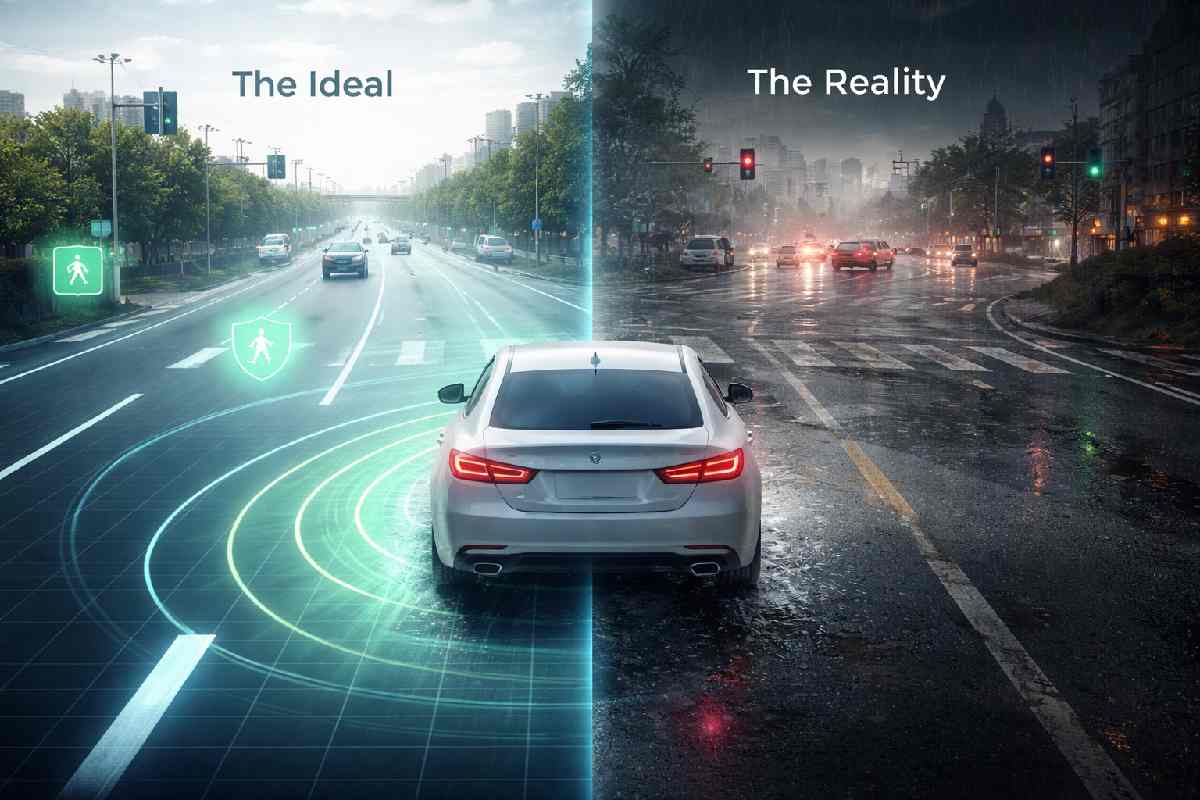
Road safety technology is often marketed as a universal solution to human error, but real‑world accident reduction is context‑specific and conditional. Road safety technologies such as advanced driver assistance systems (ADAS) can meaningfully reduce certain crash types, yet their impact depends on where, how, and by whom they are used.
In this article, “road safety technology” refers primarily to in‑vehicle systems like AEB (Automatic Emergency Braking), lane‑keeping assistance, adaptive cruise control, and related ADAS, alongside selected enforcement and monitoring tools.
Emerging research now quantifies both the benefits and the boundaries of these systems, showing that effectiveness varies across driving environments, weather, lighting, infrastructure quality, and driver behavior.
2. What the Evidence Actually Shows About ADAS Effectiveness
2.1 Aggregate crash‑reduction potential
Large‑scale simulation and exposure studies suggest that ADAS can reduce crashes substantially, but not uniformly:
-
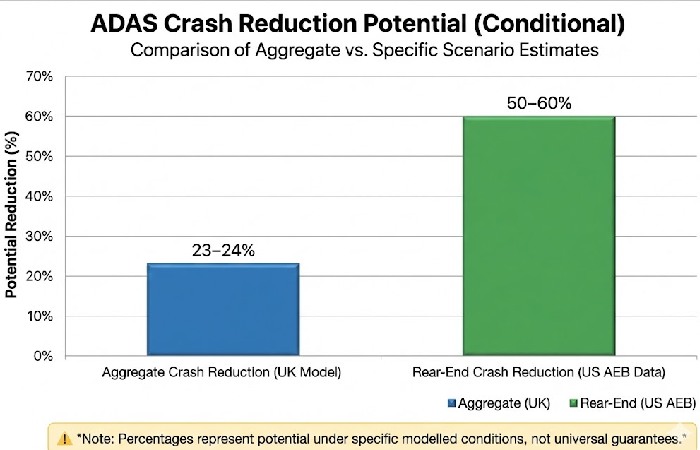
Empirical finding: A study modelling UK driving conditions found that fitting a set of core ADAS features to the vehicle fleet could reduce crashes by roughly 23–24% overall, with effectiveness varying by road type and scenario rather than being a single universal number. Independent summaries of this work highlight how advanced driver assistance systems fitted across the UK fleet could cut crashes by nearly a quarter.
-
These estimates are aggregate effects under specified assumptions (e.g., correct system use, appropriate calibration, and certain penetration rates), not guarantees for every vehicle, driver, or context.
These figures should be interpreted as “potential reduction under modelled conditions” rather than promises that any individual driver will see a 24% reduction in their own crash risk.
2.2 AEB and rear‑end crash reductions
Automatic Emergency Braking (AEB) is one of the best‑studied ADAS technologies. Empirical analyses of US crash data indicate that vehicles equipped with AEB have shown roughly 50–60% fewer rear‑end or rear‑end injury crashes than comparable vehicles without AEB, with the largest reductions observed in newer model years.
These results are consistent with broader evaluations by the Insurance Institute for Highway Safety on front crash prevention effectiveness.
Longitudinal work further suggests that AEB effectiveness has improved over successive model years, reflecting better system tuning, wider deployment, and incremental technical refinements.
These are population‑level effects drawn from crash databases, so the real‑world benefit for any individual vehicle can still vary by manufacturer implementation, driving environment, and how well the system is maintained and used.
2.3 Why these numbers are not universal guarantees
While these results are encouraging, they are conditional:
-
They assume the systems are active, not disabled by the driver, and functioning as designed.
-
They are derived from specific geographies and time periods (e.g., UK roads, particular US model years), and may not transfer directly to regions with different infrastructure, traffic behavior, or fleet composition.
It is more accurate to say “ADAS has been associated with X–Y% reductions in certain crash types in specific studies and contexts” than to state that technology “reduces crashes by 24%” as a blanket rule.
3. Contextual Limitations: Why Real Roads Challenge Ideal Performance
3.1 Condition‑dependent performance
ADAS performance is closely tied to the conditions under which it operates:
-
The ScienceDirect work on UK driving contexts shows that safety benefits vary across 18 defined contexts (combinations of road type, speed, time, and other factors), with some contexts seeing larger relative reductions and others more modest gains.
-
High‑severity crashes often occur in demanding conditions—such as at night, on rural roads, or at higher speeds—where perception and control challenges are greater; in some of these combinations, estimated ADAS benefits are smaller than in well‑marked, lower‑complexity scenarios.
Rather than saying effectiveness “drops significantly” on dark rural roads in all cases, the evidence is better summarized as: ADAS effectiveness is uneven, and some high‑risk contexts show smaller relative improvements than more controlled environments.
3.2 Sensor and perception limits
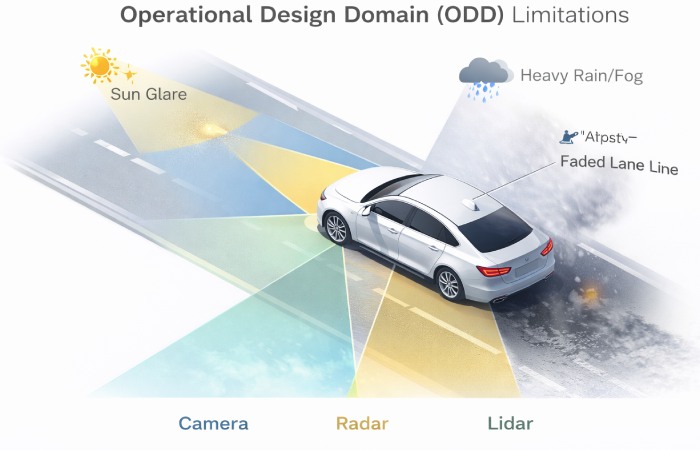
Vehicle‑mounted sensors (cameras, radar, sometimes lidar) are sensitive to environmental and infrastructure conditions. Vision‑based systems can be degraded by rain, fog, glare, low sun angles, dirty lenses, or poor lighting; models trained on clear, well‑lit imagery may not generalize as reliably to degraded scenes.
Real‑world testing and reporting have repeatedly shown that many automated and semi‑automated systems perform best in comparatively ideal conditions and still struggle with adverse weather and non‑ideal driving environments.
For readers who want to understand how specific seasonal conditions change on‑road risk, our guide to the top risks related to winter driving explores how snow, ice, and low visibility reshape everyday driving hazards.
Weak, worn, or inconsistent lane markings and signage reduce the reliability of lane‑keeping and lane‑departure systems, which often rely on clear, high‑contrast markings for detection.
These are not “failures” in the sense of malfunction; they are limitations of the operational design domain (ODD). The technology works best where its environmental assumptions hold.
3.3 Infrastructure dependencies
ADAS does not operate in a vacuum; it depends heavily on infrastructure:
-
Lane‑based systems assume standardized, maintainable markings and signage; in many regions, inconsistent maintenance, nonstandard markings, or informal road use patterns can undermine these assumptions.
-
Disparities in road quality, signage, and markings can cause the same vehicle to deliver different safety performance in different jurisdictions, even with identical onboard technology.
This gap between controlled test or modelling environments and messy, real‑world roads is a major reason why “headline” crash‑reduction numbers must be interpreted contextually.
4. Human Interaction Dynamics: Behavior, Trust, and Misuse

4.1 User knowledge, acceptance, and misuse
Technology adoption alone does not guarantee safety:
-
Studies on ADAS user acceptance indicate that many drivers have limited understanding of what systems can and cannot do, including confusion over capabilities and limits of features like lane centering and adaptive cruise control.
-
When drivers misunderstand systems, they may over‑trust automation, delegate too much responsibility, or use features outside intended conditions, altering the overall risk profile.
This means some of the theoretical safety gains estimated in modelling studies may not fully materialize in practice without effective driver education and interface design.
4.2 Over‑reliance and behavioral adaptation
Human behavior adapts to perceived safety:
-
Organizations such as AAA and safety researchers have highlighted risks of over‑reliance, where drivers place too much trust in ADAS and reduce their vigilance, believing the car will “handle it.”
-
This adaptation can manifest as increased distraction, reduced mirror checks, or delayed interventions, particularly when supervision of partial automation is required.
In such cases, technology can still reduce some crash types overall, but the pattern of risks shifts; some hazards go down while new ones related to human–system interaction emerge.
Expert and enthusiast commentary consistently stress that these systems are best treated as driving aids rather than replacements for fundamental skills, and that investments in driver education, defensive driving habits, and vehicle fundamentals often contribute as much to safety as electronic driver assists and add‑on performance parts.
4.3 Disengagement and system deactivation
Driver attitudes toward alerts and interventions influence realized safety:
-
Surveys and media reports indicate that a notable minority of drivers disable or routinely ignore certain safety features (e.g., lane‑departure warnings) because they find them annoying, overly sensitive, or untrustworthy.
-
These findings are context‑specific (particular regions, samples, and years) and should not be over‑generalized globally, but they demonstrate that perceived nuisance can materially reduce system usage and, thus, real‑world benefit.
Any safety analysis must therefore consider not just the presence of technology, but whether it remains enabled and used as intended.
5. Enforcement Technology vs. Outcome Reality
5.1 Capabilities of automated enforcement
Road safety today also includes roadside and back‑office technologies:
-
AI‑enabled camera systems, including those using computer vision and automatic number plate recognition (ANPR), can detect behaviors such as mobile phone use, speeding, or seatbelt non‑compliance at scale.
-
These systems can increase detection rates and support more consistent enforcement of traffic laws, often with fewer personnel than manual enforcement alone.
From a risk‑management perspective, they help reduce specific illegal behaviors, but their translation into crash and fatality reductions is not automatic.
5.2 Preliminary outcome evidence and its limits
Early deployments illustrate the complexity:
-
Some corridors where AI‑supported enforcement has been rolled out have reported substantial numbers of detected violations and fines, but short‑term crash or fatality trends have not always shown clear, immediate reductions.
-
Such observations—often reported in news coverage—are preliminary and highly context‑specific, influenced by exposure, traffic growth, parallel interventions, and time lags between enforcement and behavior change.
It is therefore more accurate to say: current reports suggest that automated enforcement alone does not guarantee proportional reductions in serious crashes or fatalities, and its effectiveness depends on broader strategies (infrastructure changes, speed management, public communication), rather than to generalize about “expressways where enforcement doesn’t reduce fatalities” without formal, controlled evaluations.
6. Policy Implication: Embrace Conditional Deployment and Contextual Metrics
6.1 Treat technology as conditional risk mitigation
The empirical evidence and observed limitations support a pragmatic policy stance:
This conditional view aligns with broader discussions on whether technology alone can improve safety outcomes, as explored in our analysis of whether technology is the answer to improving safety on the road.
-
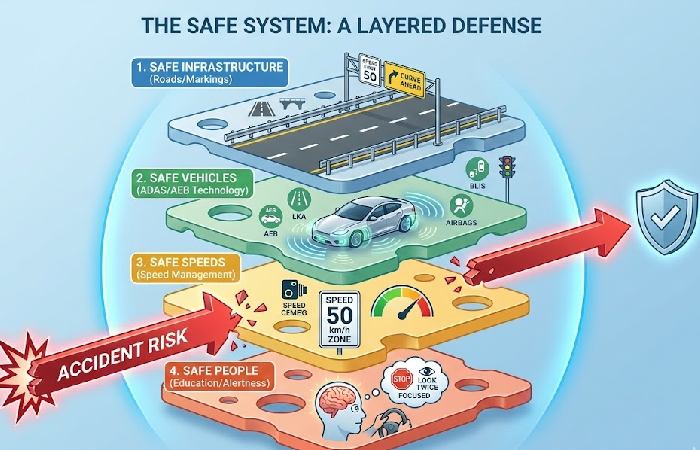
Road safety technology should treated as conditional risk mitigation: highly valuable in many scenarios, but not a universal solution that removes risk everywhere equally. This aligns with the Safe System approach promoted by the World Health Organization’s road safety framework.
-
Policymakers, fleets, and manufacturers should align deployment with the contexts where evidence shows the strongest benefits, while being transparent about limitations in more challenging environments.
This approach reduces the risk of over‑promising and under‑delivering on safety outcomes.
6.2 Context‑specific deployment strategies
Several practical policy directions follow:
-
Tailor technology deployment and expectations to road environment types (e.g., design, assess, and message ADAS differently for high‑speed rural roads, urban congestion, and controlled‑access motorways).
-
Invest in infrastructure that supports sensor performance—maintained lane markings, consistent signage, appropriate lighting, and road geometry that aligns with perception and control assumptions.
-
Standardize human–machine interface (HMI) design and strengthen driver training so that users better understand ADAS capabilities, limitations, and correct use, mitigating misuse and over‑reliance.
-
Align crash and exposure data collection with technology performance metrics, capturing not only whether a vehicle has a feature, but whether it enabled, active, and operating within its intended domain at the time of the crash.
These steps move policy from counting “features fitted” to measuring “risk reduced in specific contexts.”
7. Conclusion — Moving Beyond Hype to Measured Impact
Road safety technology does improve safety—but its value is conditional, not uniform. Quantitative studies show meaningful reductions in certain crash types and contexts, especially for technologies like AEB, yet these benefits depend on environmental conditions, infrastructure quality, driver understanding, and sustained correct use.
For governments, fleets, and technology providers, the path forward is not simply adding more sensors or more enforcement cameras. It is aligning technology deployment with real‑world contexts, reinforcing it with infrastructure and training, and evaluating it with nuanced, context‑aware metrics rather than headline averages.
By treating road safety technology as one component of a broader Safe System—rather than a universal cure—stakeholders can turn promising capabilities into reliably measured, context‑appropriate safety gains.
People Also Ask (PAA)
Why doesn’t road safety technology eliminate accidents?
Road safety technology cannot eliminate accidents because it operates within human, environmental, and infrastructure limits. It reduces specific crash types but also introduces new interaction risks, such as over‑reliance, delayed driver intervention, and misinterpretation of system behavior.
What are the limitations of road safety technology?
Key limitations include dependence on road quality and clear markings, reduced sensor performance in poor weather or low visibility, and inconsistent infrastructure. Human factors—like misuse, alert fatigue, limited understanding of system limits, and ambiguous responsibility in partially automated driving—also constrain real‑world effectiveness.
Is automation making driving safer or more dangerous?
Automation has been associated with meaningful reductions in certain crashes, such as rear‑end collisions with Automatic Emergency Braking, especially in newer vehicles. However, partial automation can increase risk if drivers over‑trust systems, disengage from supervision, or unprepared to take back control when the system reaches its limits.
Why does road safety technology work better on highways than in cities?
Many safety systems are designed around assumptions that match controlled‑access highways: clearer lane markings, more predictable traffic flow, and fewer conflict points. Urban environments add congestion, mixed traffic, complex junctions, and unpredictable behavior, which make perception and decision‑making harder for both humans and machines.
Can road safety technology replace enforcement and policy?
No. Technology can support safer behavior and reduce certain violations, but it cannot replace regulation, infrastructure design, and consistent enforcement. Sustainable safety gains require a combined approach: context‑appropriate technology, better roads, targeted enforcement, and continuous driver education.
Disclosure:
This content is informed by transportation safety research, technology system analyses, and publicly available industry studies. AI assistance used to organize, edit, and refine the material for clarity and professional readability.