
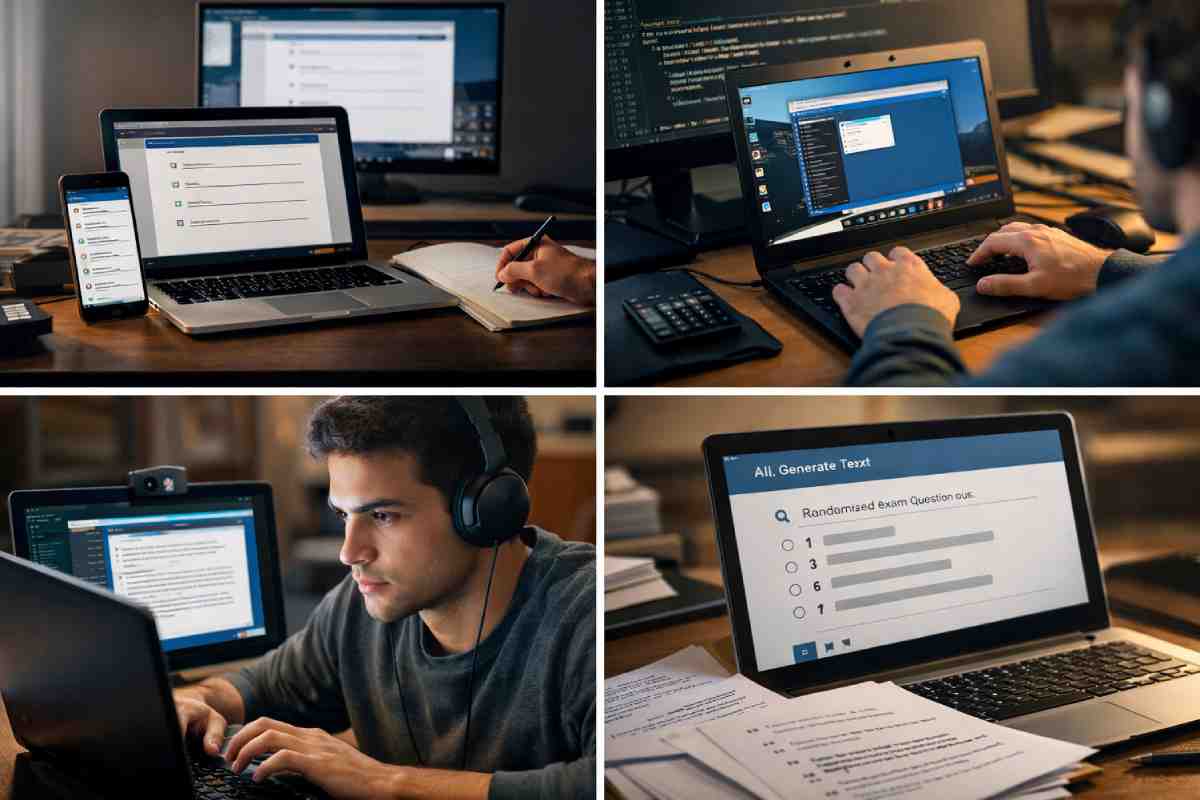
The rapid shift to remote learning permanently altered the academic landscape, but it also accelerated the arms race between educators and students intent on system bypass. Achieving robust online exam cheating prevention is no longer just about requesting webcam access. Today, it requires a granular understanding of virtual machine exploits, generative AI capabilities, and secure browser architecture.
For IT administrators, instructional designers, and university leadership, solving this issue means navigating a complex intersection of assessment psychology, surveillance technology, and strict data privacy compliance. Relying solely on legacy lockdown methods leaves institutions vulnerable.
This guide breaks down exactly how modern academic dishonesty occurs at a high level, the technical limitations of AI proctoring, and the pedagogical frameworks required to build a truly secure and equitable remote testing environment.
Table of Contents
The Modern Threat Landscape: How Students Bypass Online Assessments
Before choosing tools, institutions need a clear, high-level view of how online exams can be undermined. Most risks involve combining everyday devices and software in ways that traditional proctoring does not fully anticipate, which is why prevention must blend sound assessment design with calibrated technical controls.
The “Dual Device” and Screen Mirroring Loopholes
Standard online proctoring typically focuses on the primary exam device. Cheating attempts often revolve around additional devices or displays that sit outside the monitored view, making it easier to look up answers or collaborate out of sight. The practical countermeasure is to pair clear policies and instructions with exam formats that reduce the payoff of real-time answer sharing, such as randomized questions, time limits, and individualized prompts.
Virtual Machines (VMs) and Remote Desktop Risks
More technically skilled students may try to use virtual machines or remote access tools to keep other parts of the system available while the exam window appears locked down. This can weaken basic lockdown safeguards if left unaddressed. Institutions should explicitly configure their security stack to detect or restrict these environments where appropriate and back this up with network policies, honor codes, and clear consequences for misuse.
The Generative AI Threat in Real-Time
Generative AI tools can be misused to generate exam responses on the fly, especially for generic multiple-choice or recall-based questions. Rather than trying to block every possible tool, the safer, more sustainable approach is to design assessments that emphasize analysis, application, and context-specific problem-solving, where AI outputs are far easier to detect and far less useful as a shortcut.
Foundation First: Pedagogical Strategies to Deter Cheating
No software is impenetrable. The most robust online exam cheating prevention strategy begins with assessment design. Modifying how we test often yields higher security than escalating technological surveillance.
In addition to secure exam formats, institutions can strengthen academic integrity by encouraging both students and instructors to use a trusted plagiarism check on written assignments, helping identify unintentional overlap and reinforcing expectations around originality.
High-Entropy Design: Question Pooling and Randomization
Static exams are highly vulnerable to screenshotting and distribution. To counter this, educators must utilize algorithmic assessment delivery.
By building extensive question banks within the Learning Management System (LMS) and randomizing both question order and answer variable positioning, the exam’s “entropy” increases. If every student receives a mathematically unique test variation, the value of collaborative cheating drops near zero.
Shifting to Application-Based Assessments
The most effective counter to generative AI is assessing higher-order cognitive skills rather than rote memorization. Open-book formats that demand critical synthesis, localized case studies, or the application of concepts to highly specific, novel scenarios cannot be easily solved by basic LLM queries.
The Psychology of Frequent, Low-Stakes Testing
High-stakes exams (where a single final dictates 50% of a grade) create intense psychological pressure, driving the motivation to cheat. Replacing these with frequent, low-stakes formative assessments (weekly quizzes, reflective logs) reduces anxiety and makes it statistically harder for a student to sustain a coordinated cheating effort across an entire semester.
The Technical Defense Arsenal: Evaluating Proctoring Solutions
When pedagogical adjustments are insufficient—such as for high-stakes credentialing or final exams—technological intervention becomes necessary. However, IT decision-makers must understand the nuances of these tools to avoid deploying ineffective or disproportionate software.
Lockdown Browsers: Capabilities and Limitations
Lockdown browsers are customized applications that disable the system’s clipboard (copy/paste), block keyboard shortcuts, prevent access to secondary applications, and disable printing.
The Reality Check: While effective against casual cheating on a single device, basic lockdown browsers cannot reliably detect secondary physical devices or sophisticated multi‑layer setups without deeper integrations and, in some cases, more invasive system access. They work best when paired with sound assessment design and clear conduct rules rather than used in isolation.
Automated AI Proctoring: Gaze Tracking and Audio Analysis
Automated proctoring layers machine learning algorithms over a standard lockdown browser. It analyzes webcam feeds for behavioral anomalies using computer vision.
How it Works: Algorithms track facial recognition, gaze vectors (eye movement tracking), and biometric baselines. Audio analysis flags specific decibel thresholds or speech patterns indicating potential collaboration or suspicious background activity.
The Reality Check: AI proctoring does not prevent cheating; it flags potential issues for human review. It is highly susceptible to environmental variables and must be used with transparent policies, training, and an appeals process to avoid unfair outcomes.
Assessment Security Matrix
| Security Tier | Technology Level | Cost & Scalability | Primary Vulnerability | Ideal Use Case |
|---|---|---|---|---|
| Tier 1 (Light) | LMS Randomization + Time Limits | Free (Built-in) | Secondary devices, collaboration | Weekly quizzes, formative tests |
| Tier 2 (Moderate) | Lockdown Browser + Automated AI | Medium Cost / High Scale | VM attempts, AI false positives | Mid-terms, large cohort exams |
| Tier 3 (Maximum) | Live Remote Human Proctoring | High Cost / Low Scale | Human error, scheduling friction | Board certifications, final exams |
The deployment of invasive monitoring tools has triggered massive pushback regarding student privacy and equity. Institutions must balance academic integrity with legal obligations and students’ rights.
Algorithmic Bias and the “False Positive” Dilemma
Computer vision algorithms applied in AI proctoring have historically struggled with accuracy across diverse demographics. Lighting conditions, darker skin tones, and neurodivergent behaviors (such as natural tics or lack of eye contact) frequently trigger “false positive” cheating flags.
This places an undue burden on marginalized students and requires immense administrative overhead to manually review thousands of flagged video hours. Institutions should set clear review standards, provide an accessible appeals process, and regularly audit proctoring outcomes for bias.
Data Compliance: GDPR, FERPA, and Biometrics
Recording a student’s private bedroom, tracking their eye movements, and capturing their government ID requires rigorous compliance. Institutions must audit vendor telemetry data: what is collected, how it is stored, and when it is deleted.
Key questions include: How long are videos stored? Are biometric hashes encrypted? Does the vendor comply strictly with FERPA (US), GDPR (EU), and localized data protection laws? Ensuring full compliance is a non-negotiable IT requirement.
Deploying a Secure Assessment Architecture: A Framework
Implementing a system without friction requires a strategic, phased rollout. Over-securing low-level tests leads to platform fatigue, while under-securing high-level tests compromises institutional validity.
- Step 1: Map the Stakes: Audit your current assessments and classify them (Low, Medium, High).
- Step 2: LTI/API Integration: Ensure your chosen proctoring software integrates natively via LTI (Learning Tools Interoperability) into Canvas, Moodle, or Blackboard. Standalone systems cause severe login friction.
- Step 3: Establish the Academic Integrity Policy: Technology fails without policy. A clear, legally reviewed syllabus statement explicitly outlining what software is used, data collection practices, and the appeals process for AI flags is mandatory.
- Step 4: Conduct a “Zero-Stakes” Trial: Never deploy proctoring software for the first time on a graded exam. Run a mandatory practice test to resolve hardware conflicts, firewall blocks, and bandwidth issues before test day.
Final Verdict: Balancing Security and Empathy
Total invulnerability in online testing is an illusion. Effective online exam cheating prevention is an exercise in risk mitigation, not absolute control.
Institutions must move away from viewing surveillance software as a magic bullet. By blending randomized, application-based test design with targeted, scalable proctoring tech—and remaining acutely aware of privacy, bias, and student wellbeing—organizations can defend their academic integrity while maintaining a fair, empathetic environment for remote learners.
FAQs
How does online proctoring software detect cheating?
Online proctoring software helps protect exam integrity by monitoring the student’s environment and device activity. It uses computer vision and AI to review webcam footage for potential anomalies and pairs this with lockdown features that restrict navigation, apps, and shortcuts so students remain focused on the assessment.
Can lockdown browsers be weakened by virtual machines?
Lockdown browsers can be less effective if they are not configured to detect virtual machines or remote access tools. Institutions should work with vendors to block or flag these environments, layer in network and device policies, and clearly communicate that using such setups to circumvent exam rules violates academic integrity.
Is AI proctoring a violation of student privacy?
AI proctoring can raise privacy concerns because it may record video, audio, and behavioral data during exams. To address this, institutions must choose vendors that comply with regulations like GDPR and FERPA, minimize data collection, set clear retention limits, and transparently explain to students what is monitored, why, and how they can raise concerns.
What is the best way to prevent cheating without using invasive software?
The strongest non-invasive approach is thoughtful assessment design. Randomized question pools, time‑bound exams, open‑book tasks that require analysis or application, and frequent low‑stakes quizzes make it much harder for cheating to meaningfully impact outcomes while supporting a more supportive learning environment.
What causes “false positive” flags in automated proctoring?
False positives often occur because of normal behavior or environmental factors, such as poor lighting, background noise, intermittent eye contact, or network glitches. To keep these from unfairly harming students, institutions should provide guidance on ideal testing conditions, review flags with human judgment, and offer a fair appeals process.
Disclaimer
This guide is for informational and educational purposes only and is intended to help institutions improve academic integrity and online exam security. Any reference to third-party tools does not constitute an endorsement, and readers should review each tool’s terms, privacy practices, and suitability for their own context before use.