

Mobile app development discussions are still dominated by a false binary: hybrid vs native.
Most teams believe app success depends on whether they chose Swift/Kotlin or a shared runtime. In practice, mobile app development failures rarely originate from the framework itself. They originate from where the native boundary is placed—the seams where shared code hands control to platform-specific behavior.
This article reframes the debate entirely:
Hybrid vs native is not a mobile app development decision. It’s a boundary-design decision.
Once you see that, most popular advice collapses.
Table of Contents
Why the Hybrid vs Native Debate Persists
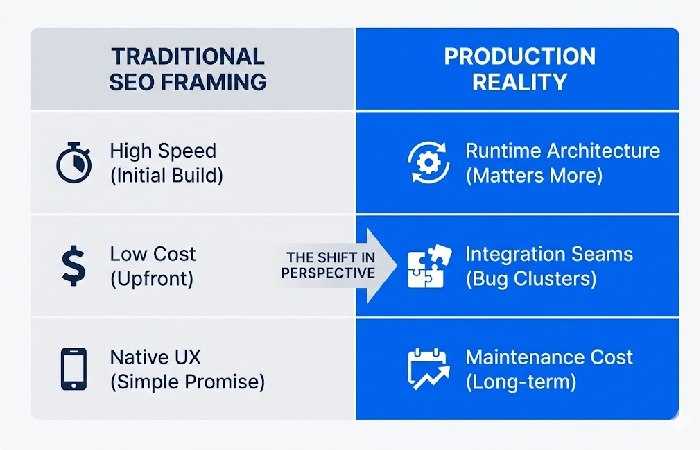
Many mobile app development articles reduce the decision to a simple trade‑off that looks good in a comparison table.
Native = performance, UX, deep OS access
Hybrid = speed, lower cost, shared code
Most readers arrive expecting a simple chart like this, where native equals performance, UX, and deep OS access, and hybrid equals speed, lower cost, and shared code. If you want that classic comparison, the overview in Hybrid vs. Native: Which Platform to Choose for Mobile App Development? covers the usual pros and cons before you come back here to think about boundaries instead.
This framing survives because it is easy to explain and SEO-friendly, not because it reflects how production systems behave.
What it ignores:
- Runtime architecture matters more than language
- Bugs cluster at integration seams, not in isolated modules
- Maintenance cost dwarfs initial build cost after the first few releases
Various studies and industry reports on software maintenance in the lifecycle indicate that maintenance and evolution can account for a large share of total software cost, often exceeding the initial development effort. Yet most hybrid vs native content optimizes for week‑1 decisions, not year‑3 consequences.
Mobile app decisions are not just technical; they are business bets on how you will acquire, serve, and retain customers over years, not sprints. If you need a refresher on how apps impact brand visibility, engagement, and revenue, our guide to mobile app development for business explains how mobile app development supports real-world growth instead of vanity installs.
The Native Boundary: What It Actually Is
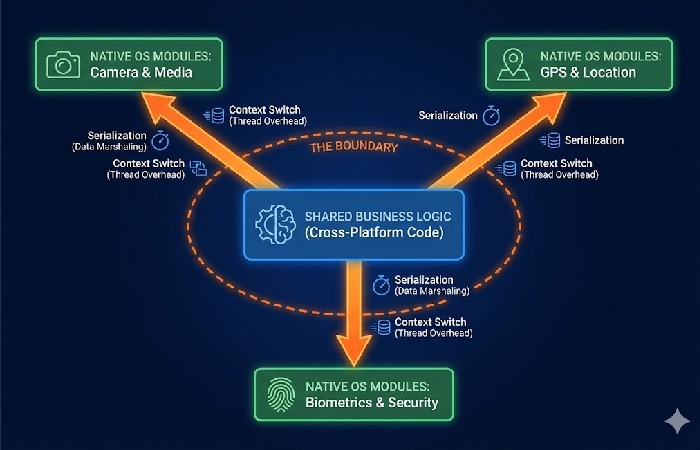
A native boundary is any point where:
- Shared logic crosses into platform-specific APIs
- A runtime bridge translates data, state, or events
- Ownership shifts from one abstraction layer to another
Examples include:
- UI rendering pipelines that hop between runtimes
- Camera, Bluetooth, biometrics, secure storage, background tasks
- Gesture handling, navigation, lifecycle events
- Performance-critical loops (animations, media, encryption)
Official Android JNI performance guidance recommends minimizing frequent cross‑language calls in performance‑critical sections, because each transition adds measurable overhead and complexity.
The key insight
Cost scales with boundary crossings, not with the framework.
Each crossing adds:
- Serialization and marshaling overhead
- Error-handling complexity
- Debugging friction
- Version-compatibility risk
- Ownership ambiguity
Android NDK documentation and related performance guidance note that JNI and other cross‑language calls add overhead and should be used carefully in performance‑critical code paths, which aligns with the idea that cross‑layer interactions can introduce latency and complexity.
Profiling tools such as Instruments and Time Profiler are commonly used to track similar cross‑layer costs in iOS apps.
Where Things Break in Real Production Apps
Across teams and industries, the same patterns repeat.
1. Performance cliffs appear suddenly

Not gradually.
Apps feel “fine” until a feature:
- Adds continuous sensor access
- Introduces real-time rendering
- Requires background execution
- Depends on synchronous native calls
At that point, performance collapses—not because the app is hybrid, but because boundary frequency crossed a threshold.
Facebook engineering retrospectives (React Native performance investigations) repeatedly showed that bridge saturation, not UI complexity, caused frame drops and jank.
React Native’s own performance documentation on the JS bridge notes that excessive communication across the bridge can overload the JavaScript thread and lead to dropped frames and visible UI jank.
2. Bugs cluster in glue code
Post-mortems rarely show:
- “Business logic error”
They show:
- Race conditions at lifecycle transitions
- State desync between runtimes
- Edge-case failures after OS updates
- Plugin incompatibilities
Xamarin and .NET for Android documentation includes extensive troubleshooting guidance for binding libraries, underscoring that binding and glue layers are a frequent source of subtle issues compared to ordinary application logic.
3. Debugging time increases non-linearly
Boundary bugs are:
- Harder to reproduce
- Harder to profile
- Harder to assign ownership
A crash that spans:
shared logic → bridge → native API → OS
often requires multiple engineers across disciplines to resolve. That coordination cost is invisible in “development speed” comparisons—but very visible in sprint velocity.
Case Patterns (Archetypes, Not Marketing Stories)
Pattern 1: Media-Heavy Consumer App
- Camera, filters, video processing
- Frequent boundary crossings per frame
Outcome:
Hybrid core, native media pipeline required. Teams that pushed media into shared layers reported persistent performance regressions.
Pattern 2: Fintech or Health App
- Secure storage, encryption, background sync
- Strict OS-level compliance rules
Outcome:
Native boundaries around security were unavoidable. Hybrid UI was viable, but core trust surfaces had to be native-owned.
Pattern 3: Content-First Productivity App
- Mostly CRUD, offline sync, list rendering
Outcome:
Shared code performed well because boundaries were coarse and infrequent.
➡️ Same technology choices. Completely different outcomes.
Boundary placement was the differentiator.
Why “Start Hybrid, Rewrite Native Later” Rarely Works
This advice appears in almost every comparison article—and fails in practice.
Why?
- Data models harden early
- Navigation assumptions leak everywhere
- State management becomes framework-shaped
- Teams optimize workflows around the initial architecture
Multiple engineering retrospectives and case studies describe large‑scale rewrites stalling feature development and sometimes re‑introducing previously solved bugs, which matches long‑standing cautions in software engineering literature about the risks of big rewrites.
Rewrites fail not because teams lack skill—but because architectural debt compounds socially, not just technically.
What High-Performing Teams Do Instead
Experienced teams stop asking “Which framework?” and start enforcing boundary discipline.
Common traits:
1. Native-first for constraint-heavy domains
Media, security, background execution, OS-coupled flows.
2. Shared layers only where behavior is invariant
Business rules, formatting, non-interactive logic.
3. Explicit ownership of every boundary
No “someone else maintains the plugin” ambiguity.
4. Boundary cost reviewed at design time
Not discovered during QA or after store rejection.
Public engineering retrospectives from companies like Airbnb and others describe moving away from blanket cross‑platform strategies toward more selective code sharing with clear native ownership, in large part to better manage boundary costs and long‑term maintainability.
For example, Airbnb has publicly described sunsetting its broad React Native adoption in favor of stronger native foundations in many flows.
How to Make the Decision the Right Way
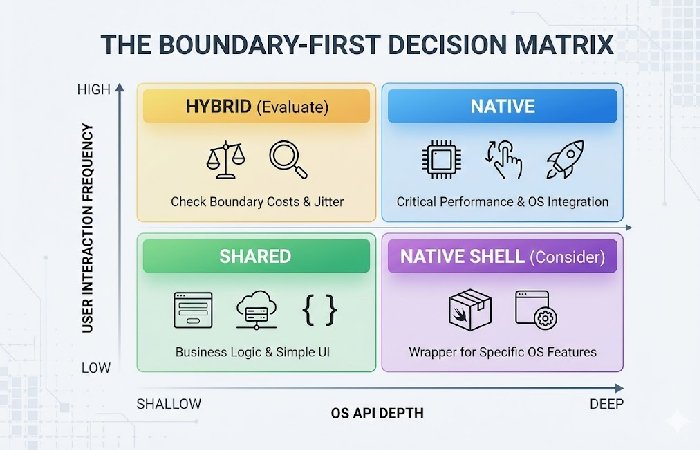
Replace the old question:
❌ Hybrid or Native?
With better ones:
- Where will latency or jitter be unacceptable?
- Which behaviors must match OS conventions exactly?
- Which layers will evolve at different speeds?
- How many times per second will boundaries be crossed?
- Who owns failures at each seam?
If you cannot answer these, the framework choice is premature.
Conclusion: Frameworks Change. Boundaries Don’t.
Frameworks rise and fall.
OS APIs evolve.
Toolchains improve.
But the cost of poor boundary design is constant.
If you design boundaries well, your framework choice becomes survivable.
If you don’t, no framework will save you.
That is the conversation the industry should be having—and the one most ranking pages still avoid.
FAQs
1. Is hybrid or native better for mobile app development performance?
Neither is automatically better; performance depends more on how often your app crosses the native boundary than on the framework label itself.
2. Why do so many articles frame hybrid vs native as a simple trade-off?
Because “cost vs performance” is easy to explain and rank for, even though it ignores runtime architecture, boundary costs, and long-term maintenance realities.
3. What exactly is a native boundary in mobile app development?
It is any point where shared logic hands off to platform-specific APIs or runtimes, such as camera access, secure storage, or gesture handling.
4. Where do mobile app bugs usually cluster in hybrid setups?
They tend to cluster in glue code at the seams between runtimes, around lifecycle transitions, OS updates, and plugin bindings rather than in isolated business logic.
5. Does “start hybrid and rewrite native later” work in practice?
Often it does not, because data models, navigation patterns, and team workflows harden early, turning the rewrite into a risky, expensive architectural reset.
Standard Disclosure
This content is based on software‑engineering literature, official framework and platform documentation, public engineering blogs, and industry experience. AI assistance was used to help organize, cross‑check, and explain these findings.
About the Author
Abdul Rahman is a professional content creator and blogger with over four years of experience writing about technology, health, marketing, productivity, and everyday consumer products.
He focuses on turning complex topics into clear, practical guides that help readers make informed decisions and improve their digital and daily lives.