

Machine learning jobs remain among the most talked-about careers in tech — but the story isn’t as simple as “learn ML → get a job.” In 2026, opportunities still exist, but the rules of the game have shifted.
Companies are seeking hybrid talent — engineers who can build real-world production systems, not just toy models — and are increasingly focused on GenAI and MLOps capabilities.
Let’s break down this evolving landscape and show how to make strategic choices that actually lead to career success.
Table of Contents
1. The Market Still Grows — But Entry-Level Saturation Is Real
It’s tempting to believe that machine learning jobs are booming everywhere and for everyone, but the truth is more nuanced, as recent AI and machine learning job trend analyses highlight.
- Reports show that AI and ML roles are increasingly featured in campus hiring, especially in Indian tech hubs such as Bengaluru, but the exact share of placements varies widely by institution and year.
-
However, recent workforce surveys show that a large majority of workers feel underprepared for the evolving job market, reflecting rising expectations from employers and uncertainty among applicants.
This combination means demand exists, but so does intense competition at the basic entry-level ML skill tier. Many applicants today arrive with similar portfolios (courses and notebook projects), making it harder to stand out.
2. Hybrid Roles Are Where Growth Is Strongest
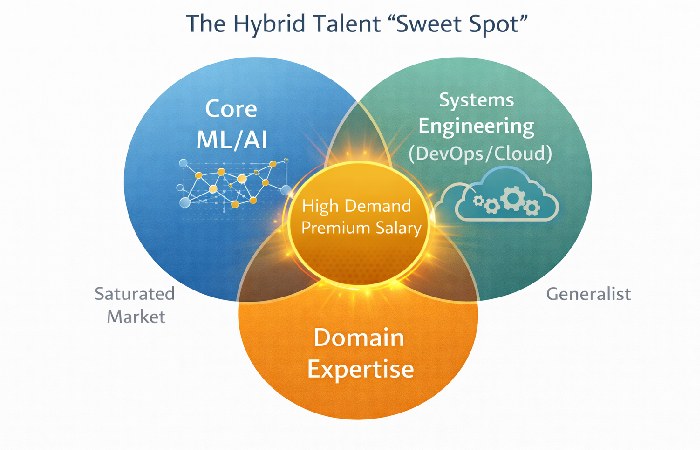
Hiring trends and job data indicate that pure ML engineering jobs are no longer the only — or most prized — direction. Instead, demand is rising for hybrid roles where machine learning intersects with other critical skills:
MLOps and LLMOps
- The MLOps field — which bridges machine learning and operations — is experiencing rapid growth in India and globally, and many companies across sizes are hiring these specialists aggressively as demand outpaces supply.
-
Roles tied to LLMOps — focused on deploying and managing large language models — are emerging as part of this shift.
GenAI Engineers
-
Generative AI‑centric roles such as “Generative AI Engineer” and “AI Innovation Lead” are surfacing as in‑demand titles, especially in startups and innovation labs, alongside broader artificial intelligence career paths that continue to evolve.
-
Recent salary guides and market analyses, such as independent machine learning statistics and salary reports, consistently place senior AI and generative AI–focused roles near the top of tech pay bands, reflecting their premium value.
AI + Domain & Product Roles
-
Job trend lists also include AI Security Specialist, Cloud Architect, and DevOps Engineer alongside ML roles — indicating that specialization and cross-domain expertise is prized.
What this means: Hybrid talent — ML + systems engineering + domain knowledge — is where most of the growth, premium salaries, and real hiring activity sits.
3. Employers Are Prioritizing Practical Production Skills
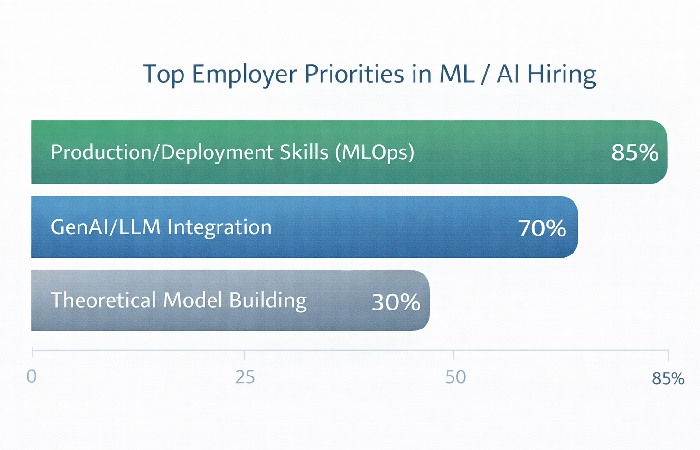
In 2026, many companies are not simply hiring based on coursework or isolated models. They want engineers who understand the full lifecycle of machine learning systems:
-
Deployment pipelines using CI/CD, cloud services, and container systems.
-
Monitoring, retraining, data governance, and observability.
-
RAG and LLM integration workflows that support real business applications.
This explains why MLOps engineering is increasingly seen as a necessary bridge between research and real-world AI production.
Portfolio Projects That Matter
Rather than polished academic models, hiring managers now look for:
-
End-to-end pipelines with deployment history
-
Systems that scale and handle messy data
-
Evidence of monitoring and reliability practices
A polished Kaggle leaderboard hardly moves the needle without production context.
4. What to Learn (and Why It Matters)
If basic ML skills are now table stakes, the differentiators are hybrid capabilities. Top skills in demand for 2026 include:
Core Technical
-
Programming: Python (baseline), and scalable engineering languages like Java/C++ for systems work.
-
Cloud platforms: AWS, Azure, GCP — essential for deploying real systems.
-
MLOps toolchains: MLflow, DVC, Kubernetes, CI/CD integration.
AI/ML Evolution
-
GenAI & LLM workflows: Prompt engineering, RAG pipelines, vector search deployments.
-
NLP and multimodal skills: Especially for generative systems and assistants.
Broad Systems & Soft Skills
-
Cloud orchestration, monitoring, observability, reliability.
-
Communication, decision-making, and cross-team collaboration as highlighted in recent top AI skills for 2026 reports.
If you prefer a structured path instead of learning everything solo, a focused machine learning certification or data science program can help you consolidate core ML, GenAI, and production skills.
The key is to treat any program as a vehicle for building real, portfolio‑worthy projects and deploying systems end to end, not just for accumulating certificates.
5. Creating a Career Roadmap That Actually Works
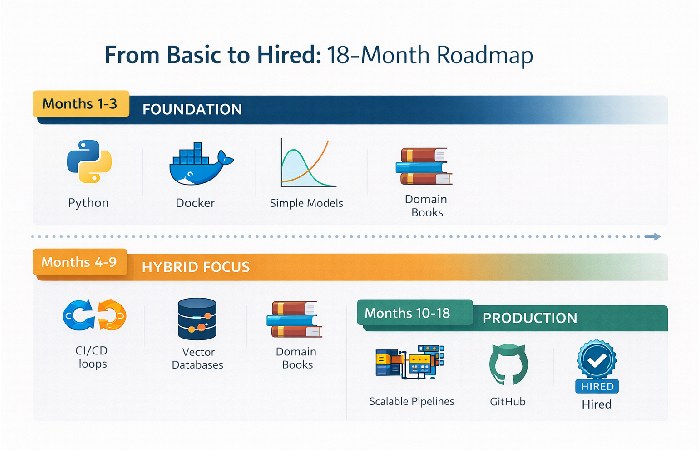
Here’s an example of a realistic 12–18 month roadmap for someone beyond the basics:
Months 1–3: Foundation to Deployment
-
Solidify Python and data engineering fundamentals.
-
Build and deploy simple ML models on cloud platforms.
-
Learn Docker + Kubernetes basics.
Months 4–9: Hybrid Focus
-
Dive into MLOps basics: CI/CD, pipelines, monitoring.
-
Start learning GenAI/LLMOps workflows (RAG + vector databases).
-
Add domain knowledge for your target industry (e.g., healthcare AI).
Months 10–18: Real Production Assets
-
Build end-to-end project portfolios: scalable pipelines with monitoring.
-
Contribute to open source or real collaborative systems.
-
Prepare interview stories around impact and reliability, not just accuracy.
In 12–18 months, a motivated candidate can often move from basic ML to at least some production‑level experience, such as deploying small systems or contributing to existing pipelines.
6. How to Stand Out in the Job Market
1. Write a Personal Job Thesis
Define:
-
Geography (your market)
-
Role focus (ML + MLOps vs GenAI)
-
Industry domain
This helps you prioritize tools and jobs instead of chasing every opening.
2. Avoid Generic Certifications Only
Certificates help signal intent, but employers want evidence of impact and production experience.
Many employers say they are shifting toward more skill‑based hiring, where demonstrated competence can weigh as much as formal degrees.
3. Be Adaptable and Curious
With the AI job market in flux — and despite some cooling for generalist roles — companies are still hiring for specialized, high-value talent.
Focus on areas that are growing, not just trending.
7. The Bottom Line: Redefine What “ML Jobs” Mean Today
Machine learning jobs in 2026 are not a single, linear path, but a constellation of roles that blend modeling, systems engineering, production skills, and domain expertise.
-
Basic ML knowledge is no longer enough — but it’s still essential as part of a deeper stack.
-
Hybrid roles — particularly those in MLOps, GenAI, and scalable deployments — are often where companies are most actively hiring, and they frequently command premium compensation compared to many generic software positions, especially in well‑funded companies and key tech hubs.
-
Job seekers must think strategically, aligning learning with market realities, not outdated roadmaps.
If you prepare accordingly, you won’t just compete — you’ll stand out.
Top Job Boards for Machine Learning & AI Roles in 2026
Landing a role in ML/AI often starts with finding quality job listings. Here are some of the best job boards where you can consistently find machine learning, GenAI, and hybrid ML roles across experience levels:
AIJobs.ai
A dedicated job board for AI, machine learning, and data science roles — from startups to established tech firms — with regularly updated opportunities.
AIJobs.com
A free AI job marketplace with listings across machine learning, NLP, computer vision, and broader artificial intelligence careers.
AAAI Career Center
Run by the Association for the Advancement of Artificial Intelligence, this board includes roles spanning research, engineering, and applied AI jobs.
AIJobs.net
A job board focused on AI and ML roles with filters to help you find positions that match your skills and preferences.
Braintrust Machine Learning Job Board
A niche board where hiring managers post ML opportunities — including full-time, remote, and freelance jobs.
Open Data Science Jobs
A broader board featuring data science and ML roles, useful for candidates targeting hybrid Analytics + ML jobs.
Internshala (for India)
While not exclusively ML, this site has numerous AI and ML job and internship postings for freshers and early career professionals in India.
Mainstream Boards (e.g., LinkedIn, Indeed)
Large platforms like LinkedIn and Indeed regularly list many machine learning and AI roles — from entry‑level positions to senior leadership tracks — across regions and industries.
Pro tip: Bookmark and set alerts on multiple boards. AI/ML roles move fast, and several niche boards update daily with high-value opportunities.
Sample Resume Templates for Hybrid ML & GenAI Positions (2026)
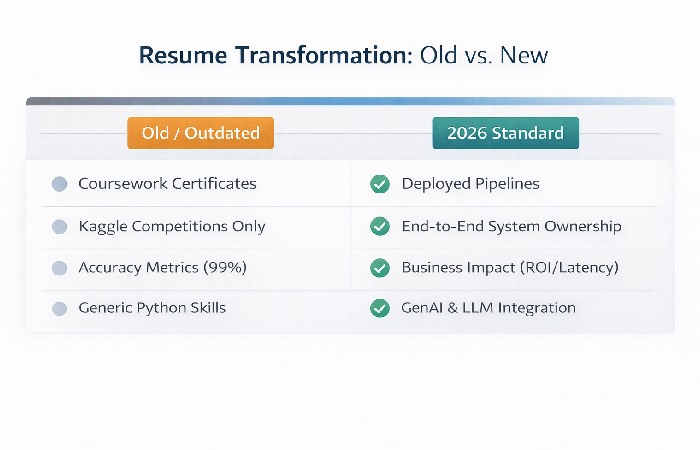
A strong resume is a critical part of landing interviews — especially for hybrid AI roles that blend modeling, engineering, and system deployment skills.
1. Generative AI Engineer Resume
For roles focused on GenAI and LLM pipelines, your resume should reflect:
-
Deployment of LLM workflows (e.g., RAG, prompt optimization)
-
Experience with AI frameworks (PyTorch, TensorFlow) and cloud platforms
-
Quantified impacts (e.g., reduced inference latency)
Example templates and bullet‑point inspiration are available in many resume‑writing guides and resources that now include sections tailored to generative AI roles, with structured layouts for skills and achievements.
2. Machine Learning Engineer Resume
Templates tailored for ML engineers emphasize:
-
ML model development and deployment
-
Cloud & infrastructure experience (AWS, GCP)
-
Scalable pipeline knowledge
Downloadable and ATS-friendly resume examples for different levels (entry, senior) are widely available online.
3. MLOps / Hybrid ML + Systems Resume
Resumes for MLOps roles should include:
-
CI/CD skills, pipeline automation
-
Kubernetes, Docker, monitoring frameworks
-
Cross-functional collaboration points
Sample resumes in DevOps/MLOps formats illustrate how to present these systems skills alongside ML experience.
4. Machine Learning & Data Science Templates
General ML/DL resume templates can be adapted for hybrid roles by:
-
Adding a Projects section with deployed, real-world systems
-
Highlighting business impact metrics
-
Listing relevant certifications and cloud expertise
There are multiple templates available online that show how to structure resume sections for these goals.
Resume Writing Tips
-
Use clear, results-oriented bullet points (e.g., “Reduced model inference time by 40% using optimized serving pipeline”).
-
Quantify impact wherever possible — recruiters love numbers.
-
Tailor your resume for each role using the job description as a guide.
(Tip: Tools like LinkedIn’s AI job search and premium features can help tailor and optimize your profile and resume for specific listings.)
Conclusion
In 2026, the machine learning job market remains vibrant, but the old narrative of “learn basic ML and you’re set” no longer fits reality, as broader AI job growth statistics make clear.
Demand has grown, yet entry-level competition is intense, and employers increasingly look for hybrid profiles that combine ML, GenAI, MLOps, cloud, and production experience.
To stand out, it’s not enough to know Python and build isolated models — you need to demonstrate practical impact, end-to-end system ownership, and the ability to solve business problems with scalable AI systems.
Strategic career planning, focused skill development, and real production experience are what separate strong candidates from the noise.
Getting the best certification courses for computer science engineers can be a practical way to structure your upskilling if you’re aiming for roles in data science, machine learning, or GenAI.
You don’t necessarily need prior industry experience to start, but you do need curiosity, an aptitude for analytics and programming, and the grit to turn that learning into deployed, real‑world projects.
Key FAQs About Machine Learning Jobs in 2026
1. Is the machine learning job market saturated in 2026?
No — overall demand for ML jobs is still growing, but competition for basic entry-level roles has intensified. Employers now favor candidates with practical, hybrid skills such as MLOps, GenAI integration, deployment pipelines, and domain expertise.
2. What skills are most important for ML jobs now?
Beyond fundamental programming and ML theory, the most in-demand skills include:
-
Production-ready ML pipelines and automation (MLOps)
-
Cloud platforms (AWS, Azure, GCP)
-
GenAI and LLM workflows
-
Data engineering and system scalability
These skills are increasingly common expectations in mid‑ to senior‑level ML/AI postings, especially for hybrid or production‑oriented roles.
3. Do I need an advanced degree to get an ML job?
Not necessarily. Industry trends show a shift toward skill-based hiring where demonstrated competencies and project outcomes often matter more than formal degrees — especially for practical, production-focused roles. Employers may prioritize portfolio experience, cloud/system expertise, and hybrid capabilities over academic credentials alone.
4. What types of ML roles are growing the fastest?
Among the roles frequently highlighted as fast‑growing are:
- MLOps Engineer
- ML + GenAI Specialist / LLMOps Engineer
- Cloud‑native ML Pipeline Developer
These roles reflect a fusion of machine learning with operations, cloud infrastructure, and generative AI technologies.
5. How should I prepare for interviews in ML and AI roles?
Interview preparation remains multi-faceted:
-
Brush up on core ML concepts (algorithms, evaluation metrics)
-
Practice common technical questions and case scenarios
-
Demonstrate experience with deployment, pipelines, and cloud services
-
Prepare to discuss real projects showing business impact
Machine learning interview questions often span from fundamentals to applied system design.
Disclosure
This content has been prepared based on a mix of industry reports, hiring trend data, and expert commentary on AI labor markets. AI assistance was also used to compile, organize, and simplify complex research findings for clarity and reader understanding.