
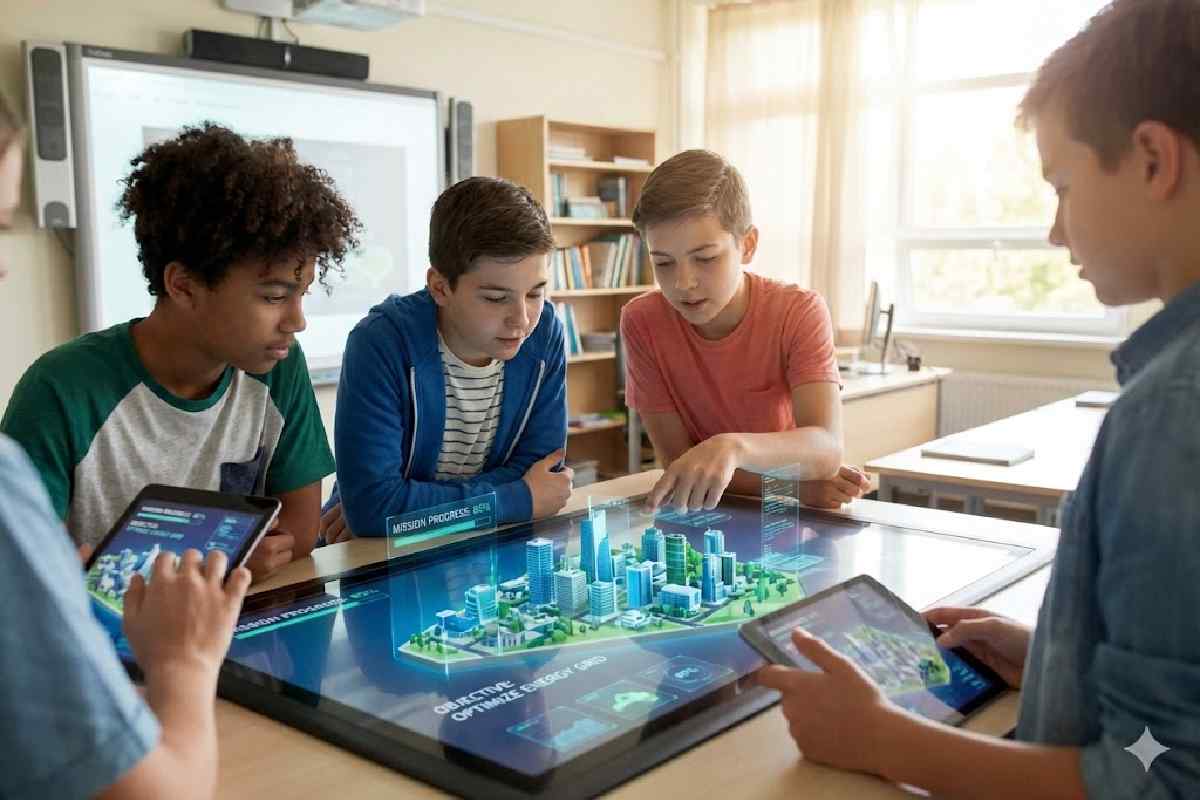
The brutal reality of attention
Today’s classrooms compete with billion‑dollar attention engines like TikTok, Roblox, and Fortnite, all optimised to keep learners hooked. National and international surveys highlight how disruptive behaviour and workload pressures contribute to teacher stress and burnout in many systems, as seen in recent OECD TALIS findings.
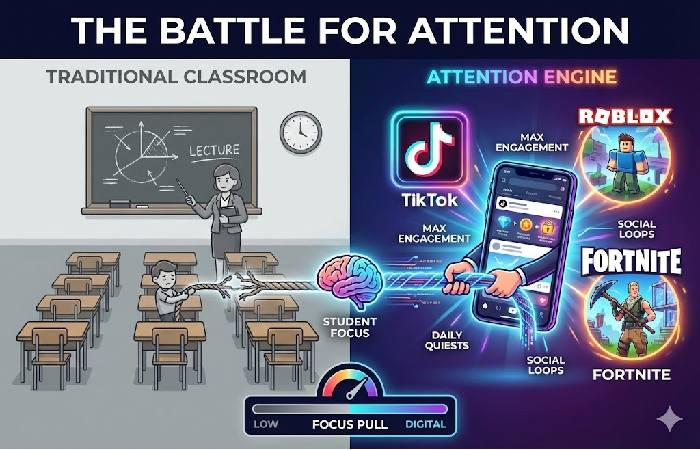
Teachers report that traditional lectures and static worksheets feel increasingly outmatched by these fast, interactive environments. Surveys in recent years show high levels of burnout among K‑12 and higher‑education staff, with many reporting frequent exhaustion and stress linked to student behaviour and disengagement.
Disengagement fuels misbehaviour, and misbehaviour in turn makes teaching harder, creating a loop that pushes some educators out of the profession.
National surveys (for example, in the U.S.) indicate that around a third of teachers say disruptive behaviour interferes with their teaching, underscoring how attention and behaviour are tightly connected.
Table of Contents
Why “chocolate‑covered broccoli” fails
Many “edutainment” tools bolt a thin game layer onto otherwise dull tasks—think low‑quality animations, generic badges, or points for multiple‑choice drills that never change the underlying learning experience.
Students who are used to rich, commercial‑grade games recognise these shallow mechanics instantly and often find them patronising.
This pattern is sometimes called “chocolate‑covered broccoli”: the content remains unappetising, and the superficial game coating wears off quickly.
Research and practitioner feedback suggest that when the fun pauses so the “real learning” can happen, attention drops and the game loses its power; the learning needs to be built into the core mechanic, not tacked on afterward.
Poorly designed gamification also leans heavily on extrinsic motivation. Points, badges, and leaderboards can work for quick sprints, but if only a few “top” students ever win, others may disengage or feel less satisfied, especially when the gap seems impossible to close.
Some studies on competitive leaderboards show that low‑ranking students can become discouraged rather than motivated, particularly when no alternative pathways to success are offered.
The shift: immersion over points
The emerging 2025 trend is a move away from trivia‑style games and toward immersive game‑based learning, where understanding the content is the only way to progress. Instead of “answer a question to get a sword,” learners must grasp underlying concepts—such as materials science, historical context, or physics—to make decisions that matter inside the game world.
This approach aligns with classic problem‑based learning patterns. Students encounter a challenge they cannot solve with their current knowledge, experience a bit of productive frustration, and then actively seek out new information or strategies to advance.
In this model, the answer to “Why do I need to know this?” becomes immediate and concrete: without grasping the concept, the bridge collapses, the mission fails, or the story cannot move forward.
Gamification vs game‑based learning
Treating gamification and game‑based learning as interchangeable is a strategic mistake. Reviews and frameworks in the learning‑science and EdTech literature distinguish them clearly in purpose and design.
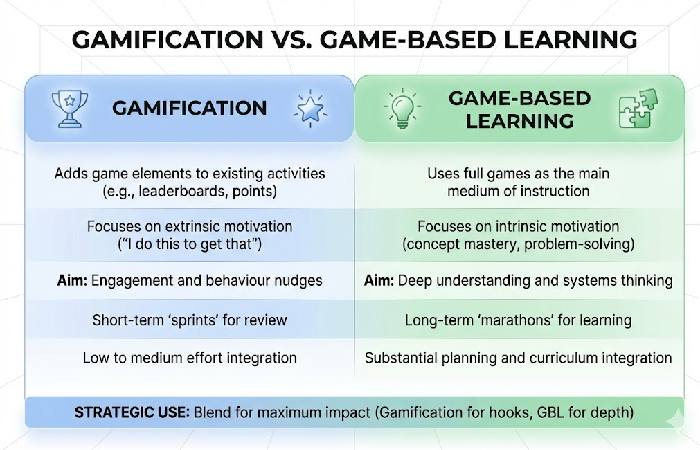
Gamification
- Adds game elements—points, badges, leaderboards, progress bars—to existing activities.
- Aims primarily at engagement and behaviour (e.g., getting homework turned in or encouraging participation).
- Often easier to layer onto current lessons, with low to medium extra effort.
- Tends to focus on extrinsic motivation: “I do this to get that.”
Game‑based learning (GBL)
- Uses full games (digital or analogue) as the main medium of instruction.
- Designed to support concept mastery, problem‑solving, and systems thinking.
- Requires more substantial planning and integration into the curriculum.
- Seeks to build intrinsic motivation: the activity itself becomes compelling.
Gamification is powerful for quick reviews, rote facts, and behaviour nudges. Short quiz tools can raise energy and help consolidate basic knowledge, while game‑based learning is better suited to complex systems, conceptual understanding, and transfer—such as managing a virtual economy, exploring historical scenarios, or experimenting with physics in a simulation, in line with evidence syntheses like John Hattie’s Visible Learning research
Game‑based learning is better suited to complex systems, conceptual understanding, and transfer—such as managing a virtual economy, exploring historical scenarios, or experimenting with physics in a simulation.
Most classrooms benefit from a mix: gamification as a “sprint” to energise and review, and GBL as the “marathon” where deeper learning happens over time.
What neuroscience suggests (without the hype)
Neuroscience and cognitive psychology offer useful clues about why well‑designed games can support learning, but these mechanisms should be described carefully rather than as absolute guarantees.
-
Motivation and feedback loops
Interactive tasks with clear goals and immediate feedback can engage reward‑related systems in the brain and support persistence.
When learners see the results of their actions right away and can quickly try again, they are more likely to remain engaged and iterate on strategies, compared with delayed feedback like waiting days for a test result.
-
Spatial and experiential learning
Studies of commercial 3D games and logic puzzles show that certain types of gameplay can influence brain regions involved in spatial navigation and memory over sustained practice periods.
While these findings come from controlled experiments rather than standard classrooms, they suggest that rich, exploratory worlds can leverage learners’ natural strengths in spatial and experiential learning.
-
Stress, safety, and experimentation
High‑stakes, high‑anxiety testing environments can impair higher‑order thinking, whereas low‑stakes, repeatable challenges in games allow learners to experience “safe” pressure.
Because failure does not carry long‑term penalties, students can take intellectual risks, test ideas, and learn from mistakes without the fear associated with formal grading.
-
Social interaction and belonging
Cooperative or team‑based games encourage communication, negotiation, and coordinated problem solving, which can strengthen classroom relationships and shared identity when well managed.
Social connection and a sense of belonging are known to support engagement and wellbeing, even though specific neurotransmitter changes are rarely measured directly in classroom studies.
Cognitive load theory also applies: good game designs introduce mechanics gradually, scaffold tasks, and provide information right when it is needed, which can reduce unnecessary strain on working memory.
However, busy interfaces or complex rules can increase extraneous load, so design quality is critical.
The “Layered Content Funnel” framework
To move beyond random game use, article 2 introduces a practical implementation model—a “Layered Content Funnel”—that sequences different types of gameplay across a lesson or unit. This aligns with research‑backed ideas about staging attention, exploration, creation, and reflection.
Phase 1: The Hook (activation and recall)
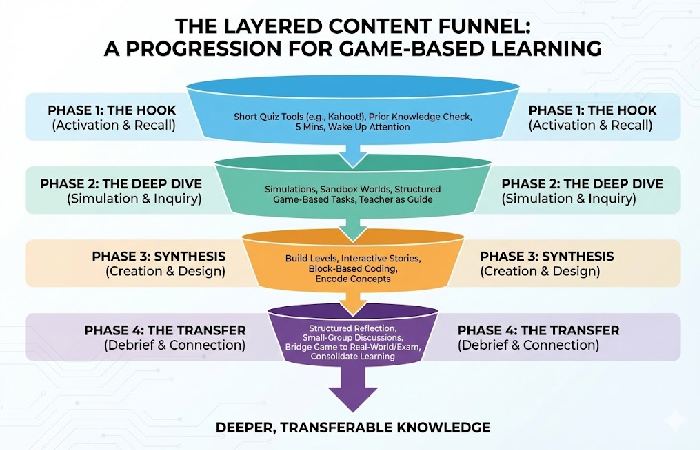
- Use short, high‑energy quiz tools (e.g., Kahoot‑style platforms) as quick “entrance tickets” at the start of class.
- Focus on prior knowledge or last lesson’s key ideas, with clear, time‑boxed play (around five minutes).
- The goal is to signal that class has started, wake up attention, and surface misconceptions—not to teach new concepts.
Phase 2: The Deep Dive (simulation and inquiry)
- Replace or shorten traditional lecture segments by using simulations or structured game‑based tasks.
- Examples include sandbox worlds, physics or science simulations, and historical strategy games, with explicit missions linked to curriculum objectives.
- The teacher’s role shifts to “guide on the side”—circulating, questioning, and helping students articulate what they are testing or observing.
3: The Synthesis (creation and design)
- Ask students to build something—levels, scenarios, interactive stories—that embodies the concept.
- Tools can range from block‑based coding and simple world‑builders to more advanced environments, depending on age and context.
- Designing a game element or interactive scene requires learners to understand rules and relationships deeply enough to encode them.
Phase 4: The Transfer (debrief and connection)
- Always close with structured reflection: short written responses, small‑group discussions, or whole‑class debriefs.
- Prompts should explicitly bridge the game context and the real‑world or exam context: “How does this game economy resemble inflation?” “What parallels are there between this mission and the historical event we studied?”
- Research on reflection and debriefing in game‑based learning indicates that this step is crucial for transferring in‑game learning to other tasks.
This funnel lets you start small (with gamified hooks) and gradually incorporate deeper forms of game‑based learning and student creation, while keeping objectives and assessment alignment visible at every stage.
Subject‑specific applications
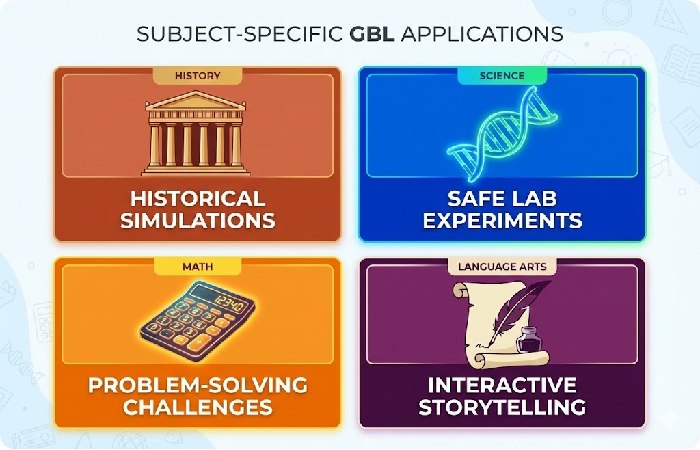
While game‑based approaches often appear first in STEM contexts, they can be adapted across subjects when carefully curated and scaffolded.
-
History and social studies
Historical or civic simulations can help students explore cause and effect, constraints, and human decisions, especially when paired with primary sources and guided discussion.
Used thoughtfully, these experiences can support historical empathy and critical thinking rather than just “time travel tourism.”
-
Mathematics
Escape‑room puzzles, digital challenges, and problem‑solving games can turn abstract concepts into tools for unlocking progress (for example, using linear equations to solve codes or optimise resources).
Studies of game‑based maths activities report gains in motivation and, in some cases, improved performance when tasks are clearly aligned to curriculum goals.
-
Science
Simulations allow students to experiment with phenomena that are too dangerous, costly, or slow for the physical classroom—such as orbital mechanics, chemical reactions, or ecological systems.
Evidence suggests that well‑integrated simulations can support conceptual understanding, especially when combined with teacher‑led explanation and reflection.
-
Language arts
Narrative games and interactive fiction can provide rich “texts” for analysis of character, plot, and theme, while authoring tools for branching stories help students practise narrative structure, point of view, and cause‑and‑effect.
Early work in this area points to improved engagement among reluctant readers and writers when games are treated as serious texts rather than peripheral entertainment.
Across subjects, the principle is the same: the fun mechanic must be the learning mechanic, and each activity must feed clearly into your learning objectives.
Safety, privacy, and risk management
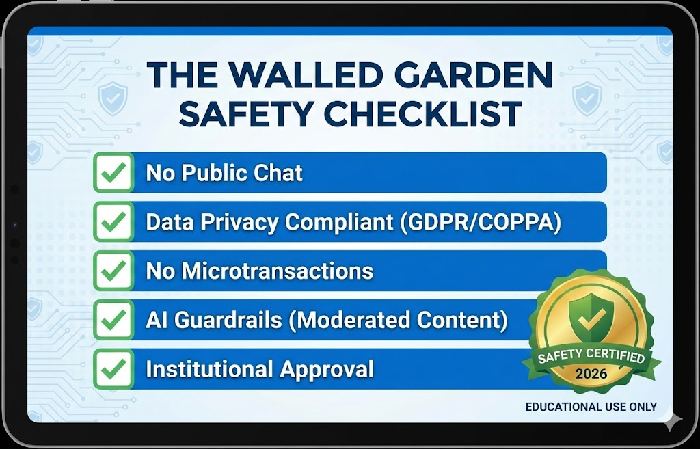
In 2025, using games in class is not just a pedagogical decision—it’s a safety and data‑protection responsibility.
Key considerations include:
-
Chat and online contact
Public servers and open chat in mainstream games can expose students to unmoderated communication, potential bullying, or inappropriate content.
Best practice is to use education‑specific versions, closed environments, or disable public chat entirely.
-
Data protection (e.g., GDPR / UK GDPR)
When tools collect student accounts, performance data, or other personal information, schools often need to conduct a data‑protection assessment and ensure appropriate agreements are in place.
Questions about what data is collected, where it is stored, and how it is used or monetised are central.
-
Advertising and microtransactions
Ad‑supported apps and games with in‑app purchases can raise equity and safety concerns, as well as introduce tracking and commercial pressure.
Many school policies now recommend avoiding tools that include ads or microtransactions in the learning environment.
-
AI content and guardrails
As more tools embed generative AI, educators need to ensure that content filters, moderation, and clear usage boundaries are in place.
Education‑oriented “walled garden” AI systems are designed with stronger safeguards than consumer‑grade chatbots or open content generators.
A simple rubric—checking chat settings, data practices, ads, purchases, and institutional approval—can help teachers decide whether a game is classroom‑ready.
Adaptive AI, stealth assessment, and “segment of one” learning
Newer platforms combine game mechanics with adaptive algorithms that adjust difficulty and sequence for each learner, aiming for a “segment of one” experience.
- Systems can respond to patterns in students’ answers and timing to offer hints, change item difficulty, or revisit prerequisite concepts. Some designs embed assessment inside gameplay (“stealth assessment”), where in‑game actions serve as evidence of skill, and teachers receive dashboards with progress indicators without separate quizzes, as seen in adaptive platforms such as Khan Academy’s personalised practice environment
- Some designs embed assessment inside gameplay (“stealth assessment”), where in‑game actions serve as evidence of skill, and teachers receive dashboards with progress indicators without separate quizzes.
Evidence from adaptive learning research suggests that these approaches can help address prior gaps and maintain engagement, particularly in skill‑heavy domains like mathematics and language practice, when used in combination with teacher guidance rather than as stand‑alone solutions.
Addressing common scepticisms
Many experienced teachers are understandably wary of gamification and classroom gameplay, especially when early experiences involved low‑quality products or chaotic implementations.
Typical concerns include:
- “It’s fluff; I need them to read and write.”
Well‑chosen games can require substantial reading, decision‑making, and writing when paired with analysis and reflection tasks. The game becomes a context for meaningful literacy rather than a replacement for it.
- “I don’t have time to build all this.”
Teachers can start with small steps—using existing quiz tools or vetted simulation libraries—before attempting larger projects. Many platforms provide curriculum‑aligned scenarios or worlds that can be reused and adapted.
- “Students just mess around.”
Unstructured “free play” does tend to drift off task. Clear missions, time limits, deliverables, and debrief questions make gameplay accountable and focused on learning goals.
Implementation: start small, scale smart
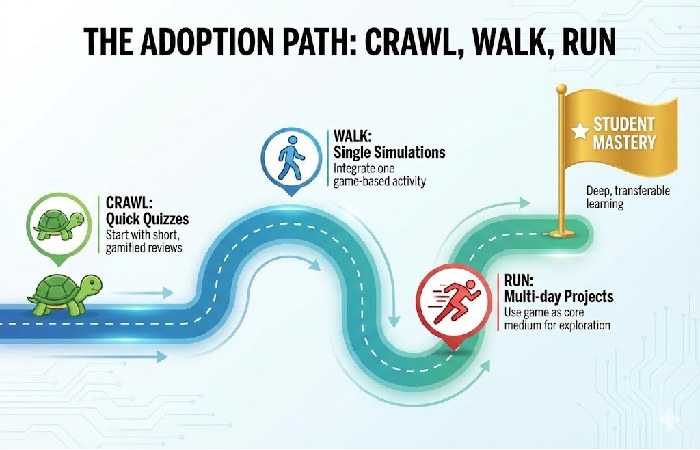
A practical adoption path looks like:
- Crawl – Add short, structured gamified reviews at the start or end of lessons to practise managing energy and transitions.
- Walk – Integrate a single simulation or game‑based activity into an upcoming unit, with a clear mission and debrief.
- Run – Plan a multi‑day project using a game or creation tool as the core medium for exploration and assessment.
In every case, keep pedagogy first and technology second: if a game does not clearly serve the learning objective, it should be reworked or dropped, no matter how engaging it appears.
Conclusion
Gameplay in classroom learning should be framed as a strategic approach, not a gimmick: it blends gamification and game‑based learning, builds on the kind of practical classroom models outlined in gameplay in classroom learning, draws on cognitive science, follows the Layered Content Funnel, and respects safety and data‑protection requirements.
When used this way, gameplay can reduce disengagement and support deeper learning, while remaining a powerful tool—not a cure‑all—for the complex realities teachers face.
Frequently Asked Questions (FAQs)
Q: What is the difference between gamification and game‑based learning?
A: Gamification adds game elements (points, badges, leaderboards) to existing lessons; game‑based learning uses a full game as the main way to teach the content.
Q: Is gameplay in the classroom safe in 2025?
A: It can be, if you use education‑specific versions, follow your school’s data‑protection rules, and lock down or disable public chat and ads.
Q: Does game‑based learning actually improve test scores?
A: Often modestly yes, especially when games are well designed, tied to objectives, and combined with feedback and reflection, though results vary by context.
Q: How do I prevent students getting distracted by the “fun” part?
A: Always debrief after play and choose games where progressing or winning requires using the target skills, not just clicking quickly.
Q: What are good AI‑adaptive tools in 2025?
A: Adaptive platforms like Khan Academy’s tools, Knewton Alta, and similar systems adjust difficulty based on performance and work best alongside teacher guidance.
Q: Is this just for STEM subjects?
A: No; history simulations and interactive fiction tools (like Twine‑style projects) are also used to build empathy, narrative skills, and critical thinking.
Disclosure:
This article is for informational purposes only and does not constitute legal, safeguarding, or policy advice. It was developed using AI‑assisted drafting, synthesising available research and practitioner reports from reputable and peer‑reviewed sources where possible, and then refined through human expert review for classroom relevance and accuracy.
About the Author:
Abdul Rahman is a professional content creator and blogger with over four years of experience writing about technology, health, marketing, productivity, and everyday consumer products. He focuses on turning complex topics into clear, practical guides that help readers make informed decisions and improve their digital and daily lives.