
Table of Contents
Introduction — Problem, Agitation, Quick Solution
Problem
You track handle times, schedules, and SLAs, but customers still complain and escalate. Call center quality assurance feels like a buzzword, not a clear, working system.
Agitation
Some agents deliver empathetic, efficient support while others sound rushed or scripted, and you can’t reliably explain why. Leadership argues over which metrics matter, QA reviews are sporadic, and coaching depends on whoever listened to the last call. That inconsistency chips away at CSAT, FCR, and brand trust, and you only notice issues once they turn into churn or public complaints.
Quick Solution
A modern call center quality assurance program replaces guesswork with a structured framework: clear quality standards, scorecards tied to business outcomes, and regular, calibrated reviews that feed into coaching and process improvements. When you define what “good” looks like and measure it consistently, you can systematically lift CX, agent performance, and retention instead of hoping metrics move on their own.
What Is Call Center Quality Assurance?
Call center quality assurance is a structured process for monitoring, evaluating, and improving customer interactions across voice and digital channels against documented quality standards.
Those standards usually cover accuracy, policy compliance, empathy, clarity, and how fully and efficiently the customer’s issue is resolved.
Unlike ad‑hoc call listening, call center quality assurance is designed as a repeatable system with clear criteria, scoring methods, and feedback loops.
In practice, this often looks like the kind of end‑to‑end program outlined in guides such as Whatfix’s overview of call center quality assurance best practices.
Why Call Center Quality Assurance Matters
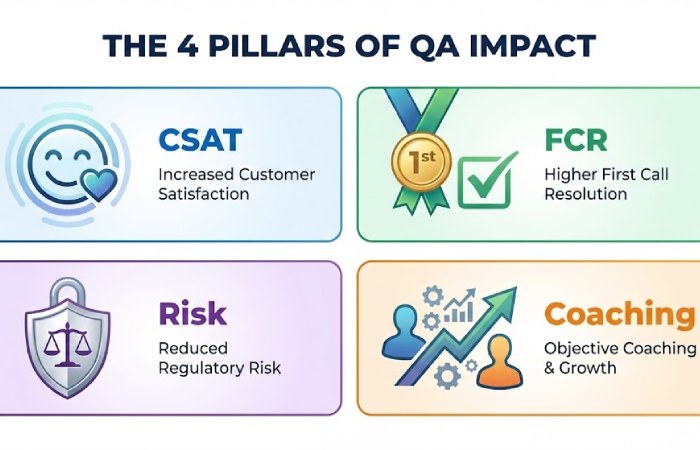
Strong call center quality assurance links day‑to‑day conversations to measurable business outcomes, and when it is treated as a strategic program rather than a checkbox you see improvements in both customer metrics and internal operations.
Robust QA helps increase CSAT, improve first‑call resolution, reduce unnecessary escalations, and lower regulatory risk.
It also creates a shared, objective definition of quality so agents, supervisors, and leaders can pull in the same direction instead of relying on informal opinions.
For a deeper breakdown of why QA matters now, resources like the Calabrio call center QA best practices guide are useful reference points.
Call Center Quality Assurance Metrics to Track
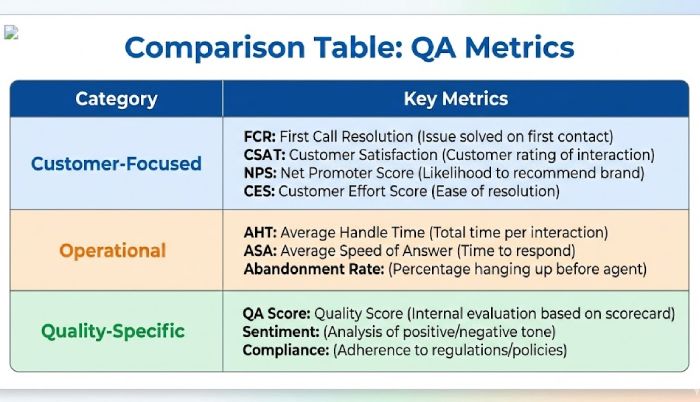
Most current QA and CX guides converge on a common set of metrics that underpin effective call center quality assurance programs.
Customer‑Focused Metrics
-
First Call Resolution (FCR): Percentage of issues solved in the first contact.
-
Customer Satisfaction (CSAT): Customer rating of the interaction.
-
Net Promoter Score (NPS): Customer likelihood to recommend your brand.
-
Customer Effort Score (CES): How easy it was to get the issue resolved.
Operational Metrics
-
Average Handle Time (AHT): Total time spent per interaction.
-
Average Speed of Answer (ASA): How quickly agents respond.
-
Abandonment Rate: Percentage of customers who hang up before reaching an agent.
Quality‑Specific Metrics
-
QA Score / Quality Score: Internal evaluation based on your scorecard.
-
Compliance and Sentiment Indicators: Flags for policy breaches and negative sentiment.
These metrics work best when documented clearly and reviewed together so you balance speed, quality, and effort rather than optimizing a single number in isolation. For more detail on formulas and use cases, see breakdowns like CallMiner’s article on call center QA metrics and best practices.
The Call Center QA Framework (Quality Lifecycle)
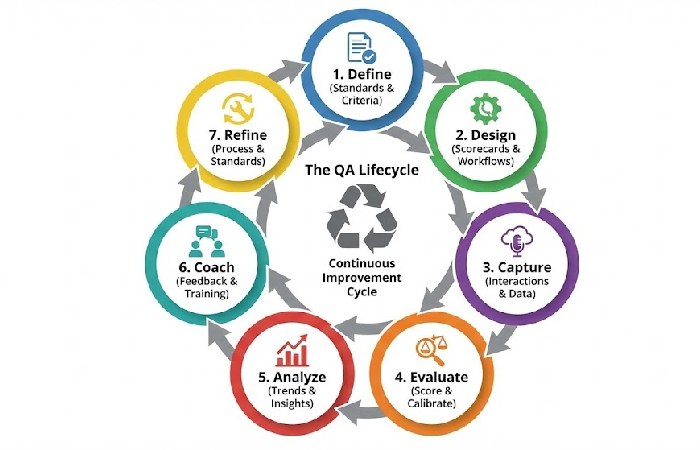
Most complete guides describe call center quality assurance as a continuous cycle rather than a one‑time project.
1. Define What “Quality” Means
Document what a successful interaction looks like for your brand: accurate information, appropriate tone, required disclosures, and a clear resolution or next step. Bringing in operations, QA specialists, and front‑line agents keeps the definition grounded in real scenarios.
2. Design Your QA Scorecard
Convert that definition into criteria grouped under categories like greeting, discovery, resolution, soft skills, and compliance. Each item needs a clear description and scoring rule so evaluators interpret it the same way.
3. Capture and Sample Interactions
Record calls and capture chats, emails, and messages through your contact center platform for later review. Sampling by agent, queue, topic, or sentiment ensures you see both everyday work and edge cases.
4. Evaluate and Calibrate
QA evaluators score interactions using the scorecard within a consistent workflow. Regular calibration sessions—multiple evaluators scoring the same interaction and reconciling differences—keep scoring fair and standardized.
5. Analyze Trends
Look beyond individual scores to patterns by agent, team, queue, and topic. Trend analysis highlights recurring failure points, knowledge gaps, and systemic issues that one‑off feedback would miss.
6. Coach and Improve
Turn insights into structured coaching sessions, targeted training, and script or knowledge base updates.
Focusing on specific behaviors and tracking post‑coaching scores helps prove whether interventions actually work, and many teams also experiment with different opening lines or objection‑handling phrases at the same point in a call—an approach similar to the A/B testing mindset described in the US Chamber’s practical guide to call center services.
7. Refine Standards and Scorecards
Review and adjust QA criteria periodically as products, policies, and customer expectations change. Many teams revisit their scorecards at least annually or quarterly to tune weightings and retire low‑value items.
Using AI and Tools in Call Center Quality Assurance
Modern QA and CX platforms combine recording, transcription, scoring, and analytics into one environment.
They leverage speech‑to‑text and natural language processing to evaluate large interaction volumes for keywords, sentiment, and compliance markers.
Real‑time coaching features in call center quality assurance tools help bridge the gap between analysis and action by surfacing high‑risk calls and letting supervisors or the system guide agents in the moment.
Solutions like Balto’s real‑time QA capabilities show how live alerts and on‑screen guidance can help agents adjust in the moment rather than only after the call.
Many modern platforms provide live alerts for triggers like prolonged silence, repeated hold events, or negative sentiment, then allow coaches or automated workflows to send targeted prompts so agents can recover the interaction before it turns into a complaint or churn risk.
Even when auto‑scoring covers a high share of interactions, human review remains important for complex calls, edge cases, and validating model accuracy.
The strongest programs use AI to broaden coverage and surface outliers while QA specialists focus on nuanced analysis and coaching.
If you want to see how this looks in practice, Zendesk’s explainer on AI in customer service quality assurance gives a useful, vendor‑neutral overview.

Beyond catching problems, call center quality assurance tools can also refine what “good” looks like by automatically highlighting top‑performing calls and the language patterns that lead to better outcomes.
Some systems surface winning phrases and talk tracks on screen during live conversations, allowing you to A/B test different approaches at the same point in an interaction and see which wording drives higher conversion or satisfaction.
Selection guides recommend matching tools to your volume, regulatory environment, stack, and need for real‑time alerts versus deeper analytics.
A separate tools comparison article can cover vendors and features in more depth and link back to this framework.
Common Call Center QA Mistakes to Avoid
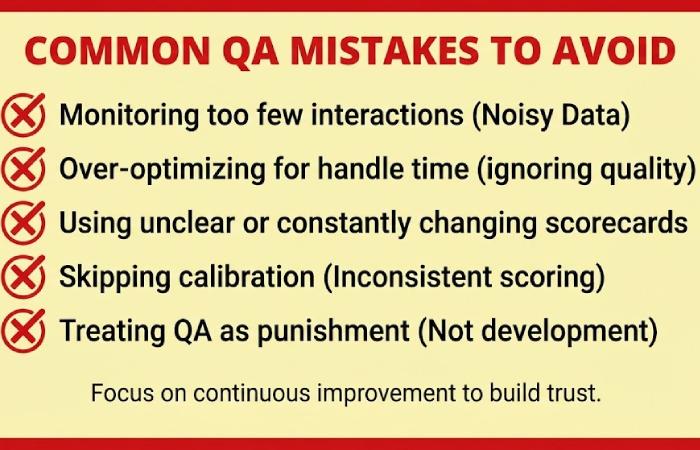
Recent best‑practice lists highlight several traps that limit QA impact.
-
Monitoring too few interactions, making data noisy and easy to ignore.
-
Over‑optimizing for handle time at the expense of resolution and satisfaction.
-
Using unclear or constantly changing scorecards that erode trust.
-
Skipping calibration, which leads to inconsistent scoring across evaluators.
-
Treating QA as punishment instead of a development‑focused program.
Shifting QA toward continuous improvement—with recognition for high and improving quality scores—helps avoid these pitfalls.
Conclusion
Call center quality assurance is the discipline that turns everyday conversations into a manageable, improvable system.
When you define quality clearly, track balanced metrics, use a structured QA lifecycle, and support it with the right tools, you move from reacting to complaints to proactively shaping customer experience and agent performance.
Short FAQs about Call Center Quality Assurance
How often should call center QA reviews happen?
Weekly or bi‑weekly per agent is common, with monthly or quarterly deeper reviews at team and process level.
Is call center quality assurance only for calls?
No, it should cover phone, email, chat, messaging, and other customer‑facing channels.
Who typically owns call center quality assurance?
Usually operations or a dedicated QA/quality management team working closely with supervisors and training.
What is the ideal frequency for QA reviews?
Consistency is key. Aim for weekly or bi-weekly reviews for every agent. While individual check-ins happen often, you should also perform a “deep dive” into team-wide trends every month to catch systemic issues.
Does QA only apply to phone calls?
Absolutely not. Modern QA is omnichannel. It should cover every touchpoint where a customer interacts with your brand, including email, live chat, SMS, and social media DMs.
Who is actually responsible for QA?
It’s a team effort. Usually, a dedicated QA team or Operations Manager owns the framework, but supervisors and trainers use the data to coach agents. Everyone from the floor to leadership should be aligned on the standards.
Does QA really improve CSAT and NPS scores?
Yes. Think of QA as the “why” behind the numbers. While CSAT tells you if a customer is happy, QA tells you what behaviors (like empathy or clarity) made them feel that way, allowing you to replicate success across the board.
Is AI mandatory for a good QA program?
It’s not mandatory, but it is a superpower. Without AI, you’re likely only reviewing 1–2% of your calls. AI allows you to scan 100% of interactions, instantly flagging high-risk issues and winning patterns that humans might miss.