
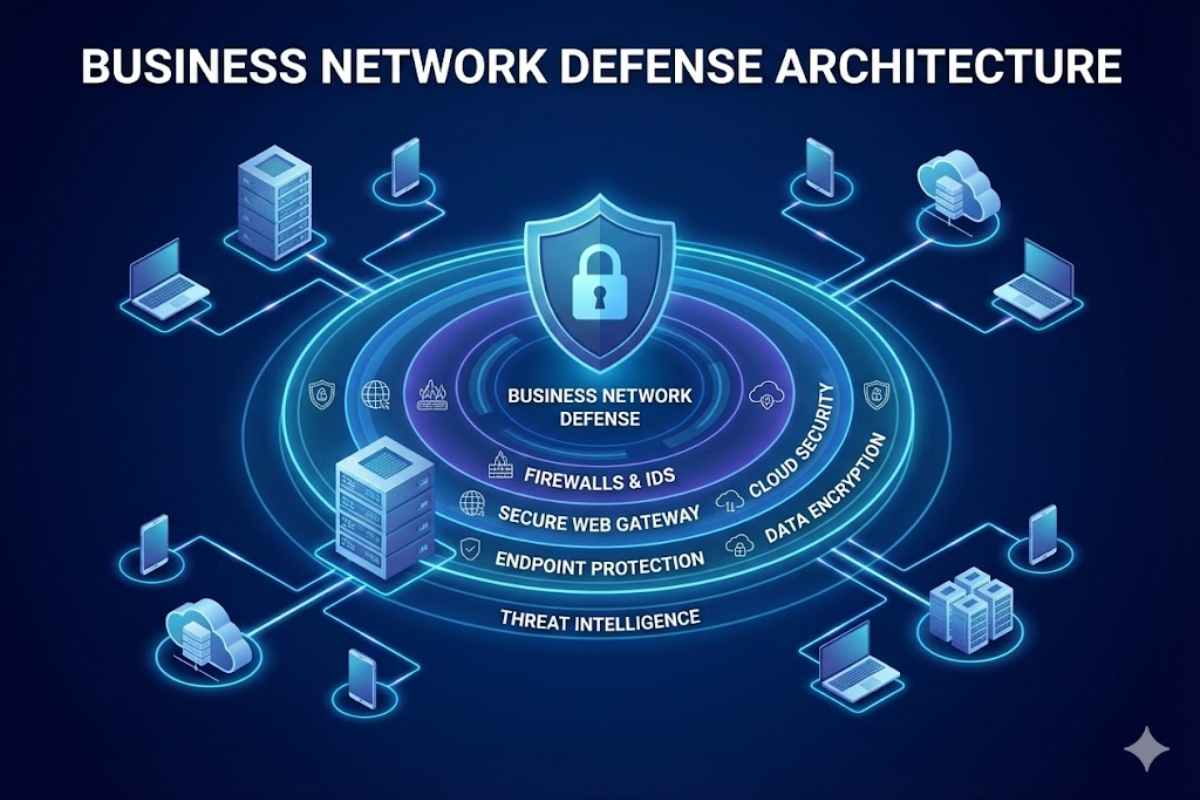
Business networks are under constant attack, and AI has made those attacks smarter, faster, and harder to detect. Breaches now cost organizations an average of USD 4.44 million globally, even after a recent 9% drop driven by faster detection and response.
This guide shows what “business network defense” really means in 2025 and how to prioritize action, not just buy more tools.
Table of Contents
Quick answer: What is business network defense?
Business network defense is a layered security approach that protects your infrastructure, data, and operations across on‑prem, cloud, and remote environments. It combines:
-
Identity‑centric access controls (Zero Trust, MFA, SSO)
-
Continuous monitoring and security analytics
-
Endpoint protection and encryption
-
Network segmentation and next‑gen firewalls
-
Ongoing security awareness for employees
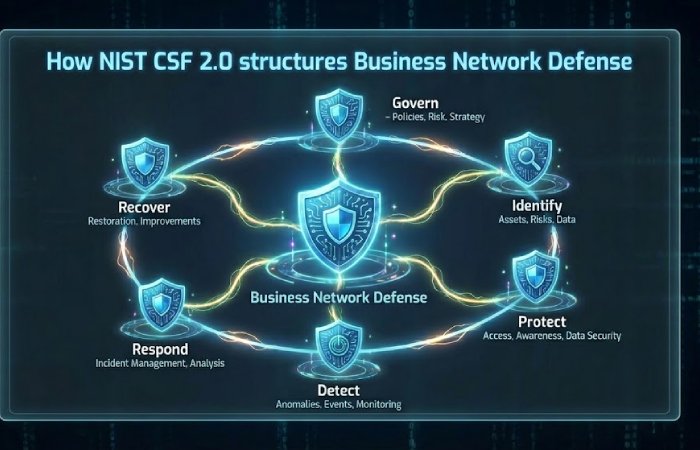
The NIST Cybersecurity Framework 2.0 organizes these efforts into six functions—Govern, Identify, Protect, Detect, Respond, and Recover—so you can build a coherent, risk‑based program instead of scattered point fixes.
The official NIST Cybersecurity Framework 2.0 documentation makes clear that these six functions are designed to work together, giving organizations a structured way to align identity, network, endpoint, and incident‑response controls with a consistent risk‑management strategy.
Establish a Strong Network Architecture
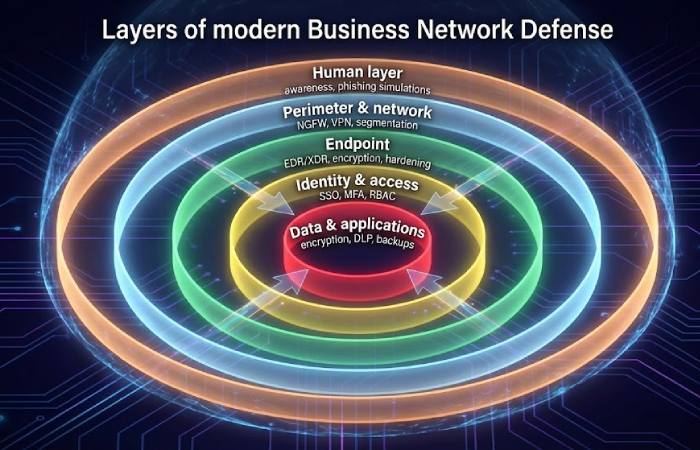
Building a secure network starts with designing an architecture that limits exposure to risks. Consider using a layered approach to separate critical business functions from less sensitive ones.
For instance, placing your web servers in a demilitarized zone (DMZ) and separating them from internal resources like databases can reduce the impact of a potential breach.
Designing your network to minimize access points and control traffic flow will make it harder for attackers to gain entry.
For example, using SonicWall firewalls as part of your network security strategy can significantly enhance your protection by monitoring incoming and outgoing traffic and blocking potential threats before they can compromise your system.
Network breach impact statistics for 2025
| Metric | 2025 snapshot (global) |
|---|---|
| Average cost of a data breach | ~USD 4.44 million per incident |
| With security AI & automation | Breach lifecycle ~80 days shorter |
| Phishing / social engineering | Still among top initial attack methods |
| AI‑assisted incidents | About 1 in 6 breaches involve AI tactics |
1. Make Zero Trust Your Default Assumption
Perimeter‑only security doesn’t work in a world of hybrid work, SaaS apps, and cloud infrastructure. Zero Trust assumes that no user, device, or workload is trusted by default, even on “internal” networks.
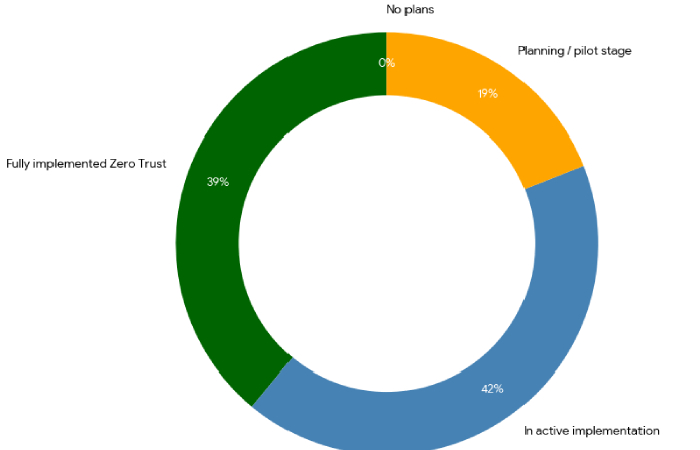
Recent surveys show around 81% of organizations have fully or partially adopted a Zero Trust model, and analysts expect most enterprises to treat Zero Trust as their primary security strategy by the end of 2025.
Recent industry surveys compiled in key Zero Trust statistics for security leaders report that 81% of organizations have either implemented a Zero Trust model or are actively rolling one out, with many CISOs now treating Zero Trust as the default blueprint for enterprise network protection rather than an optional add‑on.
Key steps:
-
Enforce strong identity and MFA for all remote and privileged access.
-
Grant least‑privilege access and review rights regularly.
-
Use network and micro‑segmentation to contain lateral movement.
-
Continuously monitor sessions and re‑evaluate trust based on behavior.
Industry analyses like key zero trust statistics for security leaders highlight that organizations using Zero Trust report improved user trust and lower incident impact when accounts or devices are compromised.
Zero Trust adoption across organizations (2025)
2. Treat AI‑Powered Attacks as “Normal,” Not Exceptional
AI has moved from buzzword to everyday attack tool. Phishing, deepfake voice calls, and automated reconnaissance are now often AI‑assisted, not handcrafted.
IBM’s latest breach research shows that faster containment is increasingly driven by AI‑assisted security tools, while separate 2025 surveys report that a large majority of organizations have already faced at least one AI‑driven cyberattack.
According to the latest IBM Cost of a Data Breach Report 2025, organizations that deploy security AI and automation extensively cut their breach lifecycles by around 80 days and save up to USD 1.9 million per incident compared with those that do not.
Practical moves:
-
Deploy EDR/XDR and SIEM platforms that use machine learning to detect anomalies, not just signatures.
-
Automate key response steps (isolating endpoints, disabling accounts, blocking IPs) for high‑confidence alerts.
-
Inventory and govern your own AI and “shadow AI” use so models and integrations do not become a new attack surface.
Analyses of the 2025 Cost of a Data Breach Report show organizations with extensive security AI and automation cut breach lifecycles by around 80 days and save up to USD 1.9 million compared with those without such capabilities.
3. Put Identity and Access Management First
Most breaches still start with stolen or abused credentials. Phishing and compromised accounts remain leading initial attack vectors and are closely tied to both AI‑generated emails and social engineering.
Focus your identity layer on:
-
Centralized directories and SSO so you can enforce consistent policies and de‑provision fast.
-
Phishing‑resistant MFA (FIDO2, strong push, security keys) across VPN, email, admin tools, and critical SaaS apps.
-
Enterprise password managers to raise password quality, especially for long‑tail tools.
-
Clean joiner‑mover‑leaver processes and regular access reviews.
Within NIST CSF 2.0, identity management sits squarely in the Protect and Govern functions, reflecting its central role in modern network defense.
If you need a simpler way to communicate this to business stakeholders, it can help to frame it as part of a broader shift in identity and access management trends—from static usernames and passwords toward continuous verification, contextual access, and tighter control over who can reach what, from where. This kind of overview shows leaders why investments in SSO, MFA, and access reviews are not “IT nice‑to‑haves” but core to keeping customer and business data safe.
Limit user privileges and access
In many real‑world breaches, attackers succeed because they abuse an insider account or a compromised set of credentials, not because they “break” the firewall.
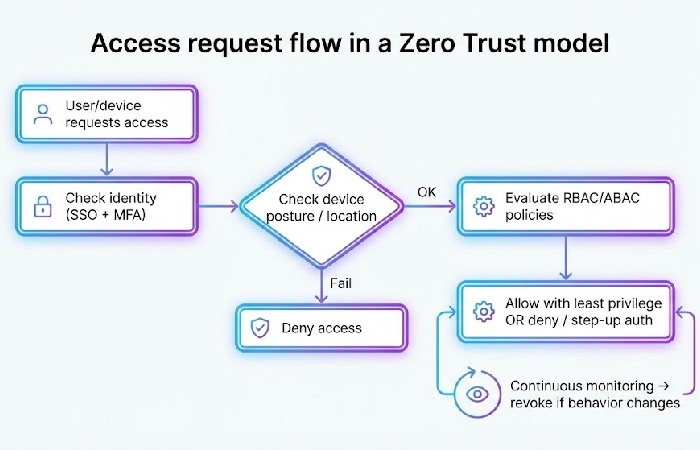
Limiting user privileges so employees and vendors can access only what they truly need, and enforcing least‑privilege policies consistently, dramatically reduces the damage a single compromised account can cause.
Additionally, using role‑based access control (RBAC) to assign and review permissions helps prevent unauthorized access to sensitive systems and data while keeping access changes manageable over time.
Identity and least‑privilege access flow
4. Encrypt Devices and Data by Default
Lost and stolen devices are still a common source of data exposure, especially in small and mid‑sized organizations. Encryption doesn’t fix everything, but it can turn many physical‑loss incidents into non‑events.
Baseline steps:
-
Enable full‑disk encryption (BitLocker, FileVault, LUKS, mobile equivalents) across laptops and mobile devices.
-
Enforce strong device lock and key‑management policies.
-
Use TLS 1.2+ (ideally 1.3) everywhere for data in transit, plus VPNs for untrusted networks.
Using a VPN is especially important for remote staff who connect over hotel, café, or home networks you do not control.
A practical way to explain this to non‑technical users is to compare public Wi‑Fi to a loud room where everyone can hear you, and a VPN to a private, encrypted tunnel that hides what you are doing from eavesdroppers.
For step‑by‑step, user‑friendly guidance, you can point them to a clear primer on how VPNs protect online privacy and data security that walks through benefits, risks, and real‑world examples in plain language.
The NIST CSF 2.0 data protection guidance explicitly calls out encryption as a core safeguard for protecting confidentiality, integrity, and availability, and regulators often treat strong encryption as a key mitigating factor when assessing breach notifications.
5. Harden Email Against Phishing and Business Email Compromise
Email is still where many attacks begin. Modern phishing blends AI‑generated content, brand impersonation, and urgency to trick users and bypass simple spam filters.
Essential layers:
-
Configure SPF, DKIM, and DMARC correctly to reduce spoofing of your domain.
-
Use advanced email security to scan links, attachments, and behavior, not just sender reputation.
-
Run regular phishing simulations and targeted training for high‑risk roles (finance, HR, executives).
Frameworks like the NIST Cybersecurity Framework emphasize secure email, identity, and user awareness as critical parts of the Protect and Detect functions, linking them directly to reduced breach likelihood and impact.
6. Upgrade to Next‑Generation Firewalls and Segment Internally
Classic port‑only firewalls can’t see what’s happening inside encrypted, application‑level traffic. Next‑Generation Firewalls (NGFWs) give you the visibility and control needed for modern threats.
What to prioritize:
-
Application‑aware policies: control traffic by app and user, not just ports.
-
TLS inspection on high‑value paths (where compliant and appropriate) to catch malware and command‑and‑control traffic inside HTTPS.
-
Internal segmentation: VLANs, internal firewalls, and DMZs isolating critical systems and departments.
Research on Zero Trust adoption and segmentation practices shows that organizations using segmentation and application‑aware controls significantly reduce lateral movement and the blast radius of successful compromises.
7. Centralize Logging and Continuous Monitoring
Without good logs, you can’t investigate incidents, prove what happened, or improve. With them—and with analytics—you can spot and contain issues far earlier.
Practical foundation:
-
Collect logs from identity providers, endpoints, firewalls, servers, cloud platforms, and key apps into a SIEM or log platform.
-
Normalize time (NTP, common time zone) so incidents can be reconstructed accurately.
-
Focus alerts on patterns that require human action: unusual admin behavior, large or unusual data transfers, suspicious new devices, and repeated failed logins.
Analyses of the IBM Cost of a Data Breach 2025 find that organizations with strong logging, monitoring, and AI‑driven analytics detect and contain breaches significantly faster, which directly lowers average incident cost.
8. Move Beyond Legacy Antivirus on Endpoints
Signature‑only antivirus cannot keep up with polymorphic malware, fileless attacks, and living‑off‑the‑land tactics. 2025 endpoint‑security guidance emphasizes behavior‑based detection and comprehensive visibility.
Aim for:
-
EDR/XDR agents that watch processes, network connections, and file behavior to flag suspicious activity in real time.
-
Application allow‑listing where feasible, especially for servers and high‑value endpoints.
-
Centralized management for policies, alerts, and remote response (quarantine, process kill, forensic triage).
Modern endpoint tools feed telemetry into your analytics stack, which improves both detection quality and incident response speed.
9. Turn Employees into Part of Your Detection Surface
Human error is still involved in most successful attacks, and AI‑powered social engineering targets people as much as systems. Training is not a checkbox; it’s a continuous behavior‑change program.
Focus on:
-
Clear onboarding: passwords, MFA, data handling, and how to report suspicious activity.
-
Role‑specific training: finance for wire fraud, HR for attachment‑heavy resumes, executives for “whaling.”
-
Frequent, realistic phishing simulations with coaching, not blame.
Industry surveys on AI‑driven cyber‑risk and user behavior show that organizations investing in targeted awareness and simulation see fewer successful phishing attempts and faster reporting of suspicious activity.
Use NIST CSF 2.0 as Your Roadmap
To tie all these tactics together, map them to NIST Cybersecurity Framework 2.0:
-
Govern – Define risk appetite, roles, and policies.
-
Identify – Know your assets, dependencies, and critical processes.
-
Protect – Identity, network, endpoint, data, and awareness controls.
-
Detect – Monitoring, analytics, and alerting.
-
Respond – Playbooks, incident teams, communication.
-
Recover – Backup, restoration, and lessons learned.
The official NIST Cybersecurity Framework 2.0 documentation and practitioner guides make it clear that this structure is now the reference point many regulators and industries expect you to align with.
What this delivers vs. typical pages
Compared with many top‑ranking “business network security” articles, this version:
-
Uses current numbers from the IBM Cost of a Data Breach Report 2025 instead of pre‑2023 averages.
-
Reflects real Zero Trust adoption and segmentation statistics from 2025 surveys, not just theoretical arguments.
-
Aligns every major recommendation to an explicit function in NIST CSF 2.0, giving you a roadmap you can actually execute.
Conclusion
A strong network defense is built through a combination of strategies that address both technical and procedural vulnerabilities. By employing a layered security approach, adopting zero trust, securing endpoints, and preparing for potential incidents, you can dramatically improve your network’s resilience.
Cyber threats are persistent, but with the right planning and execution, your business can build a network that stands strong against even the most determined attackers.
Frequently asked questions about Business Network Defense
1. What is Business Network Defense?
Business Network Defense is the combination of tools, policies, and processes that protect your organization’s network, devices, and data from cyber threats, across on‑prem, cloud, and remote environments.
2. Why is Business Network Defense important in 2025?
Breaches now cost organizations an average of about USD 4.44 million globally, and attackers increasingly use AI to scale phishing and identity‑based attacks, so strong network defense is directly tied to financial and operational survival.
3. Is Zero Trust only for large enterprises?
No. Zero Trust can be rolled out in phases, starting with MFA, identity, and basic segmentation, and there is specific Zero Trust guidance for small businesses that shows how SMBs can adopt it without enterprise‑level budgets.
4. What are the first steps to improve Business Network Defense?
Turn on MFA everywhere, patch critical systems, enable full‑disk encryption on devices, configure SPF/DKIM/DMARC for email, and centralize basic logging so you can actually see what’s happening on your network.
5. How does AI help defenders, not just attackers?
Security teams increasingly use AI‑powered EDR/XDR and SIEM tools to detect anomalies, automate containment, and shorten breach lifecycles, which IBM’s 2025 Cost of a Data Breach Report links to significantly lower average incident costs.
6. How often should a business review its network security?
At minimum, review Business Network Defense quarterly for vulnerabilities and access issues, and perform at least one full annual assessment aligned with frameworks like NIST Cybersecurity Framework 2.0.