

Parents in India who type statekaidz.com into a browser often see something strange. Instead of a kids’ learning site, they land on a gambling or lottery‑style page that has nothing to do with education.
Then Google shows a mix of glowing blog reviews and a “Welcome to StateKaidz.com – The Ultimate Smart Learning Platform for Children” page on a slightly different domain, statekaidzz.com. Confusing is an understatement.
This guide sorts that out and throws in a real, India specific review of StateKaidz, as a kids Learning App: what it actually is, which website is authentic, how safe it looks, and whether it is worth paying for it, as an add on, when you‘ve other options like Khan Academy Kids, BYJU‘S or Vedantu.
In case you just have a minute, such pointers quickly touch base on what most Indian parents are trying to understand even before getting to the official site:
Table of Contents
Quick Answers for Busy Parents
- Which website is the true StateKaidz.com? -> The original **statekaidz.com** has a very confusing history and now aliases to gambling/lottery pages, so you should ignore it as the official learning site. The active kidslearning sites are now on **statekaidzz.com** (double ‘z’), while the majority of the review blogs still call it “StateKaidz.com”.
- Defines StateKaidz.com? -> An educational website aimed at children approximately 5–13 with game-like activities, videos and quizzes in maths, science, reading and others, plus progress reports for parents and teachers.
- “Is it safe?” -> The learning site claims to be completely adfree with no external links to advertisers and use of SSL encryption, and several review blogs echo that. But much of that is user-based on the site at the time of writing, so parents should check the most recent privacy policy and monitor screen time actively, especially in India where new child data legislation is looming.
- “Does it follow CBSE/ICSE?” -> For most topics, very loosely follows topics globally taught in primary schools rather than specifically mapped to any of CBSE/ICSE/ individually. It makes sense as a conceptrevision and extrapractice aid rather then a full chapterwise examexampreparation resource.
- Is it worth the money vs Indian apps?->For some families wanting a polished, gamified supplement with more well-structured practice, it can be worth a look. For many others, free options like Khan Academy Kids or Indianfirst edtech services might better fit the monthly budget and expectations for local curriculum.
What Is StateKaidz.com (and Which Website Is the Real One)?
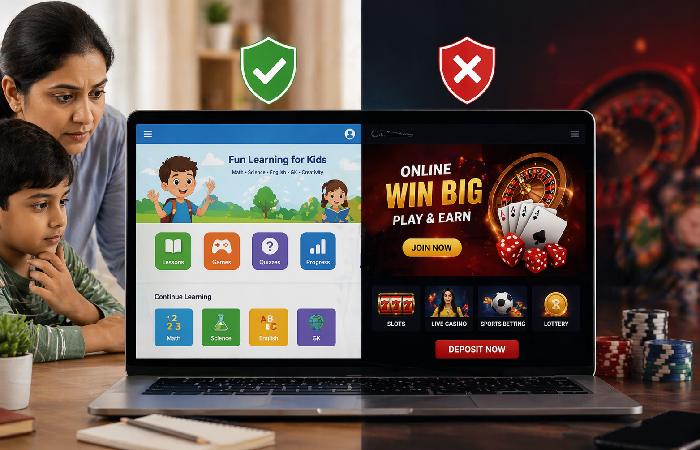
You can’t make a decision until you know which site you’re actually dealing with. This is the messy part.
Short Definition of StateKaidz.com
StateKaidz.com is a kids’ online learning platform for roughly ages 5–13 that offers animated lessons, quizzes, games and challenges in core subjects like maths, science, English, general knowledge and creativity, with a parent dashboard to track progress and an ad‑free, child‑safe design.
That’s the product almost every review page talks about. But it doesn’t live on the obvious domain anymore.
Important: which “StateKaidz” site is the real one?
If you search for “statekaidz.com” on Google, you will find some broken and confusing page copies, which may have been at some point the homepage of the statekaidz.com domain and that used to redirect visitors to odd or potentially unhealthy web sites. In fact, the current kids learning web site is being served by the dns address **statekaidzz.com** (double “z”) where as “statekaidz.com” has a very terrible domain typing history, and once was pointing to something non-educational.
So, before you ‘sign up’ at a site, keep checking the URL in the address bar – it should be httpS://statekaidzz.com-, secure and kidfocused. If you think you‘ve been directed to pages about shopping or a casinostyle site or there‘s something suspicious on the address bar, close the window and then go back from a trusted link.
Domain Confusion: statekaidz.com vs statekaidzz.com vs stateskaidz.com
Here’s what’s actually happening right now:
statekaidz.com– statekaidz.com – currently shows a gambling or lottery‑style storefront with promotional banners and links to an unrelated domain, not to any children’s learning content.statekaidzz.com– hosts the kids’ learning platform home and about pages, describing ages 5–13, interactive subjects, gamified rewards, safety promises and Indian‑friendly positioning.stateskaidz.com– contains a long article titled “StateKaidz.com – Fun & Learning Comes Together!” that explains the same learning product, while the rest of the site now focuses on health and wellness content.
So there are three very different experiences under near‑identical names. That alone will worry many parents. If you decide to explore the learning platform, you should:
- Type
https://statekaidzz.commanually or use a trusted link from a known article. - Check that the page talks about kids’ learning, ages 5–13, subjects like maths and science, and an ad‑free experience, not lottery entries or slot games.
- Avoid any page under this brand that suddenly shows gambling banners, random shopping catalogues, or sign‑up forms that don’t mention children or parents.
Is this ideal branding? No. But at least you know what’s going on.
Is StateKaidz.com Safe and Legit for Indian Kids?
This is likely your main question. You’re not just judging content — you’re judging the people behind it and how they handle your child’s data.
And for parents in India, they really have to look across multiple websites, and one that might be a good starting point is a summary of India’s legislation and regulation around online child protection that describes how legislation such as the IT Act, POCSO and the 2021 Intermediary Guidelines shape platforms and content aimed at minors.
Safety and Privacy Claims (Ads, Tracking, COPPA)
On its about and home pages, the learning platform makes several clear promises:
- No advertisements
- No external links
- No tracking cookies
- A closed, child‑friendly interface
- Encrypted security for user accounts
- Age‑appropriate lessons created by a team that includes educators and child‑psychology specialists
Several independent review blogs repeat these points almost word for word and describe the site as “safe, ad‑free and COPPA‑compliant.”
COPPA is a US law that sets rules for collecting data from children under 13, including parental consent requirements for child‑directed services. If the platform genuinely follows those standards, that’s a positive sign — even though COPPA itself doesn’t come from India.
But safety isn’t only about laws and cookies. You still have two other layers to think about:
- Screen‑time and mental health
- Indian data‑protection context
In terms of screentime, from the World Health Organization (WHO) to American Academy of Pediatrics (AAP) the recommendations now play less with a single number and more with decreasing sedentary use of the screen, monitoring content quality, and making sure that the screen does not take away from sleep, exercise, and family.
The new Digital Personal Data Protection Act (DPDPA) in India offers additional safeguards for children on tracking and targeted advertising and already researchers have noted that Indian internet users are very wary of their data. A children’s platform that is genuinely free of behavioural advertising and collect minimal data is along those lines.
Domain History, Scam Warnings and Brand Red Flags
Here’s the awkward part.
Several “is it legit or scam?” websites and older reviews document that the statekaidz.com domain has changed hands and purposes multiple times over the years: business site, general blog, inactive domain, and now gambling. Other pages describe generic e‑commerce‑style red flags on a past version:
no clear about page, recycled images, over‑hyped offers.
Today, when you open statekaidz.com, you see a full gambling storefront with promo banners and “slot” marketing, not any education content.
That doesn’t automatically mean the learning product described on statekaidzz.com is unsafe.
It does mean:
- The brand has very poor domain hygiene.
- Someone let the “obvious” domain drift into completely different hands.
- Parents must double‑check where they actually sign up.
A serious education company usually keeps tight control of its main domain and redirects old versions cleanly. The current situation looks sloppy, at best.
If you feel uneasy because of this, you’re not overreacting. That’s a sensible response.
Safety Checklist for Indian Parents
Here’s a practical way to handle this:
- Check the URL carefully
- Only use
statekaidzz.comfor the learning platform. - Avoid entering any card or UPI details on
statekaidz.comwhile it remains a gambling site.
- Only use
- Read the privacy policy and terms before you pay
- Look for clear statements about data used, data sharing, and parental consent.
- If language feels vague or copied, slow down.
- Start with a trial and a parent account first
- Explore lessons yourself.
- See what data the dashboard shows, and how easy it is to cancel.
- Use device‑level controls and AAP‑style media planning
- The AAP now recommends creating a family media plan that balances online tools with sleep, schoolwork, and play, rather than obsessing over a fixed hour limit.
- Keep the device in a common room for younger kids.
- Watch support responsiveness
- Send one support question before you commit to a longer plan.
- Slow or vague replies are a sign to keep it as a short‑term experiment.
This doesn’t guarantee perfection. It does reduce obvious risk.
From a learning-content point of view, StateKaidz.com currently feels more like a broad international primary–middle school curriculum than a tightly mapped CBSE, ICSE or state-board textbook replacement. That’s not necessarily a problem, but it does mean Indian parents usually treat it as extra practice and concept reinforcement – picking topics that match what the child is doing in class that week, rather than expecting every chapter and exercise to line up perfectly with the school book.
Features, Subjects and Learning Experience on StateKaidz.com
Once you get past the domain confusion, the actual learning environment looks fairly standard for a modern kids’ app — animated lessons, quizzes, rewards, and dashboards.
Ages, Classes and Subjects Covered
The home and about pages describe StateKaidz as built for children between about 5 and 13 years old, covering early primary through middle‑school content.
Most reviews and the stateskaidz.com article agree that the platform covers:
- Mathematics- basic numbers, operations, shapes, fractions, measurements, story problems.
- Science– daily objects and not all man-made such as plants/animals/family, weather and simple physics knowledge simple experiments.
- English / Reading– vocab. Spelling, grammar, reading comprehension, stories.
- Social Studies/ General Knowledge- people and places, geography, history snippets.
- Creativity & Cognitive Skills– puzzles, thinking problems, memory games, and (sometimes) beginning to learn coding.
For Indian parents, you can roughly map this to KG to Class 7/8 topics, but not to a precise CBSE chapter list. You’ll still need to match topics against your child’s textbook.
Gamified Lessons, AI‑Powered Paths and Rewards
Every review leans heavily on three ideas: fun, personalization, and rewards.
Here’s what that looks like in practice:
- Short animated lessons introduce a concept with narration and visuals.
- Kids then answer quizzes, tap through games or solve puzzles to check understanding.
- The system tracks performance and adjusts difficulty using simple AI rules: easier tasks if a child struggles, tougher questions when they do well.
- After each activity, children earn stars, badges, trophies, certificates and level‑ups that accumulate over time.
This kind of pattern is everywhere in kids’ learning tools, but it does help some children engage longer than with static worksheets.
There’s a catch though. Kids who already find it hard to stop playing mobile games may treat this like another endless source of rewards. That’s where your rules around time limits and session length matter more than any built‑in point system.
Parent/Teacher Dashboards and Progress Reports
One of the more genuinely useful features is the parent dashboard.
Across StateKaidz’s own pages and multiple reviews, you see recurring mentions of:
- Per‑child profiles for families with more than one child.
- Views of time spent, lessons completed, quiz scores, and topics attempted.
- Flags for areas where a child struggles, so you can focus revision.
Teachers and homeschooling parents are mentioned too, although there’s less detail about school‑wide dashboards in the public material.
Used well, this data can help you spot patterns — for example, a Class 4 child consistently getting fraction questions wrong or spending most time on only one subject. On the other hand, if you never log in, the dashboard doesn’t change much in real life.
Pricing, Plans and Value in India
Money matters, especially when pricing is in USD and your income is in INR.
Plans, Free Trial and Approximate INR Costs
Review articles and the stateskaidz.com piece describe a pricing structure like this:
- Free trial – usually around 14 days of full access.
- Basic plan – roughly US$10 per month for one child.
- Family plan – around US$19.99 per month for multiple children.
- School plan – custom pricing for classrooms.
Exchange rates move, and review articles may lag behind current offers, but to give a rough sense based on past information:
US$10/month has worked out to roughly ₹830–₹900 in recent examples, and US$19.99/month to around ₹1,650–₹1,800.
Actual INR charges depend on the day’s rate, taxes and any payment‑gateway fees.
Before you commit, check the live payment screen on the official site to see the latest plan names, currency, and the exact amount that will be billed. For a single child, this usually puts StateKaidz in the same rough monthly cost band as many Indian edtech subscriptions, sometimes on the higher side for families on a tight budget.
StateKaidz.com vs Other Kids’ Learning Apps (Feature & Value Table)
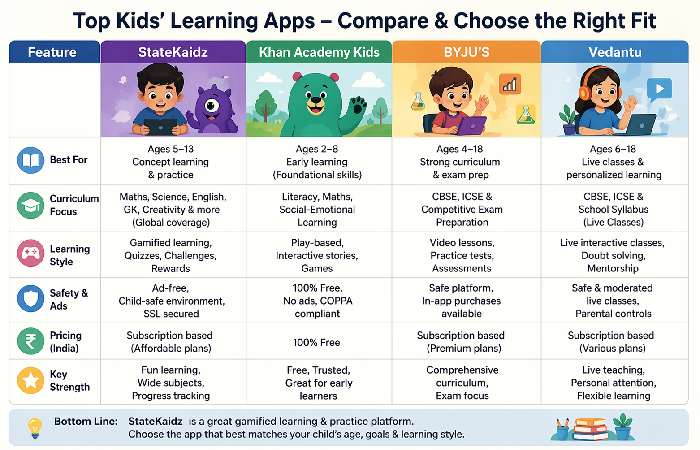
This table uses information from official sites and independent reviews of each platform.
| Platform | Age Range (approx) | Cost (approx, India) | Core Focus | Curriculum Fit for India | Main Strengths | Main Weak Points |
|---|---|---|---|---|---|---|
| StateKaidz.com | 5–13 | ~₹830–₹900/month (1 child), ~₹1,650–₹1,800 family | Gamified lessons across subjects | Global primary topics, not CBSE‑exact | Ad‑free, multi‑subject, strong rewards, parent dashboard, simple interface | USD pricing, domain confusion, weaker India‑specific mapping, requires solid internet |
| Khan Academy Kids | 2–8 | Free | Early literacy, maths, SEL | US‑aligned but concept‑friendly | High‑quality content, completely free, strong research background | Limited India‑specific context, narrower age band |
| BYJU’S (Early/Junior) | K–10 | Varies; often ₹15,000+ per year packages | Animated concept lessons, exam support | Strong CBSE/ICSE focus | Strong brand recognition, detailed syllabus coverage, exam orientation | High cost for many families, sales tactics often criticised, less playful format |
| Vedantu (live classes) | 1–12 | Class‑based fees; often ₹300–₹800+ per live class | Live tutoring, competitive exams | Strong CBSE/ICSE and test prep | Real teachers, live doubt‑clearing, exam‑oriented teaching | Needs scheduled sessions, higher cumulative cost, less “fun app” feel |
StateKaidz sits in an interesting spot:
- More playful and self‑paced than large Indian exam‑prep giants.
- More expensive than pure free options.
- Less tightly connected to CBSE/ICSE than local apps.
For many Indian families, it’ll make sense only as a supplement, not the primary education spend.
How to Decide if StateKaidz.com Fits Your Child
Now the practical part. Should you even try it?
When StateKaidz.com Works Well
StateKaidz tends to fit best when:
- Your child likes colourful, game‑style learning and doesn’t shut down when faced with on‑screen tasks.
- You already cover core schoolwork through school, tuition, or Indian apps, and just want structured extra practice.
- You have reasonably stable broadband at home and a device that can be shared or dedicated for learning time.
- You’ll actually check the dashboard every week or two and talk to your child about what they did.
In that situation, the platform can add:
- Extra maths and reading practice.
- A way to keep skills ticking during holidays.
- Some exposure to coding or logic puzzles.
When Local Alternatives or Free Tools Might Be Better
It may be smarter to skip StateKaidz or keep it very short‑term if:
- Your main goal is CBSE/ICSE exam performance and you need exact syllabus mapping.
- Budget is tight and a US‑priced subscription will squeeze other needs.
- Your child needs Hindi or a regional language first to feel comfortable with content.
- Your home has unreliable internet or limited data.
In those instance, Khan Academy Kids or whatever we get from the school or Indian ones who are operating at your state board will maybe deliver a more tangible benefit per rupee than.
Balancing Screen Time, Curriculum Fit, and Practical Constraints
All of this only works if you keep three things in balance:
- Time – how many minutes per day or week you’re comfortable with.
- Recommendations from organizations such as the World Health Organizationregarding children‘s physical activity, sedentary behaviour and sleep for children aged under 5 years suggest that very young children should have very limited sedentary, non-interactive screen time, and that older children should not have overly-long, non-interactive recreational screen use which displaces sleep and physical activity. Essentially, they are encouraging families to focus more on physical activity, sleep and quality interaction than passive scrolling or continuous viewing.
- Instead of striving for the same ‘right’ number of minutes for every child, the AAP now urges the creation of a family media plan that is flexible and tailored to each child‘s schedules.
- Content match – how closely topics match your child’s class and books.
- You may need to choose units manually to stay aligned with current chapters.
- Family logistics – devices, bandwidth, supervision.
- If screen habits are already a struggle at home, any new app can make that harder unless rules are crystal clear.
This isn’t a magic switch. It’s one tool you can fit into your own plan, or decide to leave aside.
Common Mistakes / Pitfalls to Avoid
A few avoidable errors show up again and again in parents’ stories with similar apps:
- Using the wrong domain
- Landing on
statekaidz.com(gambling) instead ofstatekaidzz.com(learning) and assuming “StateKaidz” is a scam across the board.
- Landing on
- Handing the device to a child without any rules
- Kids drift into marathon sessions because nobody agreed on daily limits or on what happens when a session ends.
- Treating StateKaidz as the only learning tool
- Schoolwork, offline reading, and physical play still matter more for long‑term outcomes than any single app.
- Ignoring billing and cancellation terms
- Forgetting to cancel a trial or not checking how to stop auto‑renew before entering card details.
- Never reviewing what the child is actually doing
- Letting the app handle everything and then being surprised when school performance doesn’t change.
Most of these are in your control. So it’s worth deciding your ground rules before you sign up.
Who This Is For / Who Should Avoid
A quick fit‑check.
Best for:
- Parents in urban or semi‑urban India who are already comfortable paying for international apps.
- Kids who like colourful, game‑style interfaces and don’t get overstimulated too easily.
- Families who want structured extra practice across several subjects rather than heavy exam drilling.
Not a good fit (or use with caution) for:
- Households where budget is tight and free or low‑cost local options are working fine.
- Children who already struggle with self‑control around mobile games.
- Parents who expect exact CBSE/ICSE or state‑board mapping without extra effort.
If you’re on the fence, you can always test the free trial with strict boundaries and see how your child reacts.
Final Verdict / Conclusion
So, is statekaidz.com “good” for Indian kids? The honest answer is: it depends what you expect, and it depends which site you actually open.
- The
.comgambling site is completely unsuitable for children and should be avoided. - The learning platform on
statekaidzz.comlooks like a typical modern kids’ learning tool: ad‑free, multi‑subject, heavily gamified, and reasonably thought through from a safety and UX perspective. - For Indian families, it can work as a supplementary practice platform for maths, reading and general knowledge alongside regular schoolwork, which is also how the Ministry of Education’s PRAGYATA and PM e‑Vidya digital‑learning guidelines describe the role of digital tools.
- A way to add some structured, supervised screen‑time with clear learning goals.
It’s less convincing as:
- A core CBSE/ICSE exam solution.
- A value pick in rupee terms compared with free options and strong Indian competitors.
If you do try it, treat statekaidz.com as a brand keyword rather than a safe URL, use statekaidzz.com, keep screen‑time within your own family limits, and keep expectations realistic. That combination is far safer than blindly trusting glowing reviews or ruling it out just because of sloppy domain management.
Frequently Asked Questions
1. Which StateKaidz.com website is the real kids’ learning platform?
The current kids’ learning platform runs on statekaidzz.com, where you’ll see content about animated lessons, quizzes and an ad‑free environment for children aged roughly 5–13. The bare statekaidz.com domain shows a gambling/lottery storefront that isn’t related to education and shouldn’t be used by children.
2. Is StateKaidz.com safe for Indian children to use?
The learning site states it‘s adfree, no outbound links, no tracking cookies & encrypted security and is COPPAcompliant and childfriendly. There‘s a good start but you should also verify the privacy policy yourself, use device-level controls, control the screentime to recommended levels, eg as directed by WHO, AAP.
3. Does StateKaidz.com follow CBSE or ICSE syllabi?
Not exactly. Public material and reviews show that StateKaidz covers global primary‑school topics in maths, science, English and general knowledge, but it doesn’t publish a detailed CBSE or ICSE chapter mapping. So it works better as a concept‑practice tool than as a strict exam‑prep platform.
4. How much does StateKaidz.com cost in India, and is there a free trial?
Most reviews describe a free trial of around 14 days, a basic plan near US$10/month for one child and a family plan near US$19.99/month for multiple children. Converted roughly, that’s around ₹830–₹900/month for a single‑child plan and ₹1,650–₹1,800/month for the family plan, but you should always check live pricing and any taxes in the payment screen.
Most reviews talk about a free trial of probably 14 days, a single plan around US$10/month per child and a family plan around US$19.99/month for multiple children. Converted roughly that is around ₹830–900/month for a single-child plan and ₹1,650–1,800/month for the family plan, but always check live price and taxes in the payment screen.
5. How does StateKaidz.com compare to BYJU’S or Khan Academy Kids for Indian kids?
Khan academy kids is targeted for early years, is totally free, and has strong educational endorsements behind it but lacks gamification features and it isn’t India-specific. BYJUs and other Indian brands are more prescriptive, maps more tightly to CBSE/ICSE and exam demands, charges higher premium and has a more serious classroom environment. StateKaidz sits somewhere in-between more playful than exam-heavy tools but less specific to Indian syllabi than local brands.
6. How can I limit my child’s screen time while using StateKaidz.com?
The most practical solution is to come up with a family media plan: how many days a week, how many minutes per day, what preconditions (homework, offline game) have to be done before the screentime. Organizations such as the WHO and AAP are more concerned with this balanced approach today rather than one number a day. You can combine this with device‑level limits and by keeping usage in a shared room instead of a bedroom.
7. Does StateKaidz.com follow the CBSE or my state-board syllabus exactly?
Most reviews and the official messaging highlight StateKaidz.com as useful for Pakistani, Indian, Gulf, UK and US students but do not publish detailed CBSE, ICSE or state-board alignment. In reality, the range of topics and skills, including math fundamentals, science topics, reading comprehension, grammar, social studies and cognitive skills, are similar to what Indian children study, just in a different sequence and nomenclature. So you‘ll probably get the best results using it as a flexible supplement: selecting lessons and quizzes that complement what your child‘s school teacher happens to be covering that day, as opposed to using it as a chapter by chapter replacement.
8. Is StateKaidz.com practical to use from India in terms of devices, internet and payments?
The platform is promoted as working across mobiles, tablets and desktop browsers, and review articles show families using it on common Android phones, iPads and laptops. Because subscription prices are usually shown in US dollars, Indian parents typically pay via international-friendly cards or other global payment methods, with the bank converting the charge into INR at the day’s rate. As with any animation-heavy, always-online learning site, you’ll want a reasonably stable broadband or 4G connection; on very patchy or low-bandwidth connections, loading videos and interactive games may feel slower or frustrating compared with lighter, mostly-text apps.
Disclaimer
The details in this guide are for general informational purposes only and do not replace your own judgment as a parent or legal/financial advice. Always review the latest information on the official StateKaidz.com website.
About the Author:
Abdul Rahman, has more than 4 years experience writing about consumer electronics, laptops and IT support solutions in Ireland and the UK. He simplifies complicated repair terms into easy, useful advice so you can be sure of your buying decisions.
Published by: www.technologyford.com a convenient source of content on business, health, technology and lifestyle that strives for relevance and use rather than sophisticated implementations and complex concepts.