

Beyond Word Count: Redefining Long Form Content Through Zero-Search Authority
For years, “long form content” has been treated as a synonym for “more words.” Marketing blogs, SEO tutorials, and agency playbooks have all pushed the same formula: write 2,000+ words, optimize your H2s, add keywords, and wait for rankings.
But that old playbook is reaching its limits. In an AI-saturated landscape, length alone is easy to replicate, and simple aggregation no longer proves expertise.
Today, the real edge is not just how much you write, but how much non‑obvious value each section delivers.
Long form content still works, but only when it combines depth with originality, information gain, and a UX that respects how people actually read.
Table of Contents
Key Takeaways
-
Long-form content is no longer defined by word count.
Authority today comes from information gain, not from hitting arbitrary length thresholds like 2,000+ words. -
Aggregation is a red ocean.
Content that simply compiles what is already available in the SERP forces you to compete on sameness; proprietary insight is what creates a defensible moat. -
Zero-Search Authority is built on proprietary friction.
Exclusive datasets, documented failures, and contrarian theses create value that cannot be scraped, summarized, or copied easily. -
Information density beats information volume.
A smaller number of genuinely new insights is more valuable than exhaustive coverage of what already exists in search results. -
Modular UX is essential for modern long-form content.
Sticky navigation, collapsible sections, and interactive blocks respect user intent and improve engagement—especially on mobile. -
Linear “pillar pages” are often structurally limiting.
Traditional long-scroll pillar pages can still perform when well designed, but they frequently make it harder for readers to navigate, skim, and dive selectively into what matters most. -
Authority must be audited, not assumed.
Every long-form asset should pass an Authority Audit that asks whether the content challenges the status quo, survives AI summarization, and delivers exclusive value. -
E-E-A-T is strengthened by lived experience, not polish.
Demonstrating real expertise through experiments, mistakes, and first-hand insights signals trust more effectively than perfect prose. -
AI raises the bar for human originality.
As AI becomes better at summarization, human content must move upstream—toward insight creation rather than explanation. -
The future of long-form content is intellectual ownership.
The most durable content assets are those that introduce ideas others reference, not guides that simply explain existing ones.
The Limits of the Classic “Ultimate Guide”
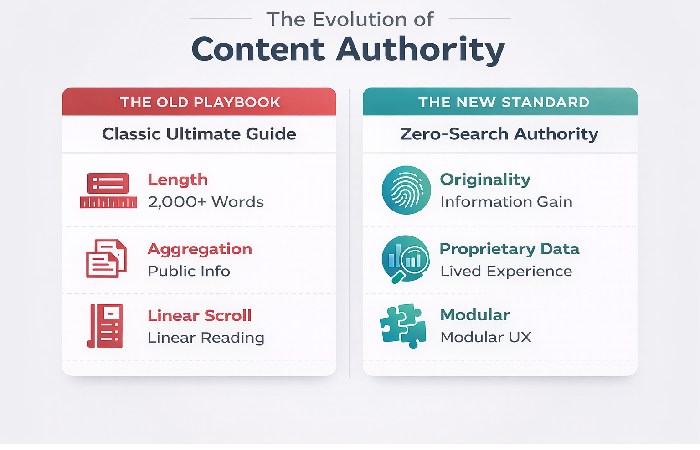
For roughly a decade, correlation studies and case studies helped normalize the idea that “longer is better,” and many successful examples of long-form SEO content reinforced that belief. Those guides typically won by being more comprehensive and better structured than competitors. In 2026, however, “good enough” completeness is widely achievable and no longer a reliable differentiator on its own.
Searchers, and search engines, now expect depth plus evidence of real experience and original thinking. Generic “Ultimate Guides” that stitch together public information still perform in some spaces, but they are increasingly vulnerable: AI tools can paraphrase the same surface‑level knowledge at scale, and users can instantly sense when they are reading yet another rehash.
The underlying shift is subtle but critical:
-
Long form still needs coverage, but coverage is now the baseline, not the moat.
-
Word count can correlate with performance, but it is not a ranking factor and cannot compensate for shallow or derivative insight.
-
The advantage goes to pieces that make readers think, not just scan.
This is where Zero-Search Authority enters.
Zero-Search Authority and Proprietary Friction
This isn’t just theory; research into information gain and modern long-form SEO guidance shows that search ecosystems increasingly reward content that adds new value rather than repeats common advice.
Zero-Search Authority (ZSA) is a strategic lens for long form: instead of competing on how thoroughly you summarize what already exists, you compete on what only you can publish.
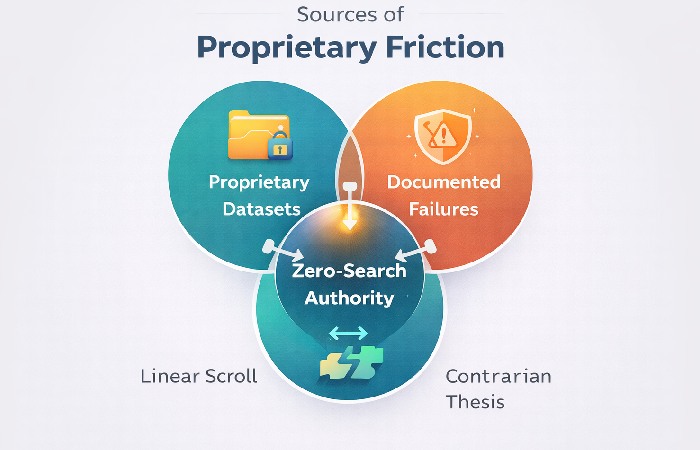
It emphasizes “proprietary friction” – the moments in a piece where the reader encounters something that could not have been generated by scraping, summarizing, or stitching together the top ten results.
Proprietary friction can take multiple forms:
-
Proprietary datasets
-
Anonymized customer data, internal benchmarks, cohort analyses, or original research.
-
Example: A SaaS tool publishing post‑AI adoption usage patterns across thousands of accounts, revealing shifts in feature adoption no public source has documented.
-
-
Documented failures
-
Honest breakdowns of experiments that did not work and the conditions under which they failed.
-
Example: “We shipped a 12,000‑word SEO guide in 2021 — here’s the 800 words that actually drove leads, and what we’d cut today.”
-
-
Contrarian or nuanced theses
-
Thoughtful challenges to accepted wisdom, backed by data or concrete examples.
-
Example: “Why our 900‑word teardown pages now drive more B2B pipeline than our 3,000‑word ‘definitive’ guides.”
-
The non‑negotiable rule: every long form piece must earn its keep with specific, frictional insights.
If a competent AI summarizer can recreate 95% of your content from the live SERP plus your article, you are competing on packaging, not substance. If readers can only get a particular dataset, story, or argument from you, you are building Zero-Search Authority.
In the past, “helpful content” often meant making information digestible and accessible. That still matters.
But in practice, “helpful” for advanced audiences now also means intellectually demanding: original reasoning, real tradeoffs, and lived experience that slows readers down because it is genuinely new, not because it is padded.
From Linear Pillar Pages to Modular Long Form
Search engines reward content that solves intent efficiently — but for humans to consume efficiently, structure matters. A page that asks its reader to scroll for 3,000+ uninterrupted words is unnecessarily frictional, especially when best-practice SEO content UX now emphasizes scannable sections, clear hierarchy, and mobile-friendly layouts.
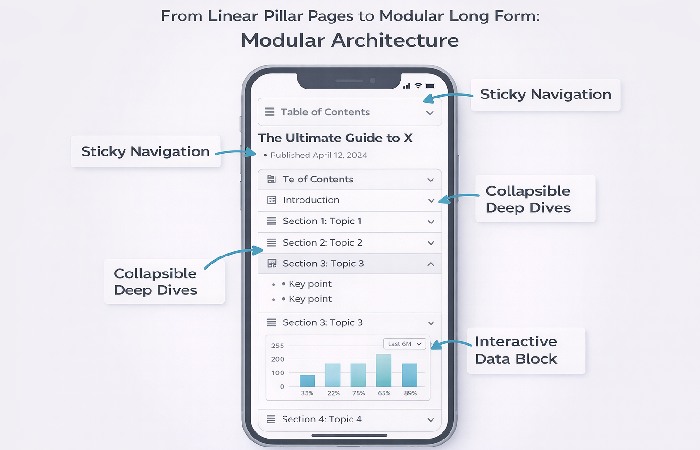
Modern content consumption is modular, mobile, and context‑dependent. Readers arrive with different levels of expertise and micro‑intents. One person wants the high‑level framework; another wants the benchmark chart; a third wants the step‑by‑step audit. For long form to perform, it has to act less like a book and more like a system of connected modules.
A modular Zero-Search Authority piece behaves like this:
-
Collapsible sections
-
Advanced readers can jump to the insight they need; beginners can expand context as required.
-
This lets you maintain depth without forcing everyone through introductory material.
-
-
Interactive or visual data blocks
-
Proprietary datasets are surfaced in charts, filters, or snapshots rather than buried in paragraphs.
-
This gives your unique evidence more weight and makes it easier to recall and cite.
-
-
Sticky navigation and jump menus
-
Readers can move laterally between modules (e.g., from “framework” to “failure case” to “metrics”) without losing their place.
-
This structure respects limited attention and keeps engagement voluntary, not enforced by scroll fatigue.
-
-
Expandable case studies
-
Detailed stories sit behind toggles, so practitioners who need depth can dive in, while others stay in a faster, strategic pass.
-
This UX shift is not just aesthetic. Better structure typically improves time on page, interaction, and reader satisfaction, all of which support the perception of quality. Even though specific behavioral metrics are not publicly confirmed as direct ranking factors, content that users willingly explore, share, and return to tends to perform better over time.
The Authority Audit: Making Originality Measurable
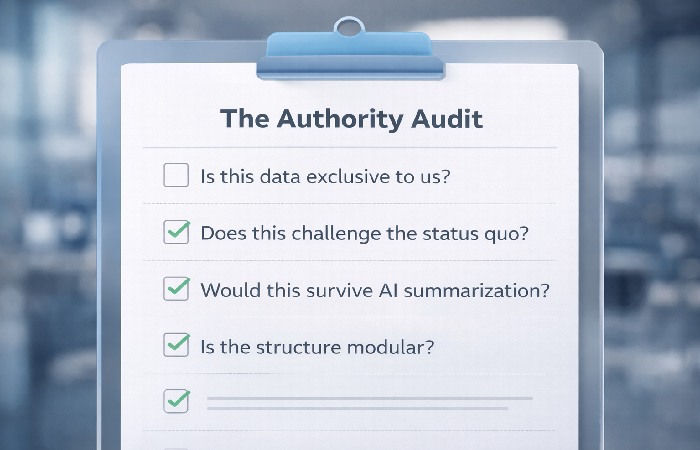
A strong thesis is not enough; Zero-Search Authority has to be operational. Before publishing, you can run an “Authority Audit” on each major section of your long form piece.
Ask:
-
Does this section contain data, examples, or reasoning that do not already appear in the top 10 results?
-
If not, you are aggregating, not advancing the conversation.
-
Aggregation may still be useful for context, but it should not dominate the piece.
-
-
Is there a contrarian, nuanced, or at least clearly differentiated point of view?
-
If you could swap your paragraph with a competitor’s and no one would notice, you are competing on sameness.
-
Differentiation can come from scope (what you include or exclude), interpretation (what the data means), or recommended actions (what you advise people to do differently).
-
-
Does this content retain distinctive value when paraphrased?
-
If an AI summarizer strips away your tone and formatting, would the summary still contain your proprietary data, specific experiments, or unique framework?
-
If all that survives is generic advice, the section lacks defensible substance.
-
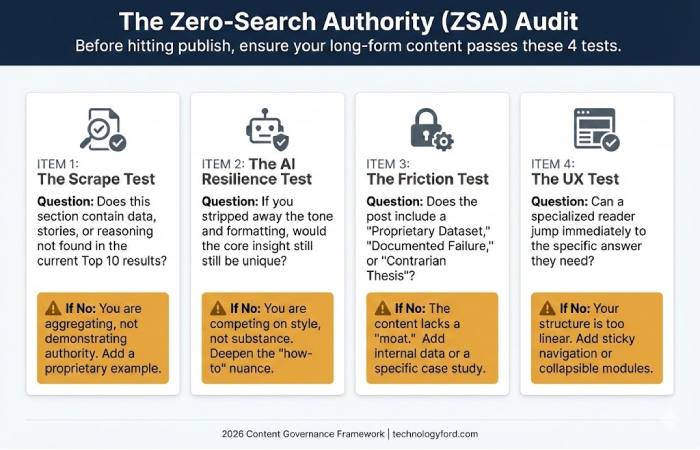
These questions do not guarantee rankings, but they help ensure you are building something that can withstand both algorithm updates and AI‑driven content commoditization.
Turning Zero-Search Authority into a Governance Framework
To move from philosophy to practice, you can codify Zero-Search Authority into a lightweight content governance framework.
1. Define ZSA Criteria for Every Long Form Asset
For each new piece, require:
-
Proprietary dataset
-
Source: internal analytics, anonymized user research, survey data, product telemetry, or unique market mapping.
-
Verification: a clear source note, appendix, or methods section.
-
-
Documented failure or behind‑the‑scenes story
-
Source: real campaigns, launches, or experiments that did not go as planned.
-
Verification: a dedicated subsection summarizing the setup, outcome, and lessons (not just a passing mention).
-
-
Contrarian or sharpened thesis
-
Source: a position that meaningfully refines or challenges a common best practice.
-
Verification: one or more clearly articulated claims plus supporting evidence or argumentation.
-
-
Modular architecture
-
Requirement: the article is structured into self‑contained modules (sections, cards, or blocks) with clear headings and navigational affordances.
-
Verification: UX checklist — internal review of headings, table of contents, collapsible elements, and readability on mobile.
-
-
Explicit information gain
-
Requirement: each core section introduces at least one concept, entity, relationship, or dataset that is not present in the current top results for your target query cluster.
-
Verification: compare your outline and key points against live SERP content using your SEO tools and qualitative analysis.
-
This turns ZSA from a vague aspiration into a repeatable standard that content, SEO, and product marketing teams can align around.
2. Map Your Language to Search Reality
To keep this approach compatible with how search quality is evaluated:
-
Use “information gain” as a working concept: each major section should add something new beyond what a searcher would have already seen in other high‑ranking pages.
-
Create an internal “originality score” for drafts: for example, count how many sections rely on proprietary data, new frameworks, or non‑obvious synthesis versus re‑explaining basics.
-
Align the framework with signals like experience, expertise, authoritativeness, and trust: highlight who ran the experiments, how the data was collected, and what risks or limitations exist.
You are not recreating Google’s internal systems; you are building a house style that nudges content toward the same kinds of qualities that tend to be rewarded: depth, originality, and authenticity.
Format and UX: Designing for Advanced Readers
Zero-Search Authority targets readers who are already conversant in the basics. The way the content feels should signal that it respects their time and intelligence.
Practical implications:
-
Modular, not linear by default
-
Structure the content so readers can scan high‑level modules first, then decide where to dig in.
-
Use H2/H3s that reflect specific micro‑intents (e.g., “Audit Questions for Information Gain” rather than “Other Considerations”).
-
-
Metadata clarity
-
Descriptive, intent‑aligned headings and subheadings help both users and crawlers understand what each section delivers.
-
This makes it easier to earn featured snippets and sitelinks for subtopics within your long form.
-
-
Transparent, thoughtful citations
-
When you reference external research, patents, or public benchmarks, cite them clearly and explain context and limitations.
-
This supports perceived trustworthiness and invites readers to evaluate the evidence themselves.
-
-
Reader agency by design
-
Provide obvious routes to the most proprietary sections: jump links to your primary dataset, the biggest failure story, or the central contrarian argument.
-
Treat those as your content’s “anchor assets” — the parts that truly differentiate you.
-
Despite shifting algorithms, multiple analyses of in-depth content performance continue to show that comprehensive, well-structured articles can improve SEO by attracting backlinks, supporting topic authority, and increasing on-page engagement — but the key differentiator isn’t length alone, it’s novelty, structure, and strategic insight, exactly what Zero-Search Authority emphasizes.
Strategic Payoff: From Commodity Content to Intellectual Moat
When you contrast classic long form with a Zero-Search Authority approach, the difference is less about length and more about defensibility.
-
Differentiation
-
Traditional long form often competes in a crowded field of similar guides, differentiated mainly by branding and formatting.
-
ZSA‑driven content leads with proprietary data, uncommon stories, and strong viewpoints, making it harder to recreate and easier to remember.
-
-
Resilience in an AI era
-
Commodity guides are easy for AI to approximate, which raises the baseline quality but compresses differentiation.
-
Content anchored in non‑public data, nuanced interpretation, and lived experience remains valuable even when summarization tools enter the workflow.
-
-
Audience quality
-
Classic guides skew toward beginners and broad informational traffic.
-
ZSA content is built to resonate with advanced practitioners, buyers closer to key decisions, and peers who influence your category.
-
-
Ranking and brand value
-
Traditional long form leans on topical coverage and word count as indirect signals.
-
ZSA content aims for information gain, experience signals, and a clear sense that the brand behind it is pushing the field forward.
-
In a world where anyone can generate an “ultimate guide” in minutes, the sustainable advantage is not being longer, but being unmistakably yours.
Zero-Search Authority gives long form content a new job: not just to attract clicks, but to encode your unique data, experiments, and worldview into assets that competitors — and AI models — have to react to rather than merely imitate.
Disclosure:
This article draws on publicly available guidance from Google’s people‑first content documentation, as well as contemporary long‑form SEO resources and peer articles, to ensure the recommendations reflect current best practices in search, UX, and content strategy. It was developed with the assistance of AI tools and then extensively reviewed, edited, and fact‑checked by a human SEO strategist.
About the Author
Abdul Rahman is a professional content creator and blogger with over four years of experience writing about technology, health, marketing, productivity, and everyday consumer products. He focuses on turning complex topics into clear, practical guides that help readers make informed decisions and improve their digital and daily lives.