

Every year, a new wave of technology trends promises to reshape how businesses operate, how people work, and how industries compete. Most of those promises land somewhere between premature and partially true.
But 2026 is different. This is the year artificial intelligence stops being an experiment and starts becoming infrastructure. Cloud architectures are being redesigned from the ground up. Cybersecurity is racing to catch up with threats that AI itself creates. And entire organizations are restructuring around technologies that barely existed three years ago.
This guide breaks down the 10 most important technology trends shaping 2026 — with real data, honest maturity assessments, and specific guidance on what to act on now versus what to watch from a distance.
Table of Contents
Key Takeaways
- What are the biggest technology trends? → AI maturation, agentic AI, Cloud 3.0, cybersecurity evolution, and physical AI lead the list
- Why does 2026 matter? → AI shifts from pilot programs to enterprise backbone — 99% of IT organizations are restructuring
- Which trends are overhyped? → Quantum computing is promising but pre-commercial for most businesses
- Who should care? → CTOs, IT leaders, career switchers, and investors evaluating where to place bets
- What should you do? → Focus on AI readiness, cloud modernization, and cybersecurity — skip trends that don’t match your maturity level
What Are Technology Trends and Why Do They Matter in 2026?
Technology trends are patterns of innovation and adoption that reshape industries, business models, and daily life over a defined period. They represent the technologies gaining traction, investment, and real-world impact — not just hype.
In 2026, these trends matter more than usual because several forces are converging simultaneously. AI has crossed the threshold from experimental to operational. According to Deloitte’s 2026 Tech Trends report, only 1% of IT leaders report that no major operating model changes are underway. That means 99% of technology organizations are actively restructuring.
Meanwhile, cloud infrastructure is being rebuilt to support AI workloads. Cybersecurity threats are evolving alongside the tools designed to stop them. And the cost dynamics of AI are creating paradoxes that most organizations haven’t figured out yet.
Understanding which trends are mature enough to act on — and which are still speculative — is the difference between strategic investment and wasted budget.
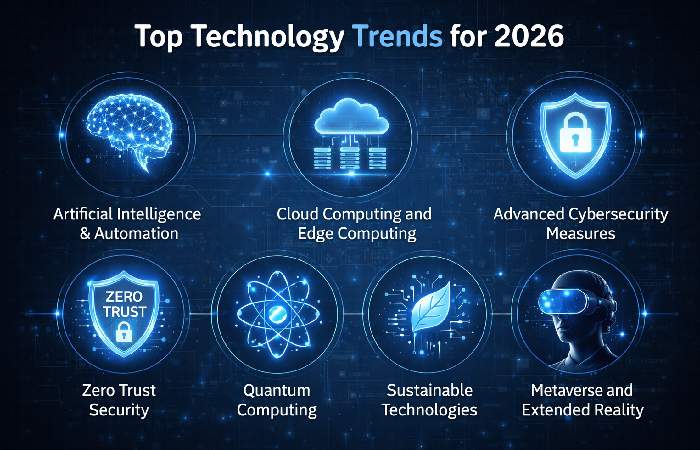
Top 10 Technology Trends Shaping 2026
1. AI Becomes the Enterprise Backbone

Artificial intelligence is no longer a feature bolted onto existing systems. In 2026, AI is becoming the foundational layer that enterprise architecture is built around.
Capgemini’s TechnoVision 2026 analysis calls this “The Year of Truth for AI” — the moment organizations shift from isolated proofs of concept to coherent, adaptive, and trusted value systems. This transformation demands governance, cultural readiness, and data infrastructure changes that go far beyond installing new software.
What’s changed: AI is embedded in decision-making, operations, and customer experience — not just data analysis. Organizations that treated AI as a side project are now racing to make it structural.
Business impact: Companies with mature AI integration report faster decision cycles, reduced operational costs, and measurable competitive advantages. But the gap between AI leaders and laggards is widening rapidly.
2. Agentic AI and Multi-Agent Systems
The most significant AI development in 2026 isn’t a bigger model — it’s AI that can act independently. Agentic AI refers to systems that can plan, execute, and adjust tasks without continuous human prompting.
Here’s the reality check: only 11% of organizations have AI agents in production, despite 38% running pilots. Gartner predicts that 40% of agentic AI projects will fail by 2027 — not because the technology fails, but because organizations automate broken processes instead of redesigning operations.
The pattern separating success from failure? Redesign workflows first, then deploy agents. HPE’s CFO captured it clearly: “We wanted to select an end-to-end process where we could truly transform, not just solve for a single pain point.”
What to watch: Multi-agent systems where modular AI agents collaborate on complex tasks are moving from research to early enterprise deployment.
3. Generative AI Moves Beyond Content
Generative AI in 2026 has evolved past chatbots and content generation. It’s now powering:
- Code generation and software development — developers express intent and AI delivers functional code within modern, secure software development practices using tools such as software composition analysis (SCA) solutions
- Product design and prototyping — AI generates design variations based on constraints
- Scientific research — models accelerate drug discovery and materials science
- Business strategy — AI generates scenario analyses and market models
The paradigm shift is from “writing code” to “expressing intent.” As Capgemini notes, software is becoming self-assembling and self-healing. The competitive edge now hinges on orchestration and governance rather than manual coding.
The cost paradox: Token costs have dropped 280-fold in two years. Yet some enterprises are seeing monthly AI bills in the tens of millions. Usage exploded faster than costs declined. This is one of the most important — and least discussed — dynamics in the technology trends landscape.
4. Cloud 3.0 — Hybrid, Sovereign, AI-Ready

Cloud computing is entering its third major evolution. After a decade focused on migration and cost efficiency, Cloud 3.0 is about becoming the operational backbone for AI workloads, enabling both large enterprises and growing businesses to turn massive data streams into practical, revenue‑driving applications.
The key shift: AI cannot scale on classical public cloud architectures alone. Organizations need to fine-tune models on proprietary data, manage data sensitivity, and deploy low-latency inference. This is pushing adoption of:
- Hybrid cloud — combining on-premises and cloud resources
- Multi-cloud — spreading workloads across AWS, Azure, Google Cloud
- Sovereign cloud — meeting data residency and governance requirements
- Edge-cloud integration — processing data closer to the source
Cloud is no longer a passive infrastructure layer. It’s an active enabler of AI-driven architectures.
5. Cybersecurity in the Age of AI
AI creates a dual challenge for cybersecurity. It’s simultaneously the most powerful defensive tool and the most dangerous offensive weapon.
Key cybersecurity technology trends in 2026:
- Zero-Trust Architecture (ZTA): Organizations adopt “never trust, always verify” security models that authenticate every user, device, and connection — even inside the network
- AI-Powered Threat Detection: Machine learning identifies anomalous patterns faster than human analysts, enabling preemptive defense
- AI Security Platforms: New tools specifically designed to protect AI models from adversarial attacks, data poisoning, and prompt injection
The challenge is real. As AI becomes embedded in critical infrastructure, the attack surface expands dramatically. Security isn’t just an IT function anymore — it’s a board-level strategic concern.
6. Physical AI and Robotics
Intelligence is no longer confined to screens. In 2026, AI is embodied in robots, drones, autonomous vehicles, and smart equipment.
Real-world milestone: Amazon has deployed its millionth warehouse robot, and its DeepFleet AI coordinates entire robot fleets, improving travel efficiency by 10%. BMW’s factories now have cars driving themselves through kilometer-long production routes.
Physical AI represents the convergence of robotics, computer vision, and large language models. Humanoid robots are entering commercial applications, and hyper-automation is expanding beyond manufacturing into healthcare, logistics, and agriculture.
7. Quantum Computing Enters Applied Use
Quantum computing in 2026 occupies an unusual position: genuinely transformative potential, but still pre-commercial for most businesses.
Honest assessment: Quantum computers are demonstrating advantages in specific domains — cryptography, molecular simulation, optimization problems. But general-purpose quantum advantage remains years away. Most enterprises should monitor developments rather than invest directly.
Who should pay attention now: Financial services (portfolio optimization), pharmaceutical companies (drug discovery), and cybersecurity teams (post-quantum encryption preparation).
8. Edge Computing and Real-Time Intelligence
Edge computing brings data processing closer to where data is generated — reducing latency, improving real-time decision-making, and reducing bandwidth costs.
In 2026, edge computing is merging with AI to create distributed intelligence networks, making it easier for organizations and businesses to deliver low‑latency, highly personalized digital services.
- Autonomous vehicles processing sensor data locally
- Smart manufacturing with real-time quality control
- Healthcare devices monitoring patients continuously
- Retail analytics personalizing customer experiences in-store
The technology becomes especially powerful when integrated with 5G networks and IoT sensors.
9. Sustainable Technology and Green Computing
Sustainability is transitioning from corporate social responsibility to operational necessity. Technology trends in 2026 include:
- Energy-efficient AI — optimizing model architectures to reduce computational waste
- Green data centers — using renewable energy and advanced cooling systems
- Circular electronics — designing hardware for reuse and recycling
- Carbon-aware computing — scheduling workloads based on grid carbon intensity
As AI workloads explode, so does energy consumption. Organizations that ignore the sustainability dimension face regulatory, reputational, and cost risks.
10. Technology Sovereignty and Digital Resilience
This is the technology trend hiding in plain sight. Governments worldwide are asserting control over critical technology stacks — from semiconductor supply chains to cloud infrastructure to AI model governance.
Capgemini identifies this as “The Borderless Paradox”: the tension between global technological collaboration and strategic self-reliance. Success depends on designing systems that remain globally connected yet locally controllable.
Why it matters for businesses: Data residency requirements, sovereign cloud mandates, and export controls are already affecting technology purchasing decisions. This trend will accelerate through 2026 and beyond.
Technology Trends Comparison — Maturity, Impact, and Adoption
| Technology Trend | Maturity Level | Business Impact | Adoption Timeline | Key Players |
|---|---|---|---|---|
| AI as Enterprise Backbone | Maturing | Very High | Now | Google, Microsoft, OpenAI |
| Agentic AI / Multi-Agent Systems | Early | High | 12-24 months | Microsoft, Salesforce, Anthropic |
| Generative AI (Beyond Content) | Maturing | Very High | Now | OpenAI, Google, Meta |
| Cloud 3.0 (Hybrid/Sovereign) | Maturing | High | Now | AWS, Azure, Google Cloud |
| AI-Powered Cybersecurity | Growing | Very High | Now | CrowdStrike, Palo Alto, Microsoft |
| Physical AI / Robotics | Early-Mid | High | 12-36 months | Amazon, NVIDIA, Boston Dynamics |
| Quantum Computing | Early | Transformative (future) | 3-5+ years | IBM, Google, IonQ |
| Edge Computing | Growing | Medium-High | Now | AWS, Azure, Fastly |
| Sustainable Tech / Green Computing | Growing | Medium | 12-24 months | Google, Microsoft, Schneider |
| Technology Sovereignty | Growing | Medium-High | Now | Regional governments, cloud vendors |
How Technology Trends Affect Jobs and Careers in 2026
High-Demand Roles
The technology trends above are creating and reshaping specific career paths:
- AI/ML Engineers — designing, training, and deploying AI systems across enterprise operations
- AI Agents Orchestrators — managing agentic AI workflows and human-agent collaboration
- Cloud Architects — designing hybrid, multi-cloud, and sovereign cloud environments
- Cybersecurity Analysts — protecting AI-powered systems from evolving threats
- Data Engineers — building pipelines that feed AI models with clean, governed data
- Robotics Engineers — developing and deploying physical AI systems
- DevOps / MLOps Engineers — automating AI model deployment and monitoring
Skills to Develop Now
Regardless of specific role, these capabilities consistently appear in hiring trends:
- AI literacy — understanding how AI models work, their limitations, and governance needs
- Systems thinking — seeing how technologies connect rather than working in silos
- Cloud-native development — building for distributed, scalable environments
- Security-first mindset — embedding security into every technology decision
- Adaptability — the specific technology matters less than the ability to learn continuously
Common Mistakes When Responding to Technology Trends
Chasing every trend simultaneously. Not every trend is relevant to every organization. Deploying quantum computing resources when you haven’t modernized your cloud infrastructure is a waste of budget.
Automating broken processes. The #1 reason agentic AI projects fail. Redesign workflows before deploying intelligent agents.
Ignoring the cost paradox. Cheaper AI doesn’t mean lower bills. Usage scales faster than costs decline. Budget for real-world consumption, not benchmark pricing.
Treating security as an afterthought. Every new technology trend expands the attack surface. Security architecture should evolve alongside — not after — technology adoption.
Waiting for perfection. Quantum computing isn’t ready for most businesses. But AI, cloud modernization, and cybersecurity improvements are. Don’t let speculative trends delay practical ones.
Who Should Pay Attention (and Who Can Wait)
Best for:
- CTOs and IT leaders evaluating infrastructure modernization and AI integration
- Career switchers identifying high-growth technology fields
- Investors and analysts assessing where the technology sector is heading
- Product managers aligning roadmaps with emerging capabilities
Not for:
- Organizations without basic digital infrastructure (focus on foundations first)
- Teams looking for specific tool reviews (this is a strategic overview, not a product comparison)
- Anyone seeking guaranteed predictions (technology trends are probabilistic, not certain)
Final Verdict — Where to Focus in 2026
The technology trends landscape in 2026 comes down to three priorities:
- AI readiness is non-negotiable. Whether it’s embedded AI, agentic systems, or generative tools — organizations without an AI strategy are already behind. Start with governance and data foundations, then scale.
- Cloud modernization enables everything else. Cloud 3.0 isn’t optional if you’re serious about AI at scale. Evaluate hybrid and sovereign options based on your regulatory environment and data sensitivity.
- Security scales with adoption. Every new technology you adopt expands your attack surface. Invest in AI-powered cybersecurity and zero-trust architecture proportionally to your technology footprint.
For everything else — quantum computing, blockchain, extended reality — monitor, don’t invest unless your specific industry has a proven use case today. If you’re exploring how digital ledger technology fits into your roadmap, start with clear business goals and simple, well‑scoped pilots rather than large, speculative projects.
The organizations that will lead in 2026 aren’t the ones adopting the most technology trends. They’re the ones choosing the right trends for their maturity level and executing with discipline.
Yes, the future of technology can feel overwhelming, but these 2026 trends show a path from experimentation to disciplined execution.
Frequently Asked Questions
Q: What are the biggest technology trends in 2026?
A: The biggest technology trends in 2026 are AI becoming the enterprise backbone, agentic AI and multi-agent systems, Cloud 3.0 (hybrid and sovereign architectures), AI-powered cybersecurity, and physical AI/robotics. Generative AI continues expanding beyond content into code, design, and scientific research.
Q: How will AI change technology in 2026?
A: AI is shifting from a standalone tool to foundational infrastructure. In 2026, 99% of IT organizations are restructuring around AI. Key changes include intent-driven software development, AI agents handling complex workflows, and AI-native cloud architectures replacing traditional setups.
Q: What technology trends will create the most jobs?
A: AI/ML engineering, cloud architecture, cybersecurity, and data engineering are the highest-demand fields. Emerging roles include AI agent orchestrators and robotics engineers. AI literacy and systems thinking are becoming baseline requirements across all technology roles.
Q: Is quantum computing ready for business use in 2026?
A: For most businesses, no. Quantum computing shows promise in specific domains like cryptography, drug discovery, and optimization problems, but general-purpose quantum advantage is still 3-5+ years away. Financial services and pharmaceutical companies are the earliest practical adopters.
Q: How can businesses prepare for technology trends in 2026?
A: Start with AI governance and data foundations. Modernize cloud infrastructure toward hybrid models. Upgrade cybersecurity to zero-trust architecture. Avoid chasing every trend — focus on 2-3 that match your current maturity level and have measurable business impact.