
Worried your next phone will stop getting updates after just two or three years? You’re not alone—update length now matters as much as camera and performance for most Indian buyers.
In 2026, some smartphones guarantee seven years of software support while others still quit early, turning an expensive device into a security risk and hurting its resale value. If you want a phone you can safely use long term, you need to know which brands actually commit to long updates—and which ones don’t
Table of Contents
Quick answer:
Google Pixel and Samsung Galaxy lead with up to seven years of Android updates, Apple typically delivers 6+ years of iOS support, while OnePlus, Xiaomi, Oppo, Vivo, and budget brands range from 2–6 years depending on the series.
Smartphones With the Longest Software Support in 2026
GOOGLE PIXEL: 7 Years
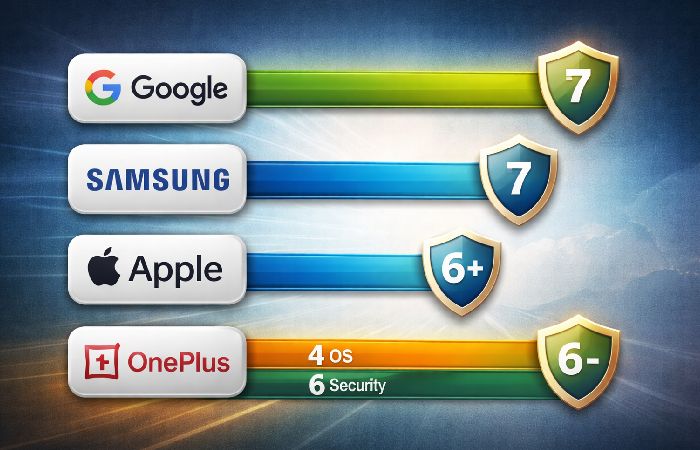
Pixel 8 and newer receive at least seven years of Android OS upgrades and security patches, as confirmed in Google’s official software support policy for Pixel 8 and Pixel 8 Pro.
SAMSUNG GALAXY: 7 Years
Samsung matches Google with seven years of support for flagships starting with the Galaxy S24 series: S24, S24+, S24 Ultra, S25, S25+, S25 Ultra, and recent foldables. This aligns with Samsung’s own Galaxy S24 series software update commitment.
What 7 years actually means:
Delivery: Monthly security patches in the early years, then quarterly and eventually less frequent as devices near the end of support. One UI feature updates also slow down after the first few years.
Tiers:
Years – Devices
- 7 – S24, S25 series, Z Fold6/7, Z Flip6/7
- 6 – A16 5G, A36, A56, select mid‑range
- 4 OS + 5 security – S23 series
- 3 OS + 4 security – Older devices
February 2026 changes:
- S21 series: Support ended (completed 5‑year commitment)
- S22 series, S21 FE: Downgraded to quarterly updates, support ends February 2027
Note: S26 series are expected in early 2026. Verify the current software update policy for your exact variant on samsung.com/in before purchase.Update policies can change, and some promises apply only to certain regions or variants. Always verify the update commitment for your exact model at purchase on the manufacturer’s official site.
APPLE IPHONE: 6+ Years
Apple doesn’t publish fixed timelines but shows consistent patterns. iPhone 11 (2019) runs iOS 26 in 2026—six years of major updates—with security patches continuing beyond that.
Current status:
Category – Devices
- iOS 26 compatible – iPhone 11 and newer, SE 2nd/3rd gen
- Security only – iPhone XS, XR
- Unsupported – iPhone X and older
Critical note: Apple announces iOS compatibility at WWDC (June). iPhone 11 may not support iOS 27 (expected September 2026) if Apple maintains its pattern of dropping one generation annually based on past cycles. This won’t be confirmed until the June 2026 announcement.
Apple’s UK regulatory filing commits to a minimum of 5 years of support for iPhone 15 and newer from first sale date. This minimum support period is detailed in Apple’s Product Security and Telecommunications Infrastructure (PSTI) compliance statement, similar to how wearables like the Apple Watch SE 2nd generation also promise multi-year software support and longevity for users.
Delivery: iOS updates arrive simultaneously worldwide for all supported models. Apple Intelligence features require iPhone 15 Pro or newer.
ONEPLUS: 4 Years OS + 6 Years Security
Flagships from OnePlus 11 onwards get four major Android updates and six years of security patches. OnePlus 13 and 13R are included.
Clarification: The out‑of‑box Android version counts as the first. OnePlus 13 (Android 15) receives Android 16, 17, 18, 19—not Android 20.
Series – OS – Security
- Flagship (11+) – 4 years – 6 years
- Nord 3+ – 3 years – 4 years
- Nord CE – 2 years – 3 years
- Nord N – 1 year – 3 years
Delivery: Security patches are usually bi‑monthly, slower than Samsung or Google.
XIAOMI / REDMI / POCO: Up to 6 Years
Select 2024‑and‑newer Xiaomi‑group phones get six years of support: four Android OS versions plus security patches.
6‑year support tier includes:
-
Xiaomi 15 series, 15T, 15 Ultra
-
Poco F7 Pro, F7 Ultra
-
Redmi Note 14 5G
Critical 2026 end‑of‑life (EOL) wave: these devices lose all OS, HyperOS, and security support in 2026:
-
Xiaomi 12, 12 Pro, 12X (Q1 2026)
-
Xiaomi 12T, 12T Pro (October 2026)
-
Redmi Note 12 series (March–April 2026)
-
Poco F5, F5 Pro (May 2026)
-
Poco X5 Pro 5G (February 2026)
Retroactive warning: the 6‑year policy applies only to 2024+ launches. Xiaomi 12‑series and other 2022–2023 devices still end support after roughly 3–4 years, even though newer phones now get 6 years.
OPPO: 5 Years OS + 6 Years Security
Oppo’s Find X series flagships (X8, X8 Pro, X9, X9 Pro) lead with five OS updates and six years of security patches.
Series – OS – Security
- Find X (2025+) – 5 years – 6 years
- Older Find – 4 years – 5 years
- Find N foldables – 4 years – 6 years
- Reno / F / K mid‑range – 2 years – 4 years
- A‑series budget – 1 year – 3 years
Oppo’s mid‑range and budget tiers lag behind competitors that now offer 4–6 years of support even on mid‑segment phones.
VIVO: 4–5 Years OS + 5–7 Years Security
Vivo’s policy varies by tier:
-
X300 series: 5 OS + 7 years security
-
X200 Pro: 4 OS + 5 years security
-
X100 Pro: 3 OS + 4 years security
V‑series mid‑range devices generally get 3 OS updates with varying security durations.
Always check individual model status on vivo.com, as the policy is not uniform across the lineup.
Budget Brands & Regional Players
Brand / Series – Typical support
-
Realme GT 7 / 7T: 4 years
-
Realme GT 7 Pro: 3 years (worse than the base GT 7)
-
Realme Number series: 2 years
-
Motorola Signature: 7 years (new 2026 policy)
-
Motorola Edge 50/60 Neo, Moto G75: 5 years
-
Most Motorola Edge, Razr: 3 years
-
HMD / Nokia: 1–3 years
-
Infinix, Tecno, Transsion: ~2 years OS, 3 years security
If you plan to keep a phone 3+ years, avoid most Realme models (except specific GT devices), most Motorola models (due to inconsistency), and ultra‑budget brands that limit support to 2–3 years.
What Updates Actually Include
-
Major OS updates: New Android/iOS versions with UI changes, new privacy controls, performance improvements, and updated APIs needed by newer apps.
-
Security patches: Fix vulnerabilities and exploits. These are critical for banking apps, UPI, DigiLocker, and other sensitive services.
-
Feature Drops (Pixel): Quarterly additions such as camera improvements, safety features, and AI tools, delivered without requiring new hardware.
Without current OS support and security patches, important apps may stop working and your risk of compromise increases significantly.
How to Check Your Phone’s Support Status
On Android
-
Go to Settings > About phone > Android version.
-
Check the “Android security patch level” date. If it is more than six months old, check your device’s support status on the manufacturer’s website.
On iPhone
-
Go to Settings > General > Software Update to see your current iOS version and available updates.
-
Check compatibility and support info on support.apple.com for your specific model.
Ending support in 2026 (examples):
-
Galaxy S21 series (support ended February 2026)
-
Poco F5 series (May 2026)
-
Xiaomi 12 series (Q1 2026)
-
Redmi Note 12 series (March–April 2026)
-
iPhone 11 (may lose major iOS updates after iOS 26; iOS 27 support unconfirmed until June 2026)
Why Updates Matter for Indian Buyers
Total cost of ownership
-
₹80,000 phone over 7 years ≈ ₹11,428 per year
-
₹40,000 phone replaced every 2 years ≈ ₹20,000 per year
Longer support means fewer upgrades, lower annual cost, and less hassle.
Resale value
Phones with years of software support remaining often retain 45–55% of their original value, while end‑of‑life devices can be hard to resell at all.
Security in a digital‑first India
UPI, Aadhaar, DigiLocker, and banking apps all assume a secure, patched device. Unpatched phones face higher risk of credential theft, malware, payment fraud, and identity compromise.
E‑waste and sustainability
India generates over 3 million tonnes of e‑waste annually. Longer software support reduces how often users replace phones, easing environmental impact.
What Changed From 2024 to 2026
-
Google extended Pixel 6/7 support from 3 to 5 years in late 2024.
-
Samsung added A‑series mid‑range phones to a 6‑year support tier and later removed the biannual‑only update tier.
-
Xiaomi introduced 6‑year support for select 2024‑and‑newer models, while many 2022–2023 models hit end‑of‑life in 2026.
-
Motorola launched the 7‑year‑support Signature model in early 2026.
2026 is a “retirement wave” year: more than 19 Xiaomi / Redmi / Poco devices, the Galaxy S21 series, and possibly the iPhone 11 (for major updates) all transition to end‑of‑life or security‑only status.
Recommendations by Use Case
Maximum longevity (around 7+ years)
-
Android: Google Pixel 9 Pro, Samsung Galaxy S25 Ultra
-
iOS: iPhone 16 Pro Max, iPhone 16 Pro, iPhone 16 Plus, iPhone 16
Best value longevity (roughly 5–6 years)
-
Galaxy S24 FE, Galaxy A56, OnePlus 13R, Motorola Signature, Xiaomi 15T
Budget with decent support (about 4–5 years or more)
-
₹15,000–25,000: Redmi Note 14 5G (6‑year policy), Galaxy A36
-
₹25,000–35,000: Poco F7 series, OnePlus Nord 4, Moto G75
Avoid if you plan to keep the phone 3+ years
-
Any phone with less than 3 years of guaranteed support remaining
-
iPhone 11 (if iOS 27 drops support; this remains unconfirmed until WWDC 2026)
-
Xiaomi 12 series, Poco F5 series, Galaxy S21, Redmi Note 12 series (all reaching end‑of‑life in 2026)
Update policies can change, and some promises apply only to certain regions or variants. Always verify the update commitment for your exact model at purchase on the manufacturer’s official site.
Key Takeaways
-
Software update length now matters as much as processor or camera when buying a phone.
-
Google Pixel and Samsung Galaxy lead Android with up to 7 years of OS and security updates, while Apple typically delivers 6+ years of major iOS versions plus extra security patches.
-
Mid‑tier brands like OnePlus, Xiaomi, Oppo, and Vivo offer 3–6 years depending on series; budget brands often stop at 2–3 years, making them poor choices if you plan to keep a phone longer.
-
For Indian buyers using UPI, Aadhaar, DigiLocker, and banking apps, staying on a supported, regularly patched phone is essential for safety and long‑term value.
-
Before buying, always confirm the exact update policy for your chosen model on the manufacturer’s official website, as promises can change and may vary by region or variant.
Verification & Methodology
Sources:
-
Manufacturer documentation and support pages
-
Android security bulletins and OEM update schedules
-
Reputable Android news outlets for delivery tracking and delay reports
-
Community‑verified end‑of‑life announcements
Limitations:
-
Policies generally apply to Indian or global unlocked variants; carrier‑locked models may differ.
-
Support timelines are manufacturer commitments, not legal guarantees.
-
Forward‑looking mentions (unreleased phones, future OS versions) are clearly marked as speculative.
Update frequency:
Always check the official manufacturer website for the latest software support information before you buy.
Last updated: February 2026
Editorial independence:
Technologyford does not accept manufacturer compensation for coverage. Affiliate links may be present for retailer referrals, but they do not influence recommendations or how update policies are described.