

Most teams are no longer asking “What can we automate?”
They are asking, “Why did our promising RPA pilot stall, and how do we avoid re‑manualizing work all over again?”
This guide is written for practitioners who need honest benchmarks on where RPA really pays off and where it doesn’t, not vendor‑driven promises.
This guide is for CTOs, CIOs, enterprise architects, operations leaders, and automation COEs who need RPA that actually scales, not just bots that look good in a slide deck.
Table of Contents
Who This Article Is For and What You’ll Learn
Intended audience
- CTOs, CIOs, and enterprise architects
- Operations and shared-services leaders
- Automation COE leaders and citizen developers
What you’ll learn
- Which RPA applications consistently deliver value in 2026
- Where RPA breaks down and why
- How to evaluate whether a process should use RPA, AI agents, or neither
- How to measure success using net operational value, not surface-level metrics
What This Article Adds (The Differentiator)
Most content focuses on:
- Industry lists
- Tool comparisons
- Simplistic ROI claims
This guide fills the implementation gap by:
- Explaining why RPA fails at scale
- Introducing net gain as the core success metric
- Connecting RPA to agentic AI in a practical, non-theoretical way
- Providing a pilot-to-scale framework grounded in operational reality
Why RPA in 2026 Is Strategic, Not Just Back‑Office
Robotic Process Automation has moved from simple back‑office scripts to being a core execution layer in enterprise automation, especially as organizations adopt broader “hyperautomation” and AI programs. According to Appian’s summary of Gartner insights in “The 4 Defining RPA Trends to Watch in 2024”, many vendors are blending RPA with AI, which suggests that RPA is increasingly embedded in larger AI‑driven platforms rather than deployed alone.
In many large firms, RPA now sits underneath conversational interfaces and AI decisioning systems, turning decisions into concrete clicks, updates, and transactions in legacy systems; this pattern is described in IBM’s enterprise examples in “RPA Use Cases, Examples & Applications”. McKinsey research indicates that AI‑powered automation may unlock significant economic value when it is applied across entire workflows rather than isolated tasks, as discussed in McKinsey Global Institute’s “AI: Work partnerships between people, agents, and robots”.
Yet even as adoption grows, many enterprises remain stuck in “pilot purgatory,” where a few bots work but the operating model never matures. Industry commentary and TCO analyses suggest that the root causes are rarely the tools themselves and typically relate to process quality, governance, and misaligned expectations about cost and effort.
The Core Problem: Pilot Purgatory and Stalled Scale
Most organizations experimenting with RPA experience a similar pattern: a successful proof of concept followed by stalled rollouts and rising maintenance pain.
Common failure patterns include:
- Bots breaking after routine UI or system changes, especially when selectors are brittle or processes rely on screen scraping.
- Underestimated monitoring and maintenance, where teams budget for licenses but not for ongoing support, change management, and regression testing.
- Poor process selection, with teams automating low‑volume, high‑exception or judgment‑heavy workflows that should have been redesigned or delegated to AI agents.
- “Re‑manualization,” where humans quietly take processes back because bots fail too often or become too expensive to maintain.
According to RPA cost breakdowns in Beezlabs’ and Blue Prism’s TCO content, development and support efforts typically represent the largest component of RPA total cost of ownership, while licensing is only one piece of the puzzle. These analyses suggest that license costs may represent only a minority of overall spend, with infrastructure, development, and maintenance taking the largest share, although exact percentages vary by organization.
From RPA to Agentic Process Automation (APA)

Leading organizations are moving from “RPA alone” to Agentic Process Automation (APA), where:
- RPA handles high‑volume, rule‑based activities with stable inputs and systems.
- AI agents manage reasoning, semi‑structured and unstructured inputs, and exception handling.
- Humans own process design, guardrails, and outcome responsibility.
Recent RPA and automation trend analyses note that “agentic” or GenAI‑assisted automation is emerging as a key pattern, with AI models planning multi‑step workflows and using RPA as one of several tools they can invoke. According to these views, AI‑based agentic automation may create substantial value by combining AI‑driven decisioning with scalable digital execution.
The shift is not about replacing RPA; it is about combining RPA as “hands” with AI agents as “brain” to avoid brittle, static automation.
High‑Impact RPA Applications in 2026

1. Governance, Risk, and Compliance (GRC)
GRC use cases remain some of the most durable RPA wins because they are rule‑driven, high‑volume, and structurally consistent, while errors are expensive.
High‑value workflows include:
- Automated regulatory reporting (for example, pulling data from multiple systems and populating standard templates).
- Continuous audit log generation and evidence collection for internal and external audits.
- Transaction monitoring rules, sanctions screening support, and compliance drift detection across financial services and other regulated industries.
RPA may shine here by turning periodic, manual checks into continuous controls that feed into enterprise risk and compliance platforms.
2. Customer Service 2.0: From Chatbots to Resolution Bots
Basic chatbots answer questions; they rarely resolve issues. In 2026, the real value lies in resolution, not conversation.
Modern customer service stacks combine:
- Conversational interfaces (chat or voice) for intent capture and clarification.
- RPA bots that log into core systems, update records, process refunds, or change account settings.
This enables:
- Refunds processed across multiple billing and ERP systems without live‑agent intervention.
- Address or plan changes pushed to multiple legacy platforms in one flow.
- End‑to‑end ticket resolution for common issues, with agents stepping in only for complex exceptions.
McKinsey’s AI adoption work notes that many organizations report service and cost benefits when AI is applied to customer‑facing operations, which supports the idea that pairing AI and automation in service may deliver measurable value when done well.
In employee onboarding, modern HR software can track offers, tasks, and checklists, while RPA bots quietly handle repetitive steps such as creating email accounts, assigning access rights, and sending standard welcome documents to new joiners.
3. Cybersecurity Operations
Security teams increasingly use RPA as a “glue layer” to coordinate responses across fragmented tooling.
Examples include:
- Access provisioning and de‑provisioning across multiple identity and HR systems.
- Orchestrated incident response runbooks that pull logs, quarantine endpoints, or open tickets in ITSM tools.
- Periodic compliance checks (for example, validating configuration baselines or evidence collection for audits).
Because these tasks are time‑sensitive and structured, RPA can significantly reduce response times while freeing scarce analyst capacity.
4. ESG and Sustainability Reporting
ESG and sustainability reporting remain data‑heavy and fragmented, making them a strong fit for RPA.
Typical patterns:
- Collecting emissions, energy usage, and supplier data from spreadsheets, portals, and internal systems.
- Normalizing formats and mapping to frameworks or jurisdiction‑specific disclosures.
- Feeding consolidated data into ESG reporting platforms and regulatory submissions.
Here, RPA is not doing the analytics; it is doing the data consolidation grunt work, reducing the manual effort and error risk inherent in multi‑source reporting.
A Concrete Example: From Pilot to Scale in Financial Services
Consider a large bank modernizing its KYC and onboarding process.
- An AI agent may review incoming documents, classify them, and flag potential issues using text extraction and risk models.
- When cases are straightforward, the agent can trigger RPA bots to update customer records, run standard checks in core banking systems, and generate audit trails automatically.
- For complex or ambiguous cases, the agent routes the work to human analysts with a summarized context.
This kind of “people + agents + robots” collaboration is consistent with McKinsey’s description of reimagining workflows around humans, digital agents, and automation in “AI: Work partnerships between people, agents, and robots”.
Suitability Scorecard: Should You Automate This Process?
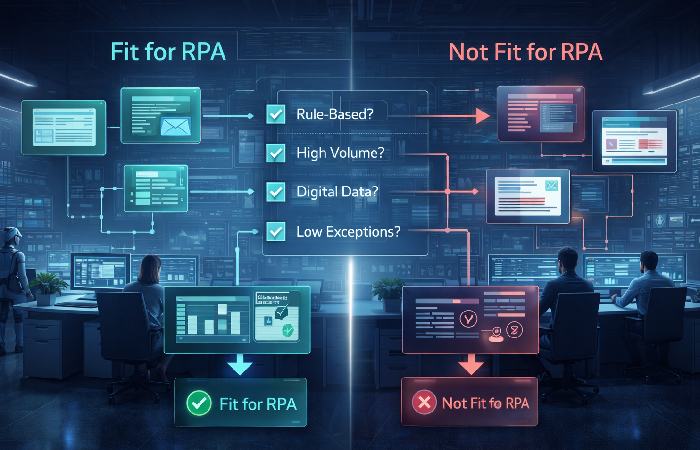
Before building a bot, run each candidate process through a simple suitability scorecard.
| Criterion | High suitability for RPA | Low suitability for RPA |
| Logic | Fully rule‑based, clear decision paths | Requires frequent judgment or case‑by‑case decisions |
| Volume | High and frequent, with consistent demand | Low, sporadic, or seasonal with long idle periods |
| Data | Digital, structured, and accessible | Ambiguous, unstructured, or locked in non‑digital |
| System stability | Infrequent UI changes, stable APIs and workflows | Constant UI or workflow changes, volatile systems |
| Exception rate | Low and predictable, easy to categorize | High, diverse, and hard to categorize |
Gartner’s RPA guidance, as summarized in Appian’s trends article, stresses that data quality and process stability are critical when selecting processes that are well suited for RPA, which aligns with this suitability scorecard. Processes failing several of these checks may need agentic augmentation or redesign before automation.
The Automation Ceiling: Why Traditional RPA Breaks
RPA does not repair inefficiency—it accelerates it. Automating a broken process simply makes it fail faster and more visibly.
Common ceilings include:
- Automating broken processes: Legacy workflows with unclear ownership, inconsistent inputs, or frequent exceptions become fragile when automated, a risk highlighted in practitioner commentary on failed RPA programs.
- Re‑manualization risk: When bots fail often, humans step back in, trust erodes, and maintenance costs balloon; TCO discussions emphasize how these hidden support efforts may erode ROI if not tracked.
- Exception management gaps: Hard‑coded exception paths and brittle selectors lead to high manual triage; trend reports suggest that mature programs increasingly use AI‑assisted selectors, pattern‑based recognition, and human‑in‑the‑loop escalation to reduce fragility.
Agentic AI may help break this ceiling by handling ambiguous inputs and dynamic conditions, while RPA focuses on deterministic execution.
RPA vs Agentic AI: Hands and Brain
Use this mental model to decide what belongs where.
| Capability | Traditional RPA (“hands”) | Agentic AI (“brain”) |
| Speed | Very high for defined tasks | Moderate, constrained by reasoning and model latency |
| Adaptability | Low; requires explicit reprogramming | Higher; can generalize and adapt to new patterns within guardrails |
| Unstructured data | Weak; needs pre‑structuring or templates | Strong; can process text, documents, and other semi‑structured data |
| Exception handling | Fragile beyond designed paths | More context‑aware; can route, explain, or resolve many exceptions |
| Governance maturity | Often high where RPA has been in place for years | Emerging; many firms are still formalizing policies and guardrails |
High‑performing organizations tend to layer these capabilities: they use RPA to execute at scale, AI agents to reason and adapt, and humans to design, supervise, and improve. McKinsey’s work on “people, agents, and robots” suggests that such blended operating models may capture more of AI’s potential value than isolated automation efforts.
The Real TCO of RPA: Beyond Licensing
RPA vendors often emphasize license costs, but licensing is only one component of total cost of ownership.
Typical TCO components include:
- Licensing and platform fees, which RPA TCO guides describe as a minority of overall automation operating cost.
- Bot development, monitoring, and maintenance, which multiple sources identify as major ongoing cost drivers that may grow as more processes are automated.
- Infrastructure and security controls, including hosting, environments, access management, and logging.
- Change management and re‑testing whenever upstream systems or processes evolve.
- Exception handling and escalation, which can silently consume operations capacity if not measured.
In practice, many organizations only discover their true TCO 12–24 months after rollout, when cumulative maintenance and support costs become visible in budgets.
Disclaimer: Cost structures and vendor pricing change quickly; use current benchmarks and your own financial data for investment decisions.
Net Gain: The Only Metric That Matters
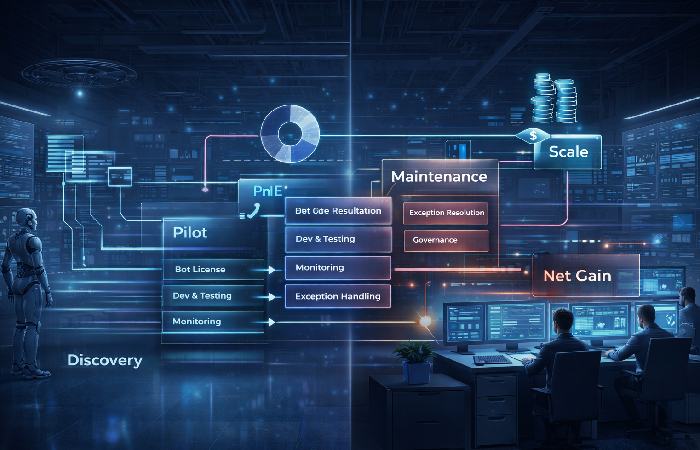
Counting bots or “hours saved” rarely captures real value. A more honest, operating‑model‑level metric is net gain:
Net Gain=Manual Work Eliminated−Automation OverheadNet Gain=Manual Work Eliminated−Automation Overhead
Where automation overhead includes:
- Maintenance and fixes.
- Exception handling effort.
- Monitoring, governance, and compliance work.
RPA ROI discussions note that maintenance and exception handling can quietly consume a substantial share of the time supposedly saved if leaders do not track these explicitly. As a practical rule of thumb, if maintenance and support hours are taking a growing share of time saved, you may need to reassess the automation or consider agentic augmentation.
Net Gain Red Flags
Watch for these signs of net‑negative automation:
- Maintenance effort trending upward relative to time saved.
- Exception queues growing over time instead of shrinking.
- Declining trust in bot outputs or quiet re‑manualization of tasks.
Embedded Net Gain Checklist
Before scaling any automation, confirm:
- Manual effort saved is clearly measurable and agreed with business owners.
- Maintenance and support hours are tracked weekly from day one.
- Exceptions are categorized (for example, UI, data quality, logic, upstream change).
- Net gain remains positive after 30, 60, and 90 days of live operation.
- Failure patterns are reviewed and acted on, not ignored.
The 90‑Day RPA Pilot Scorecard (Net‑Gain Driven)
Use this as a practical playbook to replace vanity pilots with measurable outcomes.
Days 1–30: Discovery & Suitability
- Identify high‑volume, rule‑based processes with digital inputs and low exception rates.
- Map the end‑to‑end workflow, including handoffs and upstream/downstream systems.
- Assign a business process owner accountable for outcomes, not just the automation team.
Days 31–60: Build & Resilience
- Design modular bots rather than monolithic automations, so components can be reused and updated selectively.
- Implement detailed logging and exception capture from day one.
- Run bots in parallel with humans (“shadow mode”) to compare outputs and refine rules.
Days 61–90: Deploy & Measure Net Gain
- Move to production with clear success criteria and rollback plans.
- Track “hours returned to the business” alongside support time and incident volume.
- Identify failure patterns that might be better suited to AI agents or process redesign.
Pilot success criteria may include
- Net gain remaining clearly positive over the full 90‑day period.
- Maintenance effort staying below an agreed internal threshold.
- The process being replicable across teams or regions with minimal rework.
Choosing the Right Tool for the Job
Vendors differ, but process discipline and governance maturity matter more than brand choice.
| Tool / platform | Best‑fit scenarios |
| UiPath | Large enterprises needing robust orchestration, controls, and complex integrations |
| Microsoft Power Automate | Organizations deeply invested in Microsoft 365, Dynamics, and Azure |
| SS&C Blue Prism | Regulated, compliance‑heavy sectors (for example, financial services, utilities) |
| Automation Anywhere / WorkFusion | Document‑heavy workflows requiring strong document processing capabilities |
| Zapier and similar SMB‑focused tools | Lightweight cross‑app automation for small and mid‑sized businesses |
According to Appian’s summary of Gartner’s RPA assessments, organizations increasingly prefer automation capabilities that integrate into broader platforms rather than standalone RPA, which supports the idea that tool choice should follow architecture and governance design. Deloitte’s automation insights present RPA as one component in a wider hyperautomation stack that may include integration platforms, low‑code tools, and AI services.
Modern enterprise platforms such as Robotic process automation technology can also support this layered approach, combining core RPA with orchestration and AI capabilities so teams can standardize patterns for high‑volume, rule‑based work while keeping governance and monitoring centralized.
FAQs: Straight Answers to Common RPA Questions
What are the most valuable RPA applications in 2026?
The highest‑value RPA applications tend to automate high‑volume, rule‑based tasks in stable systems, such as KYC checks, invoice processing, claims validation, inventory reconciliation, ESG reporting, and real‑time compliance monitoring. IBM’s RPA examples highlight similar repetitive, structured work across finance, operations, and customer service.
Is RPA being replaced by AI agents?
No. Industry trends describe RPA increasingly acting as the execution layer for AI agents rather than being replaced by them. AI agents may handle reasoning, unstructured inputs, and exceptions, while RPA bots carry out the resulting actions reliably inside enterprise systems.
Why do many RPA projects fail after pilot stages?
Most failures occur because teams automate broken processes, underestimate long‑term maintenance and governance effort, or deploy brittle bots that break whenever interfaces change. RPA TCO discussions emphasize that focusing on bot count instead of net gain may hide these issues until costs accumulate.
What is re‑manualization in RPA?
Re‑manualization happens when humans have to take back automated tasks because bots become unreliable, too fragile, or too expensive to maintain; practitioners describe this as a sign of weak process suitability, design issues, or missing exception strategies.
How much does RPA actually cost to run?
RPA cost guides indicate that licensing typically accounts for only a portion of total cost; TCO also includes development, infrastructure, maintenance, monitoring, and change management. Analyses from Blue Prism and others suggest that development and support may account for the majority of spend over time, with license fees playing a smaller but still significant role, although exact numbers vary by organization.
How do I know if a process is suitable for RPA?
Good candidates are rule‑based, high‑volume, digitally structured, relatively stable, and have low, predictable exception rates, which aligns with case‑selection guidance from Gartner and with common use‑case patterns in enterprise RPA literature. Processes that require judgment, frequent UI changes, or heavy unstructured data are often better handled by AI agents or process redesign.
What is the difference between RPA and Agentic Process Automation?
RPA follows predefined scripts and rules, while Agentic Process Automation uses AI agents that can reason, adapt, and recover when conditions change. Trend reports suggest that APA is better suited to complex, cross‑system workflows with ambiguity and changing inputs, where pure RPA may struggle.
Is RPA still useful for small and mid‑sized businesses?
Yes—when used selectively. Case studies and overviews show that SMBs often benefit most by automating clearly defined, repetitive workflows with measurable ROI, typically using lighter‑weight tools that integrate with SaaS apps rather than full enterprise platforms. Broad, enterprise‑style automation programs may not be necessary at smaller scale.
What metrics should be used to measure RPA success?
Beyond time saved, mature programs typically track net gain, exception rates, maintenance hours, scalability, and operational risk reduction. If maintenance and exception handling consume a growing share of the time supposedly saved, RPA leaders may need to redesign, limit, or augment the automation.
Methodology
This article synthesises public research and thought leadership from Gartner (via Appian’s summaries of RPA criteria), McKinsey research on AI-enabled workflows, and Deloitte and Blue Prism content on the future of RPA and hyperautomation. It also draws on practitioner-level examples from IBM and other enterprise RPA practitioners describing real-world use cases in finance, customer service, and operations.