

Most projects fail not because of bad ideas — but because of bad execution. According to recent PMI research on project success, only 48% of projects are rated clear successes, while 12% are considered outright failures, with the remaining 40% delivering mixed results in terms of scope, schedule, or budget.
Project management is the discipline designed to close that gap. It’s how organisations turn ideas into outcomes — consistently, predictably, and without burning out the people doing the work.
This guide covers what project management is, how the five-phase life cycle works, which methodology fits which context, what skills actually matter in 2026, and where the field is heading with Agentic AI. Whether you’re new to the discipline or looking to sharpen your practice, this is the foundation.
Table of Contents
Quick Answers
- What is project management? → The structured application of knowledge, skills, tools, and techniques to deliver a defined outcome within agreed constraints of scope, time, and cost.
- What are the 5 phases? → Initiation → Planning → Execution → Monitoring & Controlling → Closing.
- Which methodology is right? → Waterfall for fixed-scope projects; Agile for iterative ones; Hybrid when both apply — with important caveats.
- Do certifications matter? → Yes — PMI salary data shows PMP-certified professionals earn, on average, up to 16% higher median salaries across 40 countries.
- What’s changing in 2026? → Agentic AI workflows and “Power Skills” (emotional intelligence, adaptability) are overtaking technical methodology as the primary differentiators of high-performing PMs.
What Is Project Management?
According to the Project Management Institute (PMI), project management is the application of knowledge, skills, tools, and techniques to project activities to meet project requirements. A project is a temporary endeavour — it has a defined beginning, end, and purpose — as distinct from ongoing operational work.
The discipline works by applying structured processes to navigate the triple constraint: scope (what you’re delivering), time (when it must be done), and cost (what resources you can use). Every project management decision is, in some form, a trade-off between these three variables.
This is why project management is more than scheduling. It’s a framework for making good decisions under uncertainty — repeatedly.
The Triple Constraint: Scope, Time, and Cost

The triple constraint (also called the “project management triangle”) defines the boundaries of every project:
- Scope — what the project delivers; the features, outputs, and requirements
- Time — the schedule, milestones, and deadline
- Cost — the budget, resource hours, and financial constraints
Change one, and at least one other shifts. Expand scope without more time or budget and quality degrades. Compress time without reducing scope and cost rises. Understanding this dynamic — not just managing a Gantt chart — is the core intellectual work of a project manager.
The 5 Phases of the Project Management Life Cycle

The project management life cycle provides a structured framework for taking a project from idea to completion. The five phases below represent the standard process model recognised by PMI and applied across industries worldwide.
Phase 1: Initiation
The initiation phase defines whether the project is worth doing and whether it is feasible.
Key outputs:
- Project Charter — formal authorisation to begin, defining purpose, objectives, and initial scope
- Stakeholder identification — mapping who is affected, who has authority, and who needs to be consulted
- Feasibility assessment — evaluating cost, risk, and strategic alignment before committing resources
This phase is frequently rushed. Most project failures can be traced to inadequate initiation — unclear objectives, unidentified stakeholders, or unrealistic expectations set at the start.
Phase 2: Planning
Planning translates the project charter into a concrete roadmap. It is the most documentation-intensive phase and the one that pays the largest dividends later.
Key planning outputs:
- Work Breakdown Structure (WBS) — a hierarchical decomposition of all deliverables into manageable components
- Schedule and milestones — timelines built from WBS tasks, with critical path analysis
- Resource plan — who does what, when, at what cost
- Risk register — documented risks, probability/impact scores, and mitigation strategies
- Communication plan — how, when, and to whom project information is distributed
A well-built plan doesn’t prevent change — but it creates the baseline that makes change measurable and manageable.
Phase 3: Execution
Execution is where the plan meets reality. The project manager’s role shifts from architect to orchestrator: coordinating teams, removing blockers, managing dependencies, and keeping stakeholders informed.
The primary challenge in execution isn’t doing the work — it’s managing the gap between the plan and what actually happens. Scope creep, resource unavailability, and communication breakdowns are the most common execution-phase causes of project overruns.
Key execution activities:
- Directing and managing project work
- Managing team performance and conflict resolution
- Implementing approved changes via formal change control
- Communicating status to stakeholders on the agreed cadence
Phase 4: Monitoring and Controlling
Monitoring runs parallel to execution throughout the project life cycle. It answers the continuous question: are we still on track to deliver what was promised?
Key tools and techniques:
- Earned Value Management (EVM) — a quantitative method for measuring project performance against budget and schedule simultaneously. As detailed in the Defence Acquisition University’s Project and Program Management Fundamentals Handbook, EVM uses metrics such as Schedule Performance Index (SPI) and Cost Performance Index (CPI) to provide a quantitative view of project health.
- Risk monitoring — tracking identified risks and watching for emerging ones
- Change control — evaluating and approving scope, schedule, or cost changes through a formal process
The separation of execution and monitoring is a deliberate design. Without dedicated monitoring, project managers default to optimism — only noticing problems once they’re too large to correct cheaply.
Phase 5: Closing
Closing formally ends the project and captures what was learned.
Key closing activities:
- Formal acceptance of deliverables by the client or sponsor
- Lessons learned documentation — what worked, what didn’t, what to do differently
- Resource release and contract closure
- Project archive — preserving documentation for future reference
Closing is the most commonly skipped phase. Under schedule pressure, teams move to the next project before properly closing the last one — losing institutional knowledge and repeating avoidable mistakes.
Project Management Methodologies: Choosing the Right Approach
There is no universally best methodology. The right choice depends on the project’s degree of certainty, the client’s involvement, and the organisation’s culture.
Waterfall
Waterfall is a sequential, linear methodology where each phase must be completed before the next begins. Requirements are defined fully upfront and change is formally controlled.
Best for: Construction, manufacturing, regulated industries, projects with fixed contracts and clear specifications.
Limitation: Poor fit for projects where requirements evolve or technology is uncertain. Changes in later phases are expensive and disruptive.
Agile
Agile is one of several iterative and incremental project management approaches that help teams deal with uncertainty and evolving requirements. Other models in this family include dynamic systems development, extreme project management, and innovation-focused frameworks such as Innovation Engineering, which emphasise rapid learning cycles and continuous improvement within complex environments. Requirements can evolve throughout the project.
According to Northeastern University’s analysis of Agile methodologies, frameworks like Scrum and Kanban are widely adopted in software development because they accommodate changing requirements and enable early delivery of working product, allowing stakeholders to course-correct before significant investment is made.
Best for: Software development, product design, marketing campaigns, any project where requirements are likely to evolve.
Limitation: Requires active stakeholder involvement and a team culture comfortable with ambiguity. Does not suit projects requiring full upfront specification (e.g., regulated infrastructure).
Hybrid
Hybrid methodologies combine elements of Waterfall and Agile — typically using Waterfall for planning and governance, and Agile for delivery execution.
But here’s where most guides go quiet: hybrid is fragile in practice. The most common failure mode is applying Agile sprints within a Waterfall budget cycle. When corporate finance requires annual fixed budgets but product teams need the flexibility to reprioritise quarterly, the methodology contradiction produces neither the predictability of Waterfall nor the adaptability of Agile. It produces bureaucratic theatre.
Hybrid works when the organisation has deliberately designed governance to accommodate both models — not when Agile is bolted onto a Waterfall structure as a cultural compromise.
Methodology Comparison at a Glance
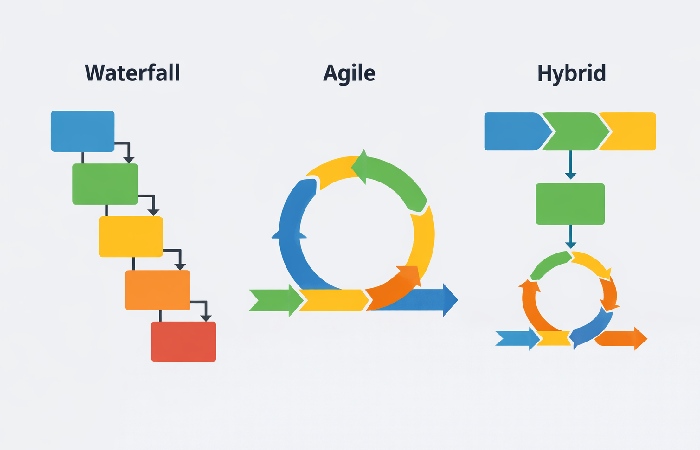
| Dimension | Waterfall | Agile | Hybrid |
|---|---|---|---|
| Requirement clarity needed | High (upfront) | Low (evolves) | Medium |
| Change tolerance | Low | High | Medium |
| Client involvement | Periodic | Continuous | Varies |
| Documentation | Extensive | Lightweight | Moderate |
| Delivery cadence | End of project | Each sprint (1–4 weeks) | Mixed |
| Best industry fit | Construction, Gov, Hardware | Software, Product, Marketing | Enterprise IT, Large Programmes |
| Risk of failure | Late discovery of problems | Scope drift without governance | Governance mismatch |
Core Project Management Skills for 2026
The technical skills of project management — scheduling, budgeting, risk logging — are table stakes. What distinguishes high-performing project managers in 2026 is something PMI now calls “Power Skills.”
PMI’s research identifies the following as the highest-impact differentiators for project success in the current environment:
Power Skills (The Human Side of PM)
- Collaborative leadership — the ability to align diverse teams around shared goals without direct authority
- Emotional intelligence — managing conflict, reading team dynamics, and adapting communication style to stakeholder needs
- Adaptability — responding to change without losing team cohesion or project direction
- Communication — not just status reporting, but active listening, narrative framing, and influencing without authority
These skills matter more in remote and hybrid work environments where the ambient signals of in-person collaboration (body language, energy in a room, informal conversations) are absent. A project manager who can run a clean Gantt chart but can’t navigate a conflicted team across three time zones is operating with a significant gap.
Technical Skills (Still Required)
- Schedule development — building realistic timelines using critical path method (CPM) and resource levelling
- Risk management — identifying, quantifying, and mitigating risks before they become issues
- Stakeholder management — mapping stakeholder influence and interest, then managing expectations accordingly
- Earned Value Management (EVM) — tracking project performance quantitatively against baseline
- Change control — governing scope, schedule, and cost changes through a formal process
AI Literacy: The 2026 Differentiator
The role of artificial intelligence in project management is shifting from “helpful tool” to “agentic participant. In 2026, leading project management platforms are beginning to deploy AI agents that can autonomously:
- Generate project schedules from natural language requirements
- Flag at-risk tasks based on velocity data and historical patterns
- Draft stakeholder communications from status data
- Recommend resource reallocation based on capacity forecasts
Project managers who understand how to configure, oversee, and critically evaluate AI-generated outputs will have a measurable advantage. Those who defer entirely to AI recommendations without applying professional judgement will introduce new categories of risk — garbage-in, garbage-out at machine speed.
Project Management Certifications: What’s Worth It in 2026
Certifications signal competence to employers and clients — but not all carry equal weight.
| Certification | Body | Best For | Level |
|---|---|---|---|
| PMP (Project Management Professional) | PMI | Experienced PMs across all industries | Advanced |
| CAPM (Certified Associate in PM) | PMI | Early-career professionals | Entry |
| PMI-ACP (Agile Certified Practitioner) | PMI | Agile-focused PMs | Intermediate |
| PRINCE2 Practitioner | PeopleCert | UK/Europe/Government projects | Intermediate |
| CSM (Certified ScrumMaster) | Scrum Alliance | Software/Product teams | Entry-Intermediate |
| PgMP (Program Management Professional) | PMI | Senior PMs managing multiple projects | Senior |
The PMP remains the global benchmark. PMI’s Earning Power: Project Management Salary Survey reports that PMP holders earn a higher median salary than non-certified peers, with an average uplift of around 16% across 40 countries, making it one of the highest-ROI certifications for most professionals.
CAPM is the logical starting point for anyone without the 36 months of project experience required for PMP eligibility.
Common Project Management Mistakes to Avoid
These aren’t theoretical pitfalls. They’re the patterns that show up in post-mortems, repeatedly.
- Skipping proper initiation. Starting execution before objectives are clearly defined and stakeholders are aligned is the single most reliable predictor of project failure.
- Under-investing in planning. Teams under time pressure compress the planning phase. Every hour saved in planning costs three to five in execution rework.
- Confusing activity with progress. A team can be very busy and still not be moving the needle. Track outcomes and deliverables — not just tasks completed.
- Ignoring the risk register after creation. Risk registers built during planning and never reviewed become compliance theatre rather than operational tools.
- Over-reliance on methodology. Agile is not a substitute for clear requirements. Waterfall is not a substitute for stakeholder engagement. Methodology provides a structure — not a guarantee.
- Neglecting lessons learned. Projects that end without a formal retrospective repeat the same mistakes in the next initiative. This is how organisations institutionalise inefficiency.
Who This Guide Is For — and Who Needs More
Well suited for:
- Professionals entering project management from another discipline seeking a foundational understanding
- Students preparing for PMP/CAPM exams who need a clear conceptual framework
- Team leads and managers who run projects informally and want to formalise their approach
- Business owners and executives who commission projects and want to evaluate PM practice in their organisations
You’ll need more specialist content if:
- You’re managing programmes (multiple interdependent projects) — the discipline differs significantly from single-project management
- You work in a specific regulated industry (construction, defence, pharma) with sector-specific standards
- You’re implementing Agile at scale (SAFe, LeSS) — these frameworks require dedicated study beyond general PM principles
Final Verdict: Project Management in 2026
Project management is not a static discipline — and the 2026 version looks meaningfully different from five years ago. The five-phase life cycle and the triple constraint remain foundational. But the methodology wars between Waterfall and Agile are giving way to context-dependent hybrid approaches; the technical skills gap is closing as AI tools automate scheduling and reporting; and the differentiators that matter most are now human — emotional intelligence, stakeholder influence, and the ability to lead distributed teams through ambiguity.
PMI’s Pulse of the Profession research shows that organisations with strong project management capabilities report significantly higher success rates, while those that undervalue project management waste around 11–12% of their investment through poor project performance.
If you’re new to the discipline: start with the fundamentals, pursue CAPM, and build your first real project plan from scratch. If you’re experienced: close the Power Skills gap, learn how to integrate AI tools critically, and treat every project closing as seriously as every project opening.
The methodology matters less than the judgement. That’s what project management actually is.
Frequently Asked Questions
Q1: What is project management in simple terms?
A: Project management is the structured process of planning, executing, and completing a specific goal within agreed constraints of scope, time, and cost. As defined by the Project Management Institute, it is the application of knowledge, skills, tools, and techniques to project activities to meet requirements. It distinguishes projects (temporary, goal-specific) from ongoing operations.
Q2: What are the 5 stages of project management?
A: The five stages of the project management life cycle are: 1) Initiation (define purpose and feasibility), 2) Planning (build the roadmap — WBS, schedule, budget, risks), 3) Execution (do the work), 4) Monitoring & Controlling (track performance against plan), and 5) Closing (deliver, document lessons, archive). Each phase produces specific outputs that feed the next.
Q3: What is the most popular project management methodology?
A: Agile is the most widely adopted methodology in software and product development. Waterfall remains dominant in construction, government, and regulated industries with fixed-scope contracts. Hybrid approaches — combining Waterfall governance with Agile delivery — are increasingly common in large enterprise IT programmes, though they require careful governance design to avoid the pitfalls of mixing incompatible planning and budgeting cycles.
Q4: Which project management certification is best in 2026?
A: The PMP (Project Management Professional) from PMI is the global benchmark for experienced project managers. It requires 36 months of project experience and 35 hours of formal training. For those early in their career, the CAPM is the correct starting point. PMI’s Earning Power: Project Management Salary Survey shows PMP holders earn higher median salaries than non-certified peers, with an average uplift of about 16% across the 40 countries surveyed.
Q5: What does a project manager do on a daily basis?
A: On a given day, a project manager typically: reviews schedule and task progress against the baseline, manages blockers and dependencies raised by team members, communicates status to stakeholders, evaluates incoming change requests, monitors risk indicators, and facilitates team decisions that require cross-functional input. The role is primarily coordination, communication, and problem-solving — not doing the technical work of the project itself.
Q6: Can you become a project manager with no experience?
A: Yes, with a structured approach. The CAPM certification has no experience requirement and builds foundational PM knowledge. Volunteering to lead small internal projects — budget, cross-team coordination, and a defined deliverable — provides real experience. Many PMs transition from related roles (coordinator, analyst, team lead) and formalise their practice through certification and deliberate study of the PM framework.