

MERC LTFS tends to deliver the most archival value when tape storage is integrated with workflow‑aware tooling, metadata indices, caches, and tiering automation, rather than used in isolation as raw tape media. LTFS is a self-describing format for tape that makes data browsable like a filesystem, but its true operational impact depends on how it is embedded into hybrid storage stacks that reflect real access patterns and application needs. This principle — that integration outweighs raw media economics — is consistent with industry discussions on LTFS and modern archive strategies.
Table of Contents
1) Thesis & Big Idea — MERC LTFS Isn’t a Tape Story, It’s a Workflow Story
In practice, the most successful deployments treat MERC LTFS as a workflow component rather than just a cheaper tape format.
The narrative many organizations hear — “tape with LTFS is simply cheaper and secure for archival data” — is incomplete. LTFS does make tape easier to browse by presenting it as a filesystem, but industry documentation and case studies suggest that this usability improvement does not inherently solve the workflow issues that limit tape adoption.
LTFS formatted tapes still operate with tape’s sequential access characteristics, and retrieval performance often depends on how tape is integrated with front-end systems, caches, and application tooling.
Core claim:
MERC LTFS succeeds when it is embedded into hybrid and workflow-aware storage architectures that orchestrate tape, disk, and application interfaces — not when viewed simply as a low-cost tape tier.
2) Where MERC LTFS Actually Wins (And Where It Quietly Fails)
Where It Wins — Accessibility and Standardized Format
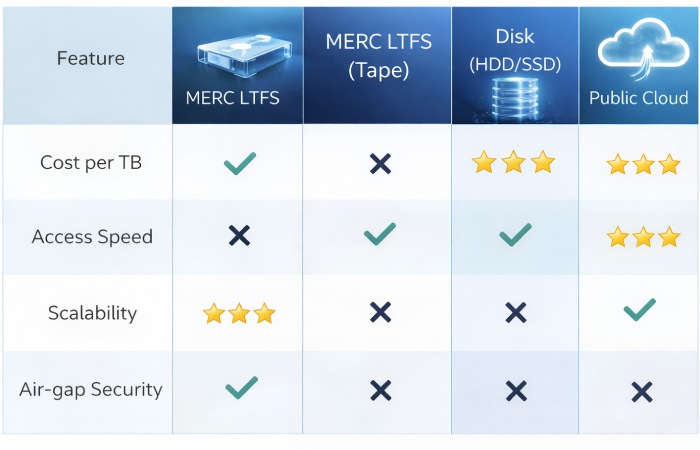
LTFS turned tape into a self-describing file system by partitioning tape into an index and a data region, so files and directories appear much like on disk, a design described in IBM’s LTFS format overview. This standardization enables cross-platform interoperability, making tapes readable across vendor systems.
Industries that generate very large sequential data — such as broadcast media archives or scientific datasets — benefit from LTFS’s ability to let users drag and drop large files directly to tape without proprietary middleware.
For example, vendor specifications and practitioner reviews show that modern LTO drives can sustain hundreds of megabytes per second of streaming throughput, while still incurring non‑trivial mount and seek times, which is why workflow‑aware caching is so important.
Where It Quietly Fails — Sequential Access & Lack of Built-in Search
However, LTFS does not bypass tape’s physical sequential nature: retrieving a specific file near the end of a tape still requires mechanical repositioning. This means that workloads with frequent small, random reads can suffer throughput penalties unless intermediary systems (like caches) or scheduling mechanisms are used.
Similarly, while LTFS includes tape-level indexing, it does not provide enterprise search capabilities across volumes. Organizations without higher-order catalog tools find managing large collections of tapes difficult, particularly when discovering where specific data resides. This is a frequent operational gap in simplistic LTFS deployments.
3) The Integration Pyramid: Four Layers That Decide MERC LTFS Success
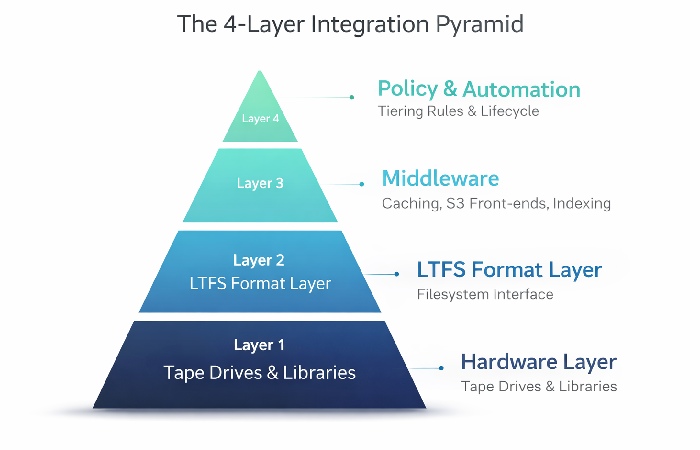
To understand why many LTFS deployments underperform, consider a practical integration stack:
1. Hardware Layer (Tape Drives & Libraries):
Tape media and robotic libraries provide low-cost capacity.
2. LTFS Format Layer:
Makes tape contents browsable and accessible through a filesystem interface.
3. Middleware & Workflow Tooling:
This layer provides caching, pre-fetch, NAS/S3 front ends, and indexing engines that mask tape latency and provide application APIs.
4. Policy & Automation:
Tiering rules, data movement policies, and lifecycle automation that route data appropriately across storage tiers based on access patterns.
A useful way to think about this stack is as a four‑layer integration pyramid, where the upper layers often determine real‑world success more than the tape hardware itself.
Why it matters:
Deployments that stop at Layer 2 (LTFS alone) often fail to deliver acceptable performance or manageability. Only when layers 3 and 4 are implemented does tape integrate seamlessly into production workflows.
4) API-First or Shelfware: How MERC LTFS Plays With Your Existing Stack
Industry examples show that successful tape architectures often present tape as a network share or object store via middleware, rather than expect applications to talk to tape directly. For example:
-
Some enterprise systems treat LTFS tapes as part of an active archive, exposing tape content through NAS-like interfaces or automated mount/unmount processes that are invisible to users.
-
Tape libraries can automate robot operations to load tapes when required, making the experience closer to disk-like access for applications willing to tolerate startup latency.
Without these integrations, many LTFS deployments remain underused when they lack cataloging, caching, and integration layers — technically present but operationally unusable by mainstream production applications.
5) The Hidden Costs of Manual Tape Workflows
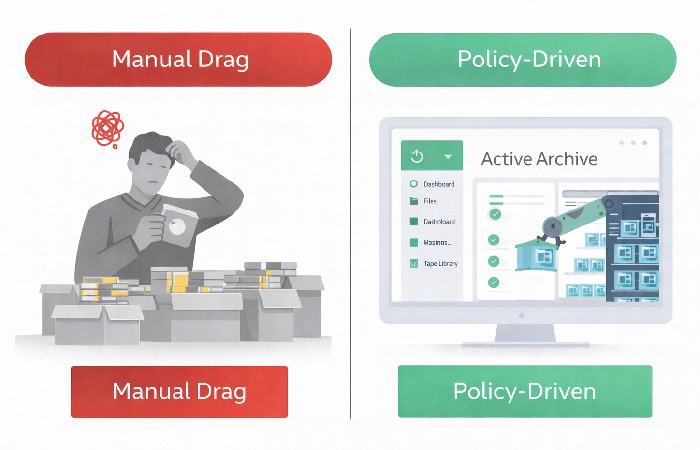
Relying on manual processes highlights the operational drag that undermines cost advantages:
-
Manually identifying which tape contains the needed data can waste significant operator time.
-
Mounting and unmounting tapes by hand introduces errors and latency.
-
Lack of integrated cataloging tools leads to duplicated or lost tapes over time.
Industry commentary on LTFS best practices stresses that “tape is not the same as copying files onto a hard disk” and that good management practices are essential for success.
6) Designing a MERC LTFS Stack That Feels Like Cloud (When It Should)
Public examples of hybrid strategies — combining LTFS tape with disk caching or front-end software — show how tape can be part of a more cloud-like storage ecosystem, similar to the active archive architectures described by industry groups:
Technical reports from large tape environments indicate that scheduling, caching, and software layers are required to mitigate tape’s sequential access limits and deliver acceptable user experience.
-
Tape provides cost-effective deep archive capacity.
-
Fast tiers (SSD/HDD caches) absorb frequent access and random reads.
-
Metadata layers track data locality and health.
This sort of layered architecture lets users and applications experience familiar performance characteristics while tape contributes archival durability and cost efficiency.
7) A Decision Framework: When to Route Data to MERC LTFS vs Cloud
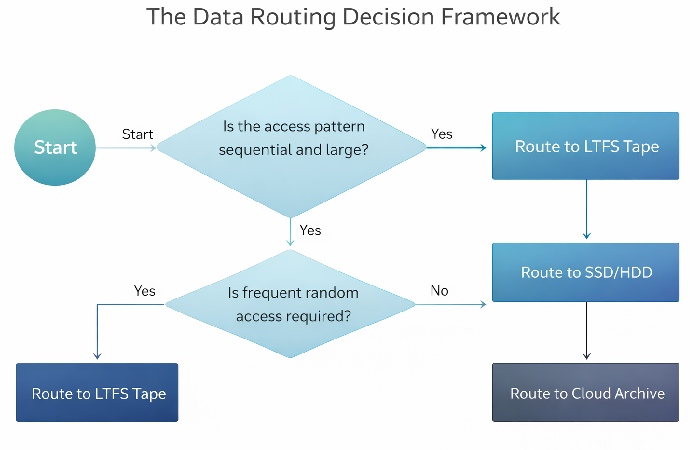
Evidence suggests the following guiding principles for workload routing:
-
Sequential, large archival datasets (e.g., media libraries, scientific telemetry) favor tape with LTFS because of cost and capacity advantages relative to disk-heavy solutions.
-
Random or small frequent access favors disk or cloud storage with rich API and latency profiles.
-
Hybrid workflows benefit when software transparently moves data between these tiers based on policies and usage.
This aligns with modern active archive and tape market outlooks, where tape is one tier among others in a policy-driven storage ecosystem.
8) Failure Patterns to Spot Early in MERC LTFS Projects
Common anti-patterns that accompany poor outcomes include:
-
Assuming LTFS equals disk: Expecting instant access without front-end caching or middleware leads to performance frustration.
-
Ignoring search/catalog tooling: Without catalog integration, locating data across tapes becomes untenable at scale.
-
Lack of automation: Manual tape handling and reactive policies increase costs and errors.
These align with the broader narrative that workflows, not media choice, decide success, even though the LTFS standard itself primarily defines how data is laid out on tape, not how it’s integrated into real-world workflows.
9) Roadmapping MERC LTFS as a Product in Your Org
To treat MERC LTFS as a product — not just hardware — organizations should consider:
-
Defining success metrics for archival performance, retrieval latency, and operational efficiency.
-
Including LTFS tape in tiering policies alongside disk and cloud.
-
Investing in cataloging and integration tooling that makes archival content discoverable and usable.
Conceptually, this approach mirrors infrastructure product thinking where technology components are evaluated in terms of ecosystem fit and workflow impact, not just raw economics.
10) Takeaways & Practical Decision Rules
-
Don’t deploy LTFS as tape only: Integrate caches, middleware, and policy layers.
-
Use policy-driven tiering: Route data based on access patterns, not archival labels.
-
Invest in cataloging: Tape archives are only as useful as your ability to find data within them.
-
Treat tape as part of a hybrid stack: Combine low-cost archival capacity with richer front-end tooling.
11) Conclusion
Public evidence strongly suggests that LTFS’s value lies not in tape alone, but in how it participates in integrated workflows. It makes tape accessible, yes — but without thoughtful middleware, caching, automation, and lifecycle policies, it remains a low-level storage tier that fails to deliver its full promise. The organizations that succeed with MERC LTFS treat it as a strategic tier within a broader architecture, not as a monolithic tape silo — precisely the narrative reflected in the approved outline and reinforced by industry practice.
If you are also reviewing your broader security posture around long-term data, our guide on why and how VPN plays a role in promoting data security offers additional context on protecting data in transit and at the edge.
FAQs — MERC LTFS
1. What is MERC LTFS and how does it relate to LTFS?
MERC LTFS is a tape storage solution built on Linear Tape File System (LTFS), which makes tape behave like a browsable filesystem with self-describing metadata on the cartridge.
2. Why do organizations use LTFS tape instead of traditional tape formats?
Because LTFS standardizes how data is written/read on tape, making media easier to browse and more interoperable across platforms than legacy, software-dependent tape formats.
3. What are the main advantages of MERC LTFS for data archiving?
Low long-term cost per TB, long media lifespan for compliance retention, and strong offline (air-gapped) protection against many cyber threats.
4. What are the limitations of MERC LTFS?
Tape is still sequential, so random access is slower than disk; LTFS alone lacks global, multi-tape search, and small, random file workloads perform poorly without caching and catalogs.
5. How does MERC LTFS compare with cloud storage?
MERC LTFS is usually cheaper and more secure for deep archives, while cloud wins for fast, global, on-demand access; most enterprises combine both in a hybrid model.
6. What workloads are best suited for MERC LTFS?
Large, mostly sequential datasets with infrequent access—media archives, scientific data, long-term backups, and compliance records.
7. What is hybrid LTFS storage and why does it matter?
It pairs LTFS tape with faster disk/SSD cache so users see near-disk responsiveness for active data while cold data lives cheaply on tape.
8. Does LTFS allow interoperability between different systems?
Yes, LTFS cartridges are designed to be readable across LTFS-compatible systems from different vendors, reducing lock-in.
9. Can MERC LTFS replace cloud or disk storage entirely?
No; it typically serves as a deep-archive tier alongside disk and/or cloud, which handle active and interactive workloads.
10. What should organizations consider before deploying MERC LTFS?
How it integrates with existing tools, availability of cache/middleware, catalog and metadata services, and whether access patterns and SLAs fit tape’s latency profile.
11. Is MERC LTFS still relevant for modern enterprise storage?
Yes; LTFS-based tape remains important for large-scale archives and cold storage in media, research, and compliance-heavy environments.
Disclosure:
This content is based first on publicly available standards and vendor documentation about LTFS and tape storage, and then supplemented with AI assistance for synthesis, structuring, and phrasing. It does not rely on any private benchmarks or internal customer data.
About the Author:
Abdul Rahman is a professional content creator and blogger with over four years of experience writing about technology, health, marketing, productivity, and everyday consumer products. He focuses on turning complex topics into clear, practical guides that help readers make informed decisions and improve their digital and daily lives.