
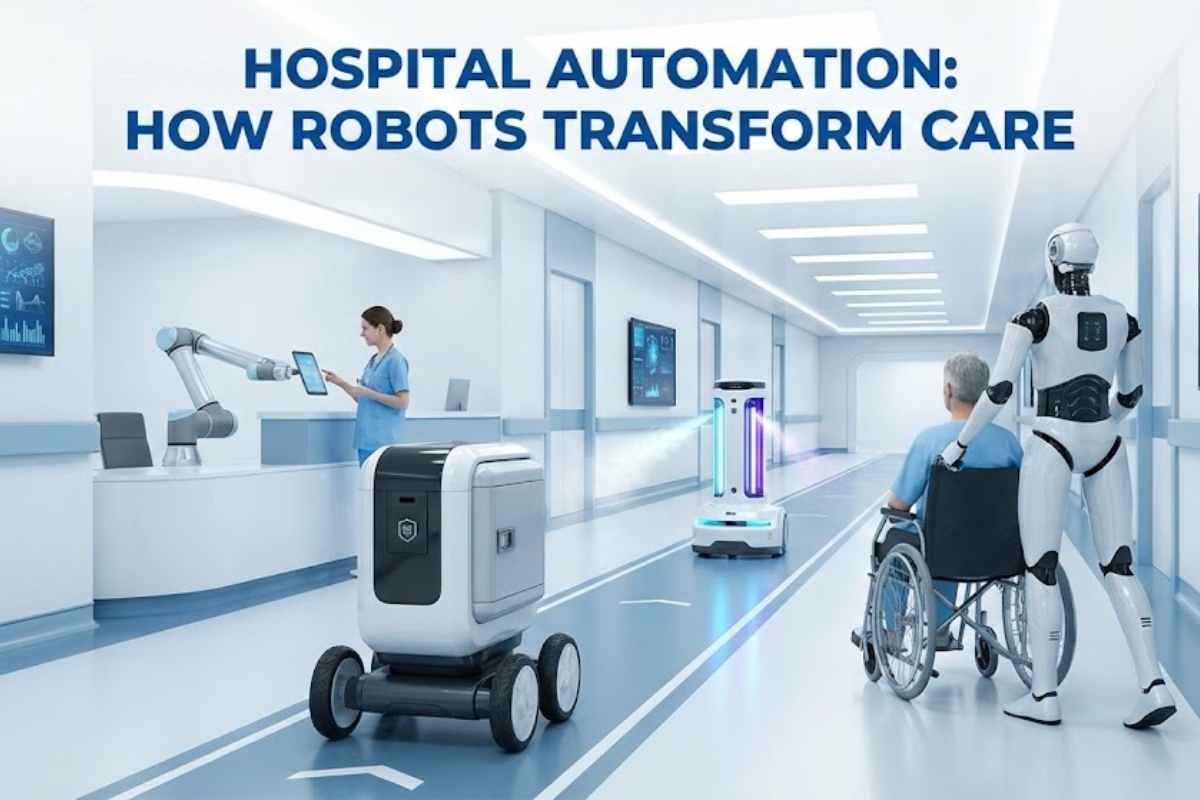
Hospitals today operate under constant pressure — staff shortages, infection control risks, medication errors, and growing patient volumes.
Robotics has emerged as one of the most practical tools to ease this strain, not by replacing healthcare professionals, but by automating high-risk, repetitive, and physically demanding tasks
Table of Contents
Quick Answer (Search Intent Match)
Hospital automation uses robots to assist with patient care tasks, sterilization, logistics, surgery, and medication handling.
Evidence shows these systems can reduce certain types of human error, improve infection control, and free healthcare workers to focus more on clinical decision-making and patient interaction, although results vary by hospital and implementation quality.
What Hospital Automation with Robots Really Means
Hospital automation refers to integrating physical robotic systems into everyday workflows, including:
-
Surgical assistance
-
Disinfection and infection control
-
Logistic and transport support
-
Patient monitoring and engagement
Academic literature consistently shows that robots are most effective in repetitive, rule-based tasks that do not require human clinical judgment, where they can increase efficiency and consistency while clinicians retain decision-making control.
Clinical impact of hospital robotics
Table 1: Clinical impact of hospital robotics (surgical vs disinfection vs logistics)
| Category | Evidence | Key outcome | Source |
|---|---|---|---|
| Robotic surgery | Studies report that AI-assisted robotic systems can reduce operative time and complications in selected procedures, compared with conventional approaches. | Faster procedures and fewer complications in some surgeries. | PMC |
| Surgical precision | Robotic systems can improve targeting and instrument control, particularly in complex or minimally invasive procedures. | Higher precision during demanding procedures. | PMC |
| Recovery time | In certain indications, robot-assisted surgery is associated with shorter recovery and reduced length of stay, though results vary. | Better postoperative recovery in selected cases. | PMC |
| UV disinfection robots | UV-C disinfection robots enhance surface decontamination when used as an adjunct to manual cleaning, not a replacement. | More effective environmental disinfection. | PMC |
| Hospital logistics | Mobile robots can save staff time and improve efficiency in repetitive transport and delivery tasks. | Reduced manual workload and time on routine tasks. | MDPI |
Therapeutic vs operational robotics
Table 2: Therapeutic vs operational robotics — realistic expectations
| Robot type | Primary function | Clinical benefit | Limitation |
|---|---|---|---|
| Surgical robots | Assist precision surgery | Reduced complications and faster recovery in some procedures. | High cost; requires extensive training and experience. |
| Disinfection robots | Surface/pathogen reduction | Faster, more consistent disinfection cycles. | Must complement, not replace, manual cleaning. |
| Transport/logistics robots | Supply delivery, patient/equipment movement, navigation | Frees staff from routine physical tasks and reduces strain. | Navigation challenges in crowded, dynamic environments. |
| Social/patient assistance robots | Patient engagement, directions, basic information | Reduce interruptions for staff and support patient orientation. | Limited direct clinical utility and no independent judgment. |
Key Roles of Robots in Hospital Automation
1. Use Robots For Patient Care
Robots now play a visible role in patient care in hospitals, especially in non-clinical and semi-clinical support tasks that take up a lot of nurses’ time. They handle routine monitoring, basic mobility assistance, information delivery, and even nurse call routing so staff can stay focused on direct, hands-on care.
Research shows these systems can ease workload and physical strain, particularly during staffing shortages, but they do not replace the empathy or clinical judgment that only human caregivers bring to the bedside.
Robots work best as assistive tools that quietly remove friction from hospital workflows rather than trying to act as autonomous “robot nurses” in place of real people.
2. Use Robots To Sterilize the Hospital
Hospital-acquired infections remain a serious risk, even when environmental services teams clean thoroughly and follow protocol.
Automated cleaning and UV-disinfection robots now patrol operating rooms, isolation wards, and high-touch corridors, adding an extra layer of protection on top of manual cleaning rather than replacing it.
These systems use targeted disinfectant spraying and powerful UV-C light to reduce surface pathogen load, which in turn helps lower staff and patient exposure in high-risk environments.
However, they do not make infection “impossible” or remove the need for basic hygiene, and simple measures such as using hand sanitizers alongside robot-assisted cleaning remain essential to keeping transmission risk as low as realistically possible.
3. Robots for Patient Management

As wards grow busier, robots are increasingly used to support patient management tasks, such as:
-
Patient tracking and location
-
Routine vitals collection in controlled environments
-
Alerts for irregular movement or potential falls
This matters because nurses spend less time on repetitive checks and can respond faster to emerging patient needs, which helps reduce burnout linked to constant monitoring tasks.
At the same time, robots cannot interpret complex clinical symptoms or replace nurse assessments, so human evaluation remains central to safe care
4. Endoscopy Robots
Robotic endoscopy systems are designed to enhance precision in minimally invasive procedures. They help by improving navigation in confined anatomical spaces, stabilizing camera and instrument movement, and reducing operator fatigue during long or technically demanding cases.
Evidence from early systems shows that robotic assistance can improve the consistency of movements and visualization inside the body, making it easier for clinicians to perform delicate maneuvers.
Human oversight remains mandatory at every step, and these robots assist procedures rather than independently diagnosing or deciding on interventions.
5. Surgical Robots
Robotic surgical systems are among the most validated hospital robots in terms of research and clinical adoption. In appropriate procedures, they can increase precision, reduce the impact of hand tremors, enable smaller incisions, and contribute to faster recovery times for some patients.
However, surgical robots do not perform surgery on their own, and outcomes depend heavily on surgeon training, team experience, and adherence to protocol.
Not all procedures benefit equally from robotic assistance, so hospitals need clear criteria for when robotic surgery adds real value versus when conventional techniques are sufficient.
6. Robots for Patient Transfers & Transport
Moving patients and heavy equipment is one of the biggest causes of strain and musculoskeletal injury for nurses and other frontline staff, especially during busy shifts and emergencies.
Purpose-built transport robots now help with patient transfers and equipment movement, reducing physical load and making handling more consistent and predictable.
Many systems are designed to operate safely in low-light or disaster conditions and can be paired with LED lights to stay visible during blackouts or emergency evacuations.
Even so, these robots must always follow strict human-override and emergency stop protocols, and trained human supervision remains mandatory whenever patients are being moved.
7. Pharmaceutical & Medication Robots
Medication errors are among the most serious safety risks in hospitals, which is why many health systems now rely on automation to support — not replace — pharmacy workflows.
Automated systems are used for drug dispensing, inventory management, and dose verification, helping to reduce dispensing errors while improving traceability and auditability across the medication pathway.
These tools lower the risk of human slip-ups in repetitive tasks, but they never remove the need for pharmacist review, clinical oversight, and clear communication with the care team.
For hospitals exploring automation more broadly, an automated assembly line manufacturer can provide flexible robotic arms and components that may be adapted to pharmacy and medication-handling workflows, but the focus should always remain on safety, process design, and governance rather than specific brands.
Key Risks & Responsible Deployment
Robotics also introduces new risks that hospitals must manage carefully, including system downtime, integration failures, over-reliance on automation, and staff resistance or mistrust. These issues can undermine both safety and return on investment if they are not anticipated and planned for.
Best practices for responsible deployment include:
-
Gradual rollout with clear evaluation metrics
-
Human-in-the-loop controls and easy overrides
-
Regular safety audits and maintenance
-
Staff training, co-design, and acceptance programs
Final takeaway
Hospital automation through robotics is no longer experimental; it is a mainstream strategy in many health systems worldwide. When deployed responsibly, robots can reduce workload, improve accuracy, enhance infection control, and support overburdened healthcare workers.
But robots are tools, not replacements, and the most successful hospitals use robotics to strengthen human care — not remove it
FAQs on Hospital Automation with Robots
1. What is hospital automation with robots?
Hospital automation with robots means using physical robotic systems to handle tasks like surgery assistance, disinfection, logistics, and medication handling, while clinicians keep control of decisions.
2. Do robots replace doctors and nurses?
No. Robots support staff by taking over repetitive, high-risk, or physically demanding tasks, but human clinical judgment, empathy, and final decisions remain essential.
3. Are UV disinfection robots enough on their own?
No. UV-C robots improve surface decontamination but must be used in addition to manual cleaning and standard infection prevention practices.
4. How do robots reduce hospital-acquired infections?
They standardize cleaning, reduce surface pathogen load, and limit staff exposure to high-risk areas, which together can lower infection risk when combined with good hygiene.
5. Can robots prevent medication errors completely?
They significantly reduce dispensing and selection errors and improve traceability, but pharmacist review and clinical checks are still required.
6. How do transport robots help staff?
Transport robots move supplies, equipment, and sometimes patients, reducing physical strain and freeing staff time for direct patient care.
7. Are surgical robots safer than conventional surgery?
In some procedures, robotic surgery is linked to fewer complications and quicker recovery, but benefits depend on the procedure and surgeon experience.
8. What are the main risks of hospital robotics?
Key risks include system downtime, integration failures, over-reliance on automation, and staff resistance if training and change management are poor.
9. How should hospitals roll out robots safely?
Start small, keep humans in the loop, run regular safety and performance audits, and invest in staff training and involvement.
10. Are social robots clinically useful?
They mainly support communication, wayfinding, and engagement, reducing interruptions for staff, but they have limited direct clinical effect.