

A mobile game design document only needs to be as big as your project. For a simple hyper‑casual title, a one‑page GDD that captures the core loop, controls, and monetization hooks is often enough.
For multi‑level games with rich stories, live‑ops, and complex 3D assets, the document should grow into a clear, shared blueprint for design, engineering, and art. When you are working with external specialists in 3D modeling for games, that same GDD (or an asset‑focused excerpt) gives them the gameplay context, technical limits, and platform constraints they need to deliver game‑ready models instead of generic art.
Guides like Game Design Document: Steps & Best Practices for 2025 also highlight that a GDD can be a concise, living document rather than a huge static spec, as long as it clearly communicates concept, features, visuals, and technical requirements to the whole team.
Table of Contents
The Blueprint Fallacy
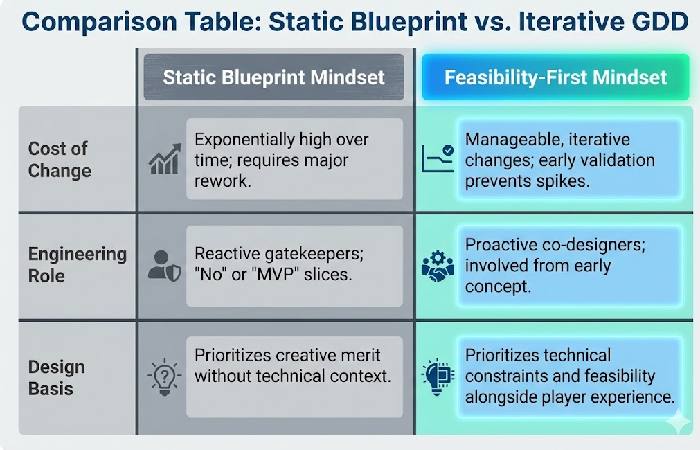
Traditional GDD guides often lean on the architectural blueprint metaphor, positioning the document as the master plan that dictates every wall, window, and door.
This is comforting but dangerous. In construction, the cost of change is truly exponential—you do not move the foundation after the roof is up. In game development, iterative practices can keep changes manageable for a while, but once you violate core architectural constraints, the cost of change spikes sharply.
A static “blueprint” mindset locks in designs before technical constraints are understood, forcing the team to either build brittle systems or spend months re‑architecting subsystems that should never have been designed that way.
When designers work in a vacuum, they naturally prioritise features based on creative merit and player experience, which is their job. However, without technical context, they inevitably bake in assumptions about performance, memory, networking, and complexity that are incompatible with the target platform or engine architecture.
By the time this document reaches engineering, developers are forced into a reactive role. They become gatekeepers whose primary job is to say “no” or to carve out “MVP” slices that bear little resemblance to the original vision.
This fuels a “Design vs Code” tribalism: every “no” feels like an attack on creativity, while every unvetted “yes” becomes immediate technical debt—fragile, hacky systems that buckle under future iterations. Practical advice such as Writing Design Documents Your Game Engineers Won’t Hate explicitly calls out this failure mode and urges teams to involve engineers early.
The Feasibility‑First Framework
To avoid this dynamic, teams need to move from a workflow of “Design → Review” to “Collaborate → Validate → Record.” In a feasibility‑first game design document, the GDD is not a container for wishes; it is a living ledger of feasibility status. It tracks design ideas from initial concept to implementation‑ready features, and its structure forces collaboration rather than assuming it.
Below is a practical framework you can adopt or adapt in your own studio.
The Three‑Tiered Feasibility System
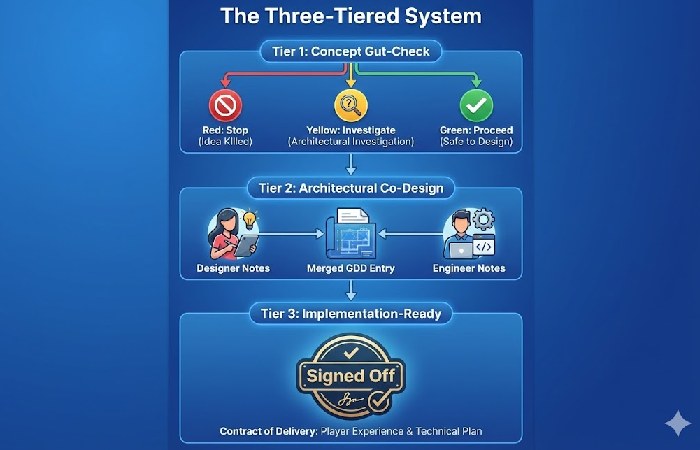
Instead of writing a full design spec and asking for late‑stage review, bring feasibility into the writing process from the first paragraph.
Tier 1: Concept Gut‑Check
Before a mechanic is fully written into the GDD, a lead engineer provides a rapid Red/Yellow/Green assessment based on the current tech stack, tools, and bandwidth.
- Red: The idea is killed or radically reconceived immediately. No pages of copy are wasted on unbuildable fantasies.
- Yellow: Proceed with caution. The idea requires architectural investigation and spikes. This triggers a Tier 2 session.
- Green: Safe to design in detail with known constraints. The “Write” flag is given.
This mirrors the kind of early feasibility and risk assessment many software teams perform but makes it explicit and visible inside the design document itself.
Tier 2: Architectural Co‑Design
For Yellow and Green items, the designer and engineer co‑author the GDD entry. This is the critical hand‑off. The section is no longer just “what the player sees”; it also captures “what the system actually has to do” and under what constraints. A Tier 2 entry typically includes:
- Technical constraints – for example, “Max 5 active AI agents per room to maintain 60fps on target hardware.”
- Performance budgets – CPU, GPU, draw calls, animation, and memory budgets for this feature.
- Data implications – how the feature’s data will be represented and serialized (configuration tables, state machines, network messages, and so on).
Articles on technical game design documentation stress including this kind of system‑level detail so features do not fall apart at implementation time.
Tier 3: Implementation‑Ready
A feature is only marked “Ready” in the GDD when both design and engineering sign off. At this point, the GDD entry serves as a contract of delivery: it expresses both the player experience and the technical plan.
If implementation deviates because of new discoveries or constraints, the GDD is updated by both parties, keeping documentation synchronized with reality.
Structural Changes Inside the GDD
To support this approach, your game design document template has to move beyond “Story,” “Mechanics,” “Controls,” and “Art Direction.” It needs metadata that forces the feasibility conversation and preserves technical intent.
Risk tags
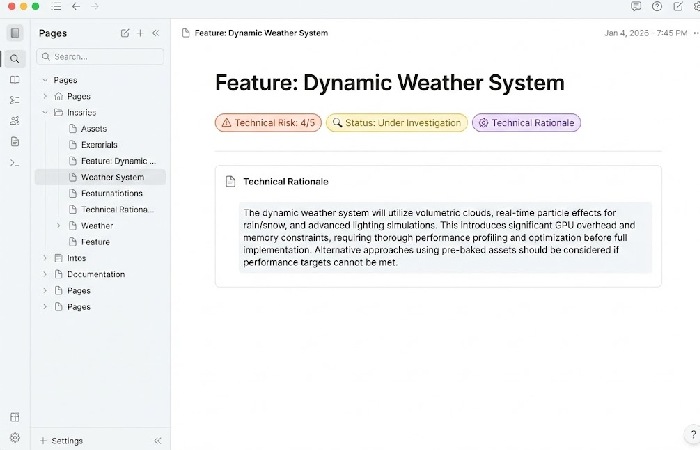
Every major system header should include visible fields such as:
- Technical Risk (1–5) – a quick signal of uncertainty or complexity.
- Feasibility Status – for example, Concept, Under Investigation, Architected, Blocked, Live.
This echoes how some teams use tagged sections or feature documents in wiki‑style GDDs to track status and risk.
Dual rationale: design and technical
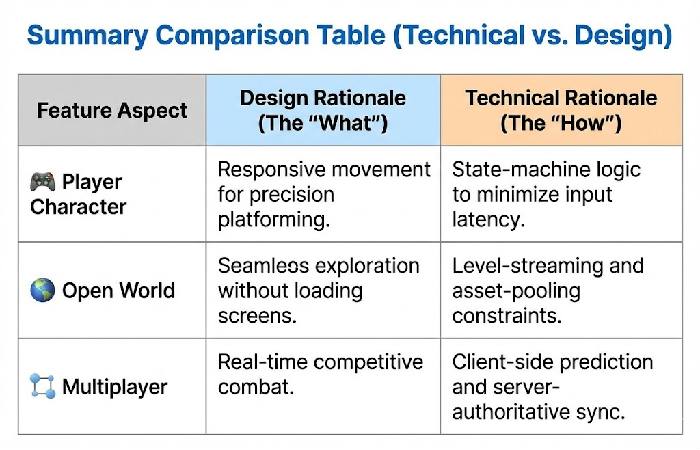
Alongside “Design Rationale,” include a “Technical Rationale” field that explains why a feature is built a certain way, such as:
- “We used a state machine instead of behaviour trees to reduce memory overhead and simplify debugging on mobile devices.”
Documenting these decisions mirrors software‑engineering advice about recording architectural trade‑offs so new team members do not “optimise” away critical constraints. It prevents future erosion of the architecture when new designers or programmers join and attempt to re‑implement systems without understanding their history.
Operational Reality Checks
A common objection to feasibility‑first GDDs is efficiency: “We do not have time for engineers to sit in design meetings. It slows us down.” In practice, the opposite is true.
Rework is one of the largest hidden costs in software development; studies and practitioner reports note that a significant fraction of effort is spent redoing or revising work due to misunderstood or incomplete requirements.
Spending two hours killing or reshaping an unbuildable feature can save weeks or months of implementation and refactoring. Measure twice, cut once applies as much to game systems as to carpentry.
When feasibility is addressed early:
- Impossible or wildly expensive features are caught before they hit sprint backlogs.
- Engineers are not forced into permanent “no” mode, because constraints are baked into design discussions from the start.
- Designers learn the boundaries of current tools and architecture and can pitch ideas that fit those constraints or explicitly justify expansions.
Constraints also sharpen creativity. When designers know the “box” they have to play in—such as “We can only support 50 dynamic lights in this scene” or “We only simulate 10 fully reactive NPCs at a time”—they can shape experiences that feel rich within those boundaries instead of aiming for unrealistic “everything simulates everything” systems.
A Hypothetical Example: The “Reactive AI” Pivot
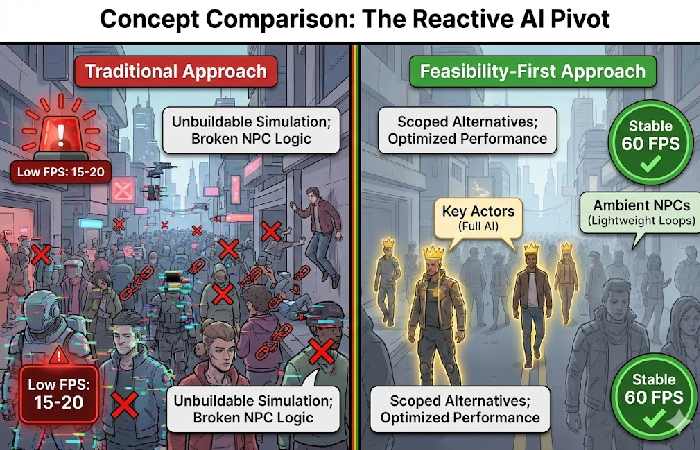
Consider a hypothetical feature: a “Living City” where every NPC has a full schedule, relationship web, and reacts dynamically to player actions over time.
Traditional approach
In a traditional GDD, this might be described in detailed prose, with diagrams outlining NPC schedules and behaviour trees. The document is handed to engineering, which then discovers that simulating 100 deep‑state NPCs in real time on the target hardware is impossible without collapsing the frame rate.
The probable outcomes:
- The feature is cut entirely late in production.
- Or a heavily compromised version ships, running at 15–20fps in busy scenes.
- The team feels demoralised, and the GDD is branded as “nice fiction” rather than a real guide.
Feasibility‑first approach
Under a feasibility‑first GDD:
- The designer pitches the “Living City” concept as a Tier 1 candidate.
- The lead engineer flags it Red for full simulation but opens a Tier 2 discussion about scoped alternatives.
- Together, they design a hybrid system:
- A limited number of Key Actors (quest givers, recurring characters) use fuller schedules and more complex AI.
- The rest of the population are Ambient NPCs running lightweight animation loops and simple triggers.
The corresponding GDD entry is co‑authored:
- The “Living City” section describes the player‑visible illusion of life.
- The technical section explicitly lists a performance budget (for example, 5% CPU for background AI) and caps on active, fully simulated characters.
- The feature is stamped Architected – Green, with clear constraints and a defined feasibility status.
The result is a busy, believable city that maintains frame rate and can be iterated on, rather than a brittle system that collapses under production pressure.
Making Feasibility‑First GDDs Work Day to Day
For this model to succeed, the GDD must live where the work happens, not as a forgotten file. Many teams implement feasibility‑aware design docs inside wiki‑style tools (Confluence, Notion, internal wikis) and link feature sections directly to tasks in issue trackers such as Jira. This allows:
- Engineers to see design intent and feasibility metadata directly from their task boards.
- Designers to update rationale and constraints when playtest feedback or technical discoveries require changes.
- Producers to track risk and status at the feature level, not just at the ticket level.
Modern GDD guides such as Game Design Document: Steps & Best Practices for 2025 and Your Guide to Game Design Documentation consistently recommend documentation that is searchable, modular, and easy to update, which aligns well with feasibility tags and co‑authored sections.
Key FAQs About Feasibility‑First Game Design Documents
Q1. How is a feasibility‑first game design document different from a traditional GDD?
A feasibility‑first GDD is co‑created by designers and engineers and includes technical constraints, risk tags, and performance budgets alongside player‑facing descriptions, whereas traditional GDDs often focus mainly on narrative and mechanics without explicit engineering input.
Q2. Does this approach replace agile tools like user stories and backlogs?
No. A feasibility‑first GDD complements agile practices by acting as a shared reference for intent and constraints, while user stories and backlogs handle granular work management in tools like Jira or similar systems.
Q3. Won’t involving engineers in early design slow the team down?
Involving engineers early can feel slower in the moment but usually reduces overall time by avoiding unbuildable features and expensive rework later, which aligns with findings about the high cost of late requirement changes.
Q4. How detailed should technical sections be?
They should be detailed enough to capture key constraints (budgets, limits, data approaches) without duplicating implementation code. Many teams treat the GDD as a design‑plus‑architecture overview, with deeper specifics documented in code and separate technical design docs.
Q5. What tools are best for hosting a feasibility‑first GDD?
Teams commonly use wiki‑style knowledge tools like Notion, Confluence, or similar platforms because they support modular pages, tagging, and integrations with project‑management tools, all of which help with feasibility tracking and collaboration.
Disclosure
This article is for informational purposes only and does not constitute legal, production, or contractual advice. It is based on current industry best practices, expert guides, and openly available resources on game design documentation and software engineering, including Writing Design Documents Your Game Engineers Won’t Hate. AI assistance was used to help organise, edit, and clarify the content, with human oversight to ensure relevance and accuracy for game development workflows.