

You’re a talented developer. You write clean code, debug faster than most, and understand complex systems. But in a stand-up meeting, the words won’t come. During a code review, your comments get misunderstood. At a job interview for that dream remote position, you freeze.
This is the reality for millions of skilled tech professionals around the world. English skills for tech workers aren’t a nice-to-have — they’re a career multiplier. In a global industry where English dominates documentation, open-source communities, and cross-team collaboration, your language proficiency directly shapes your opportunities.
This guide breaks down the specific English skills tech workers need, maps them to real workplace scenarios, and gives you a practical improvement roadmap — whether you’re a junior developer or a senior engineer looking to step into leadership.
Table of Contents
Key Takeaways
- Why does English matter in tech? → English is the dominant language of programming, documentation, and global tech collaboration — proficiency directly impacts career growth and earning potential.
- What skills do I need? → Technical writing, verbal communication, reading comprehension, presentation skills, and (increasingly) AI prompting.
- How do I improve? → Combine immersion in English-first tech communities with scenario-based practice and structured learning.
- What’s the biggest mistake? → Waiting for “perfect” English before speaking up — functional fluency beats perfection in tech workplaces.
- Who is this for? → Non-native English-speaking developers, IT pros, and tech career changers targeting global roles.
Why English Skills Matter More Than Ever in Tech
The Global Lingua Franca of Technology
English isn’t optional in modern tech — it’s infrastructure. English accounts for roughly half of all website content globally, and the share is even higher for technical and developer-focused material.
Programming languages use English syntax. The world’s largest developer communities — Stack Overflow, GitHub, Hacker News — operate in English. Technical documentation from AWS, Google Cloud, and Microsoft Azure defaults to English first, with translations often lagging behind.
For tech workers, this means your ability to read, write, and speak English determines how quickly you can learn, collaborate, and advance. EF’s 2024 English Proficiency Index reports that higher national English proficiency correlates with stronger economic competitiveness and more globally connected industries, including technology.
English in the Age of AI and Remote Work
Here’s a counterintuitive truth: AI tools are making English more important for tech workers, not less.
Effective prompting for tools like ChatGPT, GitHub Copilot, and Gemini requires precise English. Reviewing AI-generated code, documentation, or summaries demands strong reading comprehension. The engineers who get the best results from AI are those who can articulate clear, specific instructions — in English.
Remote work amplifies this further. In distributed teams, async communication happens through Slack messages, Notion docs, Loom recordings, and pull request comments. When you can’t rely on body language or real-time clarification, your written English carries the full weight of your ideas.
What Are English Skills for Tech Workers?
English skills for tech workers are the specific language competencies — reading, writing, speaking, and listening — that technology professionals need to communicate effectively in English-dominant workplaces. Unlike general English proficiency, these skills are tailored to technical contexts such as code documentation, team stand-ups, technical presentations, and cross-functional collaboration in global or remote settings.
5 Essential English Skills Every Tech Professional Needs
1. Technical Writing (Documentation, PRs, and Commit Messages)
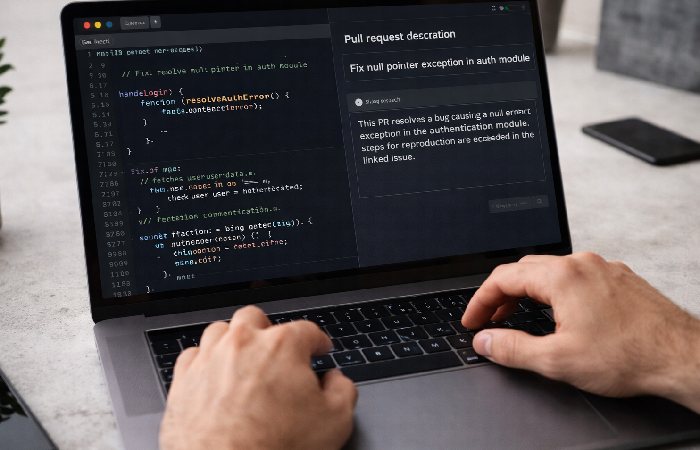
Technical writing is likely where you’ll use English most frequently. This includes:
- Code documentation — READMEs, inline comments, API references
- Pull request descriptions — Clear context for reviewers about what changed and why
- Commit messages — Concise, conventional format (“Fix: resolve null pointer in auth module”)
- Bug reports — Structured descriptions with reproduction steps
- Emails and proposals — Professional communication with stakeholders
The goal isn’t literary elegance. It’s clarity and precision. A well-written PR description saves your team hours of review time. A confusing one creates back-and-forth that slows everyone down.
Pro tip: Study the writing style in top open-source repositories on GitHub. Projects like React, Kubernetes, and VS Code maintain exceptionally clear documentation that serves as a free masterclass in technical English.
2. Verbal Communication (Stand-ups, Demos, and Client Calls)
Speaking English in tech contexts requires a different skill set than casual conversation. Key scenarios include:
- Daily stand-ups — Concise status updates (“Yesterday I completed…, today I’m working on…, I’m blocked by…”)
- Sprint planning and retrospectives — Discussing priorities, estimating effort, giving feedback
- Demo presentations — Walking stakeholders through new features
- Client calls — Explaining technical concepts to non-technical audiences
- Pair programming — Thinking out loud while coding collaboratively
You don’t need a perfect accent. What matters is being understood clearly and responding confidently. Many successful tech leaders are non-native speakers who’ve mastered functional fluency — communicating effectively without obsessing over grammatical perfection.
3. Reading Comprehension (Documentation, Stack Overflow, and Specs)
Tech workers read English constantly — often without realizing how much their reading speed affects productivity. You need to quickly parse:
- Official framework documentation (React, Django, Spring Boot)
- Stack Overflow answers — Evaluating quality and relevance
- Technical specifications and RFCs
- Research papers and whitepapers
- Error messages and log outputs
Strong reading comprehension means you can onboard onto new tools faster, debug more efficiently, and stay current with rapidly evolving technologies.
4. Presentation and Negotiation Skills
As tech workers advance into senior and leadership roles, English presentation skills become critical:
- Conference talks and webinars — Sharing expertise with broader communities
- Internal knowledge sharing — Tech talks, architecture decision records
- Salary and role negotiations — Articulating your value clearly
- Technical interviews — Explaining your thought process during live coding challenges
The Common European Framework of Reference (CEFR) associates effective professional presentation and interaction skills with roughly B2 level and above, which is a useful benchmark for tech workers setting language goals.
5. AI Prompting and Review Skills
This is the newest — and fastest-growing — English skill for tech workers in 2026.
Effective AI usage requires:
- Prompt engineering — Writing clear, specific instructions for AI coding assistants
- Output review — Critically reading AI-generated code, documentation, and summaries
- Iterative refinement — Adjusting prompts based on output quality
Engineers who can write precise English prompts like “Generate a Python function that takes a list of user objects and returns only those with active subscriptions, sorted by join date descending” get dramatically better results than those who write vague instructions.
How to Improve English Skills for Tech Work
Immerse Yourself in English-First Tech Communities
The most effective (and free) way to build technical English is through immersion in communities you already use:
- Contribute to open-source projects on GitHub — Write issues, review PRs, update docs
- Answer questions on Stack Overflow — Explaining solutions forces clear English
- Join English-language Discord and Slack communities — Real-time practice in context
- Follow tech leaders on Twitter/X and LinkedIn — Absorb natural professional English
- Listen to English-language tech podcasts — Syntax, Changelog, Software Engineering Daily
Practice Scenario-Based Learning
Generic English classes teach you to order coffee. What you actually need is to:
- Write a clear bug report with reproduction steps
- Give a 2-minute status update in a stand-up meeting
- Explain a technical decision to a non-technical stakeholder
- Negotiate a deadline with a project manager
- Conduct a code review with constructive, respectful feedback
Practice these specific scenarios — role-play with colleagues, record yourself, or work with a tutor who understands tech contexts.
Use Structured Courses and Tutoring
If self-study isn’t enough, structured learning accelerates progress:
| Method | Cost | Best For | Limitations |
|---|---|---|---|
| Self-study (YouTube, podcasts, reading) | Free | Building vocabulary, passive skills | No feedback, no speaking practice |
| Online courses (Coursera, edX) | $30–$80/course | Structured learning, certificates | Not personalized, limited interaction |
| 1-on-1 tutoring (Preply, iTalki) | $15–$50/hour | Speaking skills, personalized feedback | Higher cost, scheduling required |
| Language exchange (Tandem, HelloTalk) | Free | Conversational practice | Unstructured, inconsistent partners |
| Company training programs | Employer-funded | Comprehensive, job-specific | Not always available, may be generic |
Build a Technical Vocabulary System
Don’t try to memorize the entire dictionary. Focus on the 20% of vocabulary that covers 80% of your daily work:
- Start a personal glossary — Add terms you encounter daily with context sentences
- Categorize by domain — DevOps vocab, frontend vocab, project management vocab
- Use spaced repetition — Apps like Anki help retain vocabulary long-term
- Learn phrases, not just words — “Deploy to staging” is more useful than learning “deploy” in isolation
According to the U.S. Bureau of Labor Statistics, overall employment in computer and information technology occupations is projected to grow much faster than the average for all occupations through the coming decade. In this expanding global market, English proficiency is a competitive advantage that compounds over time.
Common Mistakes Tech Workers Make with English
- Waiting for perfection before speaking up — Functional fluency wins. Your team values your technical insight more than flawless grammar.
- Relying entirely on AI translation — Google Translate and DeepL are useful safety nets, but they can’t replace the nuance you need for code reviews, negotiations, or relationship building.
- Only studying formal English — Tech communication is often informal. Learn to read and write casual Slack messages, not just formal emails.
- Ignoring listening skills — You can’t respond well if you haven’t understood the question. Practice listening to English-language tech talks at normal speed.
- Treating English as separate from work — The fastest improvement comes from using English in your work — writing PRs in English, joining English-language channels, doing code reviews in English.
Who Should Prioritize English Skills (And Who Might Not Need To)
Best for:
- Non-native developers working in multinational or English-first companies
- Remote tech workers collaborating across time zones
- Job seekers targeting roles at global companies (FAANG, startups with international teams)
- Freelancers and contractors serving English-speaking clients
Not for (or lower priority):
- Professionals working exclusively in native-language tech ecosystems (e.g., Japanese companies with all-Japanese teams)
- Very early-stage beginners — learn fundamental coding skills first, then layer on English
- Workers whose companies provide dedicated translation/interpretation support
Final Verdict — Your English Roadmap
English skills for tech workers are a career multiplier — not because English is inherently better than any other language, but because the global tech industry has standardized around it.
The good news? You don’t need to be perfect. You need to be functional. Start with the skills that matter most for your current role:
- If you write code daily → Focus on technical writing (documentation, PRs, commit messages)
- If you’re in meetings often → Prioritize verbal communication and listening
- If you’re job searching → Work on interview English and presentation skills
- If you use AI tools → Practice clear, precise English prompting
Pick one area. Practice it in real work contexts. Stack skills over time. The compound effect of consistent English improvement will show up in your career faster than you expect.
Frequently Asked Questions
Q1: Why is English important for tech workers?
English is the dominant language of programming, technical documentation, and global tech collaboration. Proficiency enables access to the largest developer communities, open-source projects, and career opportunities. Tech workers with strong English skills can collaborate across borders, read documentation faster, and advance into leadership roles.
Q2: What English skills do software developers need most?
The five most critical skills are technical writing (documentation, PRs), verbal communication (meetings, stand-ups), reading comprehension (documentation, Stack Overflow), presentation and negotiation skills, and AI prompting. Technical writing and reading are typically the most frequently used on a daily basis.
Top employers in global tech hubs consistently emphasize strong people skills, client management, and teamwork alongside technical ability, so your English communication directly supports these in-demand soft skills.
Q3: How can IT professionals improve their English quickly?
Combine immersion with structured practice. Contribute to English-language open-source projects, join tech communities on Discord or Slack, and practice scenario-specific skills like giving stand-up updates or writing bug reports. Structured courses or 1-on-1 tutoring accelerate progress for speaking skills.
Q4: Is English required for programming jobs?
Not always — many companies operate in local languages. However, English significantly expands your job market, salary potential, and access to learning resources. Most high-paying global tech roles list English proficiency as a requirement or strong preference.
Q5: What is technical English?
Technical English is the specialized vocabulary, phrasing, and communication style used in professional and technical fields. For tech workers, this includes coding terminology, documentation conventions, Agile/Scrum language, and the precise, concise writing style used in code reviews and technical specifications.