

You wake up and reach for your phone, scroll before bed, and feel oddly restless if you can’t check your apps. That pattern is not just “modern life” — heavy recreational screen and social media use is consistently linked with poorer sleep, more anxiety, and lower life satisfaction in large population studies.
Quick 30-Second Audit: Is it time for a reset? Check all that apply to you:
-
[ ] I check my phone within 10 minutes of waking up.
-
[ ] I feel “phantom vibrations” or the urge to check apps when bored.
-
[ ] My screen time is higher than I’d like it to be.
-
[ ] I struggle to focus on one task for more than 20 minutes.
-
[ ] I scroll social media even when I’m not enjoying it.
A digital detox is not about rejecting technology; it’s about resetting your relationship with devices so you regain intentional control of your time, attention, and mental energy. It means taking a planned break from non‑essential digital engagement (doomscrolling, constant notifications, autoplay videos) so focus, sleep, and mood can recover.
Result: If you checked 2 or more, the framework below is designed specifically for you.
Table of Contents
Quick answer: what a digital detox really is
A digital detox is a deliberate, time‑bound reduction or pause from non‑essential digital use — especially social media, recreational scrolling, and constant notifications — to reduce overload and support better sleep, focus, and mental health.
It does not mean abandoning technology altogether; most evidence supports intentional reduction and boundaries over all‑or‑nothing abstinence, and major health resources like Cleveland Clinic’s guide to digital detox describe it as a planned break from certain apps or devices to improve mental and physical well‑being, not a total rejection of technology.

Why digital overload hits so hard in 2025
Adults now spend about 6.5–7 hours a day on screens, with a big chunk going to social media and entertainment.
Evening screen use suppresses melatonin, which is tied to poorer sleep, lower mood, and reduced concentration. Heavy recreational screen users also report more anxiety, depression, and lower life satisfaction than lighter users, even though the link isn’t purely one‑way.
For busy adults balancing remote work, family chats, and constant pings, the line between “on” and “off” time almost disappears. A recent Medical News Today overview of digital detox research notes that this always‑on pattern drives stress, fragmented sleep, and cognitive overload when screen use isn’t actively managed.
If constant notifications and endless feeds are making it hard to focus, pairing a digital detox with smarter device habits helps — our guide to smartphones and modern mobile technology shows how to reduce distractions without losing useful features.
As you free up time from screens, you can reinvest your attention into tools that genuinely support your life; our overview of smart home and emerging tech trends explores ways to enjoy connected devices without slipping back into mindless scrolling.
What the latest research actually shows
Recent trials and reviews give a clearer picture of what digital detoxes can do — and where expectations should be realistic.
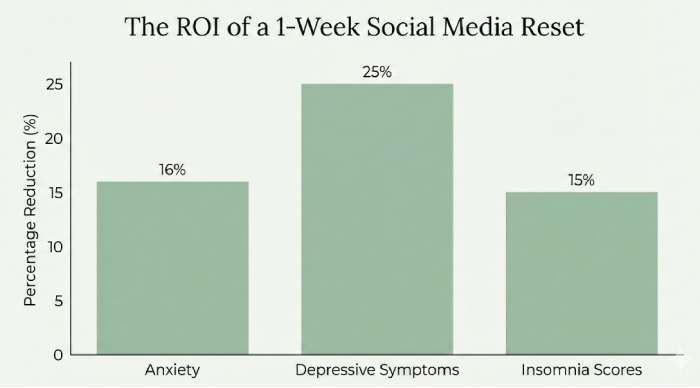
Short social media detoxes help mood and sleep. A one‑week social media reduction trial in young adults, where participants cut use to roughly 30 minutes a day, produced around a 16% reduction in anxiety, 25% reduction in depressive symptoms, and ~14–15% reduction in insomnia scores. A detailed New York Times report on a one‑week social media detox explains how even this brief change led to measurable mental health improvements.
Intervention studies show broader benefits. Controlled digital detox or reduction programs report measurable improvements in mood, life satisfaction, sleep quality, and sustained attention, even over short periods.
Longer detoxes can have sizeable effects. A longer‑duration screen‑time reduction study highlighted by Georgetown University found participants slept longer, felt less stressed and anxious, and performed better on attention tasks, suggesting benefits that are comparable in size to other lifestyle‑based mental health strategies.
Meta‑analyses and scoping reviews add nuance. A 2025 Cureus scoping review on digital detox strategies and mental health reports that structured reductions in digital use can significantly reduce depressive symptoms, while broader effects on well‑being depend on the type of intervention and individual differences.
Overall, the pattern is clear: strategic, voluntary reductions — especially around social media and evening screens — tend to help, but effects are not uniform and rebound can happen if changes are too extreme or short‑lived.
| Metric | Improvement After 1 Week |
| Anxiety | 16% Reduction |
| Depressive Symptoms | 25% Reduction |
| Insomnia Scores | 15% Reduction |
Who should consider a digital detox?
A detox is worth serious consideration if you notice patterns like:
- Doomscrolling before bed and waking up unrefreshed.
- Difficulty sustaining attention, especially on deep work.
- Anxiety, irritability, or restlessness when separated from your phone.
- Constant checking of notifications and feeling “on call” 24/7.
- Feeling strangely unfulfilled despite long hours online.
These are less about one bad day and more about habit loops that keep your nervous system in a semi‑stressed, distracted state — exactly what a structured detox aims to disrupt.
A practical detox framework for busy adults (evidence‑informed)
Forget extreme retreats or quitting your job. This framework blends a survival‑guide structure with what intervention studies say is realistic and sustainable.
1. Clarify your “why”
Specific goals make detoxes stick:
- “I want to fall asleep faster and sleep better.”
- “I want 2–3 hours a day for deep work without interruptions.”
- “I want to feel calmer and less triggered by news or social media.”
Writing this down helps you choose boundaries that fit your actual life, rather than copying someone else’s 30‑day challenge.
Your 24-Hour Detox Kickstart:
-
Identify your ‘Why’: (e.g., “I want better sleep”).
-
Set a ‘Hard Stop’: Turn off all screens 60 minutes before bed tonight.
-
Change the Scenery: Move your phone charger out of the bedroom.
-
Cull the Noise: Disable notifications for 3 non-essential apps right now.
-
Pick an Analog Win: Choose one book or hobby to grab instead of your phone this evening.
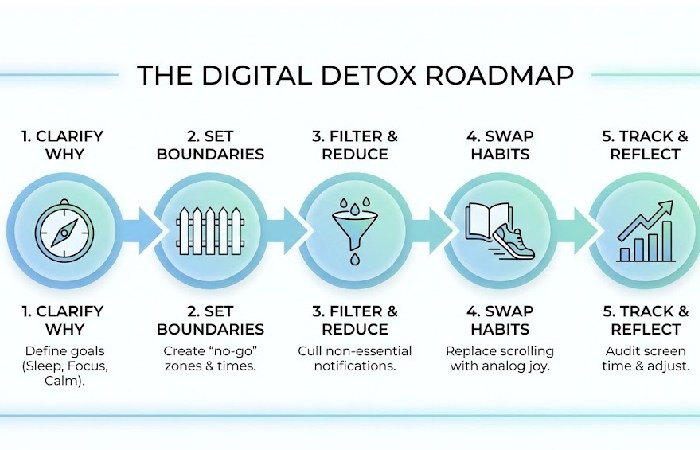
2. Set clear, measurable boundaries
Instead of vague “I’ll cut down,” use concrete rules that research and clinical guides support:
- No screens for 60 minutes before bed on weeknights.
- No social apps during meals or family time.
- Two screen‑free hours each evening (e.g., 7–9 pm), except for essential calls.
- Charge devices outside the bedroom and use a basic alarm.
These small structural changes disrupt automatic checking and reduce late‑night light exposure, helping circadian rhythm and sleep.
3. Reduce, don’t just remove
Evidence and reviews increasingly favor structured reduction over extreme, forced abstinence for most people:
- Turn off notifications for non‑urgent apps (social, shopping, news).
- Use “Do Not Disturb” or focus modes during deep‑work blocks.
- Set app‑level limits (e.g., 30 minutes per day of social media), similar to protocols used in successful trials.
This reduces cognitive load and interruption frequency while keeping work‑critical tools available.
4. Replace screen time with purposeful activities
Detox benefits are stronger when removed screen time is replaced with meaningful offline activities, not just boredom. Research repeatedly highlights that tactile engagement and movement buffer stress better than passive scrolling.
| The Trigger (How you feel) | The “Analog” Alternative | Why it Works |
| Bored or Restless | A 10-minute walk (ideally outdoors). | Movement lowers cortisol and resets focus. |
| Stressed/Overwhelmed | Reading a physical book or magazine. | Long-form reading calms the nervous system. |
| Lonely/Disconnected | Face-to-face conversation or a meal. | Provides deep emotional satiety screens can’t. |
| Mentally Fatigued | Hands-on hobbies (cooking, crafts, music). | “Flow state” activities restore cognitive energy. |
Studies on digital detox and well‑being repeatedly highlight that real‑world engagement and movement buffer stress and boost mood better than passive scrolling.
5. Track, reflect, and adjust
Intervention studies and behavior‑change research point to self‑monitoring and reflection as key success factors:
- Use built‑in screen‑time analytics to capture your baseline, then compare after 1–2 weeks.
- Note changes in sleep quality, mood, focus, and stress (even short mood logs work).
- Identify triggers (boredom, stress, social comparison) that drive your heaviest use and tweak boundaries accordingly.
This turns your detox into a learning experiment rather than a one‑off “challenge.”
Evidence‑based benefits you can realistically expect
You can keep a benefit table, but tie each point to the broader evidence:
Better sleep quality
Evening light reduction supports melatonin and more consistent circadian rhythms; both RCTs and clinical guidance note improvements when screens are restricted before bed, and this is echoed in Medical News Today’s digital detox benefits analysis.
Reduced stress and anxiety
Detox and reduction trials report meaningful drops in anxiety scores, with some meta‑analyses showing significant effects on depressive symptoms as well.
Improved focus and attention
Participants in intervention studies show improvements in sustained attention and subjective focus when notifications are reduced and social media is limited.
Stronger real‑world connection
Reducing recreational screen time naturally increases opportunities for face‑to‑face interaction, which is consistently associated with higher well‑being and lower loneliness.
Greater reflection and intentional use
Qualitative and mixed‑methods studies find that people often come away with clearer awareness of their habits and more intentional long‑term digital use after detox experiments.
Not every study shows large gains for everyone, but across trials and reviews, the trend favors small, structured changes over time rather than radical, one‑off breaks.
Common pitfalls, rebound, and safety notes
Relapse into old habits
Treat your detox as a starting point for digital minimalism — keeping only tech that adds value and cutting low‑value, high‑dopamine loops. Building small, recurring screen‑free blocks is more sustainable than a single intense challenge.
FOMO or withdrawal‑like anxiety
Initial discomfort (restlessness, boredom, FOMO) is common; studies note this often fades after a few days as new routines and offline rewards take hold.
Work and essential use
Most expert guidance, including Cleveland Clinic’s digital detox recommendations, emphasizes that detoxing does not mean abandoning necessary work tools; instead, it targets non‑essential recreational and distracting use.
Forced, extreme abstinence
Reviews caution that rigid, forced “no‑tech” rules without planning can be harder to maintain and may be less effective than voluntary, structured reduction combined with self‑awareness.
Bottom line for 2025 busy adults
A digital detox in 2025 is best seen as a science‑supported reset for an always‑on world — not a rejection of technology or a wellness fad.
Short, structured breaks and reductions in social media and evening screens can meaningfully improve sleep, mood, and focus for many people, especially heavy users, as highlighted in a detailed New York Times report on a one‑week social media detox.
For busy adults, the strongest approach blends clear boundaries, realistic reductions, meaningful offline replacements, and ongoing reflection, supported by practical medical guidance such as Cleveland Clinic’s guide to digital detox and broad syntheses like the 2025 Cureus scoping review on digital detox strategies and mental health, so that the gains you feel in a week or two can turn into sustainable, calmer digital habits for the long term.
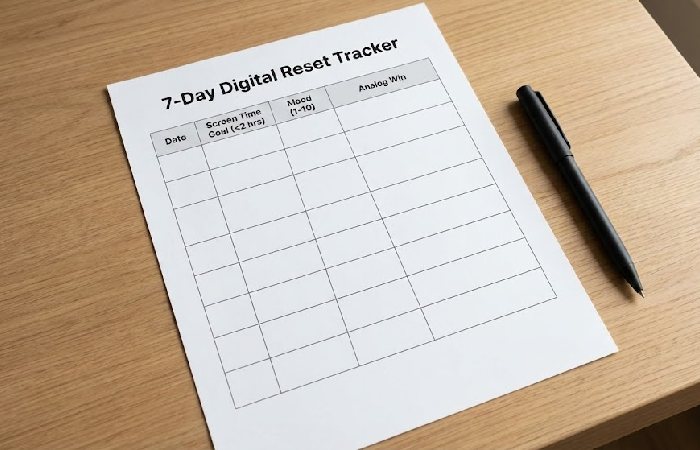
Bonus: Download Your Free Tracker
Turn these insights into a habit. Download our free 7-Day Digital Reset Tracker PDF to log your baselines, track your “Analog Wins,” and note improvements in your sleep and mood.
7-Day-Digital-Reset-Tracker.pdf
Frequently Asked Questions about Digital Detox
1. What exactly counts as a digital detox?
A digital detox is a planned period where you intentionally reduce or avoid non‑essential digital activities (like social media and endless scrolling) to protect your sleep, mood, and focus.
2. How long should a digital detox last?
There’s no fixed length; many people start with daily screen‑free windows (like evenings) or short 1–7 day breaks and then adjust based on how they feel.
3. Do I have to quit social media completely?
No. Research shows you can benefit by cutting down — for example, limiting social media to around 30 minutes a day or using set check‑in times.
4. Will a digital detox cure anxiety or depression?
It can ease stress and improve mood, especially if your use is high, but it does not replace professional care for clinical anxiety or depression.
5. Can I still use technology for work during a detox?
Yes. The focus is on reducing non‑essential, recreational use while keeping necessary tools for work and important communication.
6. What if I feel bored or restless without my phone?
That’s common at first; it usually eases once you intentionally replace screen time with other activities like walking, reading, or hobbies.
7. How do I maintain the benefits after my detox?
Keep some screen‑free routines, leave most non‑essential notifications off, and review your screen‑time and how you feel every few weeks.
Disclosure
This guide was created using up‑to‑date, peer‑reviewed research and reputable health sources, including Cleveland Clinic’s guide to digital detox, Medical News Today’s overview of digital detox benefits and challenges, and the 2025 Cureus scoping review on digital detox strategies and mental health. AI assistance was used to help organize and simplify complex findings, but all claims were checked against primary or high‑authority secondary sources where available.
About the Author
Abdul Rahman is a digital content strategist and blogger with over four years of experience translating complex research on technology, mental health, and productivity into clear, actionable guides. He specializes in evidence‑based, user‑first content that helps busy professionals set healthy boundaries with screens, improve focus, and build sustainable digital habits.