

Many Game Design Documents fail in practice — even the ones that are well written.
They fail despite having clear sections, detailed mechanics, neat formatting, and pages of explanation. They fail not because teams skipped steps or ignored templates, but because the GDD was treated as a document instead of what it actually needs to be: a coordination system.
If you’ve shipped a game (or tried to), you’ve seen this play out. The GDD starts strong. Everyone aligns. Production begins. Then reality intervenes. Decisions accelerate.
Constraints appear. Context moves faster than documentation. The file survives — but shared understanding doesn’t.
That failure isn’t about writing quality. It’s about how teams think about documentation.
In practice, a coordination-first Game Design Document is a living system that records design intent, decisions, constraints, and rationale so teams can align across time, roles, and changing conditions — not a static specification of features.
For teams that want a more structured, engineer‑friendly approach to this idea, a dedicated feasibility‑first game design document framework shows how to bake technical constraints and decision checks directly into the GDD so it stays realistic as production evolves.
GDDs collapse in production because decisions accelerate while documentation lags — and because teams lose context long before they lose features.
Table of Contents
Executive Summary
Most Game Design Documents fail not because they’re incomplete or poorly structured, but because they’re treated as static specifications instead of coordination systems.
In real production, decisions change, constraints emerge, and context decays faster than features evolve.
This article reframes the GDD as a living system that preserves design intent, decision rationale, and cross-discipline alignment over time.
It explains why templates break down in shipping environments, how experienced teams actually use documentation, and how a coordination-first GDD prevents re-litigation, design drift, and institutional memory loss.
This article is written for designers, leads, and producers who have worked on live or shipped projects and have seen traditional GDDs break down under real production pressure.
Why “Well-Written” GDDs Still Collapse in Production
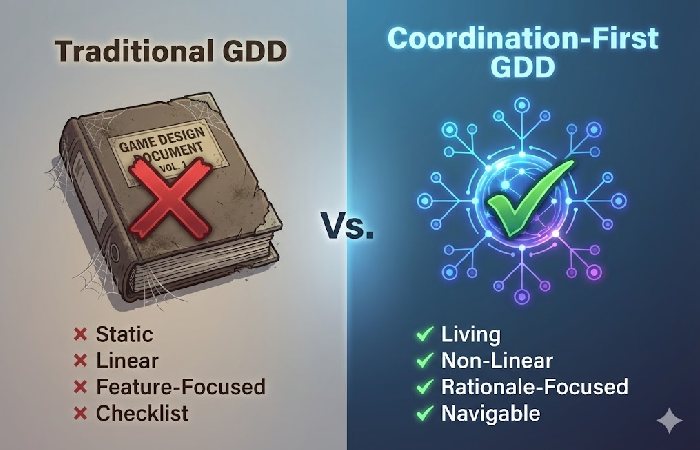
Traditional GDD advice assumes conditions that don’t exist in modern development:
- Requirements are stable
- Decisions are linear
- Understanding is permanent
- One artifact can serve all disciplines equally
Real production violates all of these.
Design decisions are provisional. Teams change mid-project. Constraints emerge unexpectedly. Context decays faster than features evolve. A document optimized for completeness at a single moment in time cannot survive this environment.
This is why GDDs often become historical artifacts rather than active tools. They describe what the game was supposed to be, not how it is actually being built.
Reframing the GDD: From Specification to Coordination System
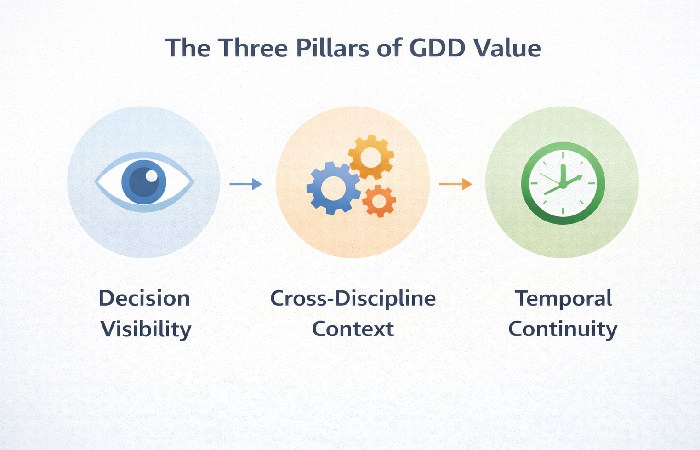
A coordination-first GDD does not exist to describe the game exhaustively — it exists to preserve alignment under change. It exists to solve three concrete production problems.
1. Decision Visibility
A working GDD makes it obvious:
- What was decided
- When it was decided
- Under which constraints
Teams don’t just forget what they chose — they forget why they stopped debating. When rationale disappears, decisions reopen by default, usually with worse information than before.
2. Cross-Discipline Context
Designers, engineers, artists, and producers do not need the same information, at the same level of abstraction, at the same time.
A coordination system acknowledges that:
- Engineers need constraints and edge cases
- Artists need intent and boundaries
- Producers need implications and risk
A single linear narrative fails all three.
3. Temporal Continuity
The true value of a GDD appears months later:
- When onboarding someone mid-project
- When revisiting a cut or constrained feature
- When a system resurfaces under new technical or market conditions
If documentation cannot answer “why did we do this?” long after the decision was made, it has failed its highest-value role.
What Experienced Teams Actually Use a GDD For
Teams that keep their GDDs alive don’t read them cover-to-cover. They query them surgically to:
- Prevent re-litigation of settled decisions
- Onboard new contributors without relying on oral history
- Align design intent with unavoidable implementation compromises
- Explain why something is “good enough” rather than “perfect”
Notice what they don’t use it for: validating that every section exists.
Why Templates Fail at Scale
Templates often break down at scale when teams treat them as checklists instead of coordination tools.
Templates optimize for teaching and reassurance. They are excellent for:
- Students
- First-time designers
- Conceptual completeness
They are poor at:
- Change tolerance
- Retrieval speed
- Decision traceability
A long template encourages teams to fill boxes instead of surfacing uncertainty, tradeoffs, and pressure points. Production documentation does not need to be complete — it needs to be navigable, current, and intentional.
Rationale Is the Highest-Value Data You Can Capture
Features age poorly. Rationale compounds.
Six months into production, teams rarely ask:
“What does this system do?”
They ask:
- Why is this constrained this way?
- Why was the alternative rejected?
- Is this limitation intentional or accidental?
When rationale is missing, teams either re‑argue old debates, freeze decisions out of fear, or make changes without understanding consequences. Work on design rationale documentation stresses that capturing the “why” behind decisions is critical to avoid repeated debates and to support safe evolution of complex systems.
How Coordination-First GDDs Fit Modern Workflows
A coordination-first GDD does not replace:
- Meetings
- Playtests
- Prototypes
It binds them together.
Effective GDDs link:
- Design intent → prototypes
- Decisions → implementation tickets
- Playtest results → design adjustments
When a playtest invalidates a mechanic, the change is contextualised — not silently overwritten. Agile game‑dev discussions, such as Agile Game Development: Working Game vs GDD, emphasise that documentation should track outcomes of iteration, not just initial predictions.
Practical Coordination-First GDD Model Teams Can Adopt
Core Shift
A coordination-first GDD is organized around decisions and intent, not features and sections.
1. Organize by Decision Domains (Not Features)
Instead of:
- Gameplay
- Story
- Levels
Use decision domains, such as:
- Core Player Experience
- Combat / Interaction Model
- Progression & Economy
- Technical Constraints
- Content Scope & Cut Lines
Each domain exists where misalignment would be costly.
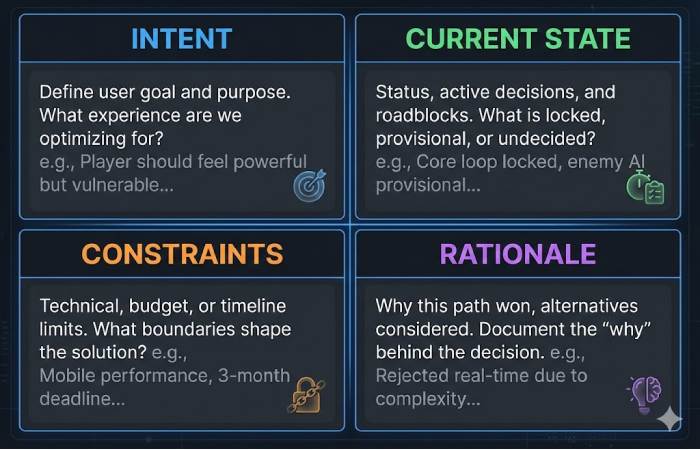
2. Use the Same 4-Block Structure in Every Domain
A. Intent
What experience are we optimizing for?
What problem does this domain solve?
B. Current Decision State
What is locked, provisional, or undecided right now?
C. Constraints & Tradeoffs
Technical, time, budget, or team limits that shape decisions.
D. Rationale & Rejected Alternatives
Why this path won, and under what conditions it should be revisited.
This is organizational memory.
3. Assume the GDD Is Queried, Not Read
If your GDD requires linear reading, it is already failing.
Teams ask:
- “Why can’t we add X?”
- “Is this behavior intentional?”
- “What happens if we cut Y?”
Design for fast answers, not narrative flow.
4. Ownership Is Mandatory
Every domain has:
- One owner
- One backup
Ownership means:
- Updating intent when direction shifts
- Marking decisions clearly
- Recording rationale when debates end
No owner = silent decay.
5. Update on Decisions, Not on Schedules
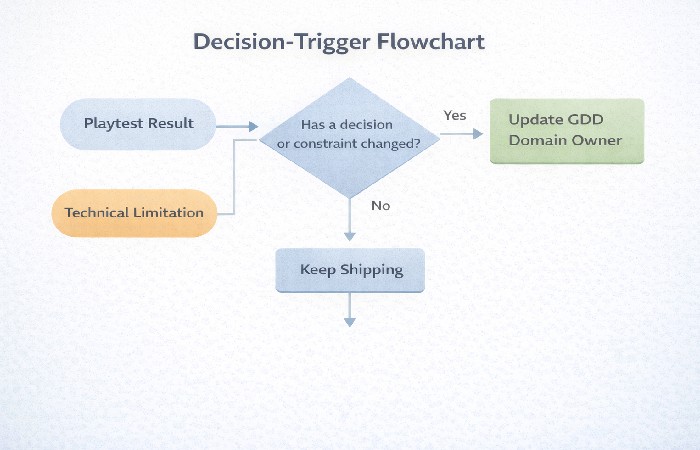
Bad rule: “Update weekly”
Good rule: “Update when a decision is made or reversed”
Trigger updates when:
- A playtest changes direction
- A constraint appears
- A feature is cut
- A workaround becomes permanent
6. Minimal Viable GDD
- Day 1: 3–5 domains, intent + constraints only
- After first playtest: decisions and rationale
- Mid-production: fewer changes, higher rationale value
Documentation grows with complexity — not ahead of it.
Example (One Page)
Domain: Combat System
- Intent: Tactical, readable combat where positioning matters more than reflex speed
- Decisions: Turn-based (locked), grid movement (locked), permadeath (provisional)
- Constraints: Mobile performance limits, small animation budget
- Rationale: Real-time rejected due to animation cost and input precision issues
This single page outperforms ten pages of feature description.
Counter-Arguments (and Why They Miss the Point)
“This Is Overkill for Small Teams”
Correct — and intentional. Coordination-first GDDs scale with complexity. Small teams and early prototypes should stay lightweight until coordination costs rise.
“A Strong Lead Can Do This Without Documentation”
Temporarily. But undocumented coordination doesn’t survive turnover, scale, or time. This model externalizes leadership context.
“Agile Teams Don’t Need GDDs”
Agile teams don’t need static specs. They absolutely need decision memory. This model documents outcomes of iteration, not predictions.
Conclusion
Most guides ask:
“What should my GDD contain?”
That’s the wrong question.
The better one is:
“What coordination problem is this documentation solving right now?”
A Game Design Document that doesn’t coordinate decisions, preserve rationale, and align people across time isn’t a design document at all.
It’s just formatted speculation.
Key FAQs About Coordination‑First GDDs
Q1. What is a coordination‑first game design document?
A coordination‑first GDD is a living system that records intent, decisions, constraints, and rationale so teams can stay aligned as the game changes, rather than a static feature list.
Q2. How is this different from a traditional GDD template?
Traditional templates focus on filling out sections for completeness, while a coordination‑first GDD focuses on decision visibility, ownership, and fast retrieval of “why” behind choices.
Q3. Do small or agile teams really need this?
Small or early‑stage teams can keep it very lightweight, but once you have multiple disciplines, turnover, or live updates, explicit decision memory becomes critical even in agile environments.
Q4. What should I document first if I’m starting from scratch?
Start with a few decision domains (e.g., core experience, combat, progression) and capture intent, current decision state, key constraints, and high‑level rationale on a single page for each.
Q5. Which tools work best for a coordination‑first GDD?
Collaborative, searchable tools like Notion, Confluence, or other wiki‑style platforms work well because they support modular pages, links to tickets, and easy updates.
Disclosure
This article is for informational purposes only and does not constitute legal, production, or contractual advice. It is based on current industry best practices and openly available resources on game design documentation, agile game development, and design rationale. AI assistance was used to help organise, edit, and clarify the content, with human oversight to ensure accuracy and practical relevance for game development teams.
About the Author
Abdul Rahman is a professional content creator and blogger with over four years of experience writing about technology, health, marketing, productivity, and everyday consumer products. He focuses on turning complex topics into clear, practical guides that help readers make informed decisions and improve their digital and daily lives.