
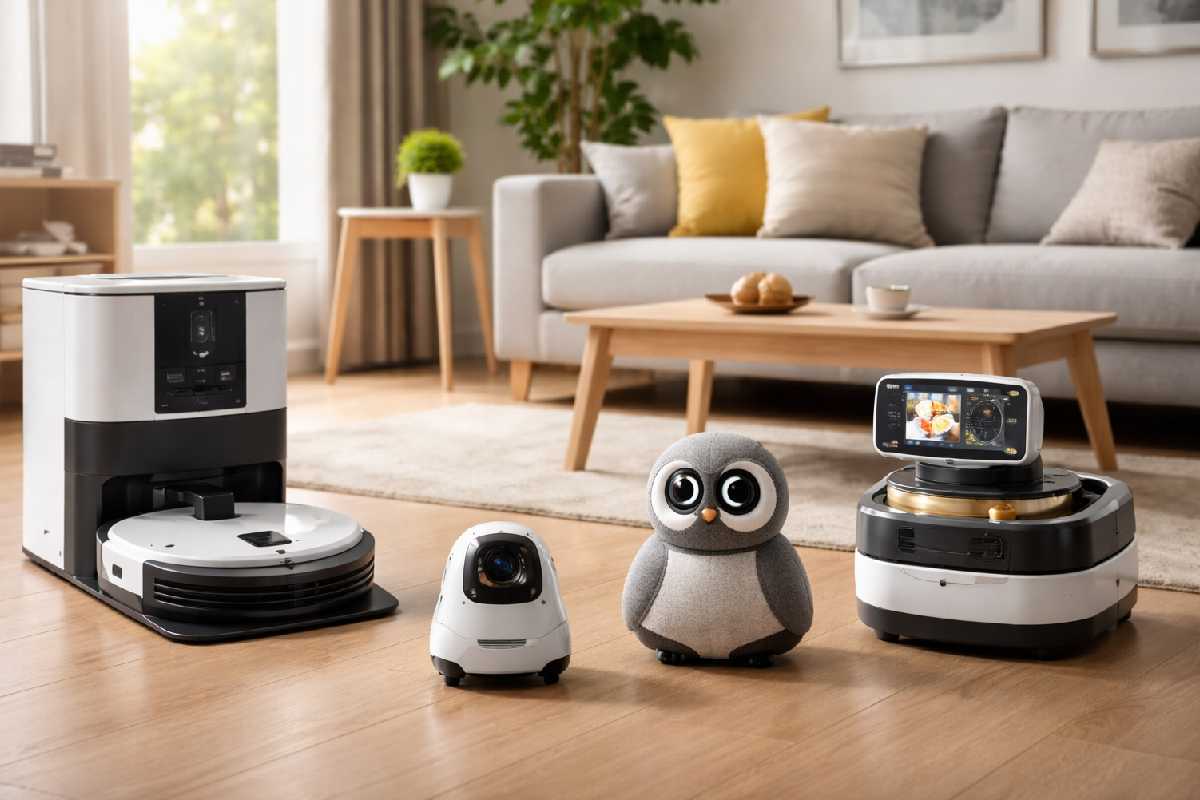
Many pages discussing cool robotic gadgets for your home blur the line between robots and generic smart devices. Others focus on inspiration but avoid practical questions—like cost, suitability, limitations, and real-world trade-offs.
This guide closes those gaps. It explains:
- What qualifies as a home robot
- What they typically cost (with realistic bands and examples)
- Who each category is suited for
- Their advantages and disadvantages
- How to choose responsibly without relying on marketing claims
Table of Contents
Purpose of This Guide
The purpose of this guide is to help readers:
- Make sense of the growing home robotics space
- Understand where robots add value and where they don’t
- Compare categories using transparent, non-promotional criteria
- Avoid buying mismatched or unsuitable devices
This is an informational guide, not a product endorsement.
Who This Guide Is For
This guide is designed for:
- Homeowners and renters researching robotics cautiously
- People comparing options before spending
- Families, pet owners, and busy households
- Readers who value context over hype
It is not intended for readers looking for deals, discounts, or rankings.
Common Questions and Pain Points
People researching home robots commonly ask:
- How much do these robots usually cost?
- Are they suitable for apartments or only houses?
- Which robots are useful versus novelty-driven?
- What are the downsides no one talks about?
- How do I know which type fits my lifestyle?
Each section below addresses these questions directly.
What Qualifies as a Robotic Gadget
For a broader look at how robotic systems operate beyond household tasks, see the Technologyford overview on robotic automation in enterprise environments, such as in “Robotic Process Automation Applications: 2026 Use Cases” which explores how automation and robots are defined in practice across industries.
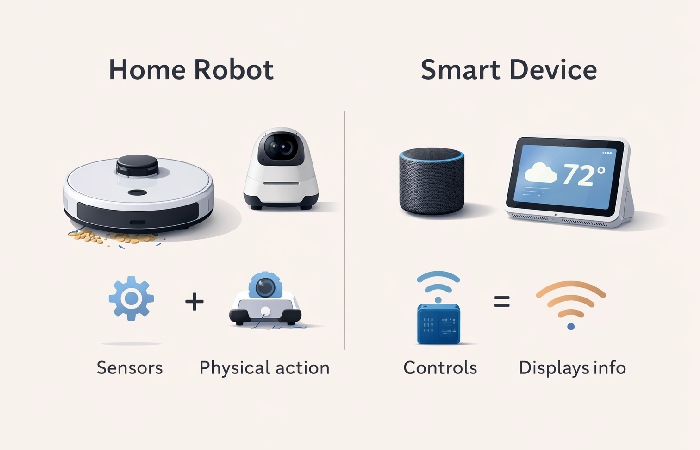
For clarity, a device is considered a robotic gadget in this guide if it:
- Performs a physical task autonomously or semi-autonomously
- Uses sensors, programming, or AI-assisted logic
- Acts in the physical environment, not just digitally
Devices that only connect, control, or display information are excluded. These criteria are consistent with how major robotics organizations describe service and household robots, as outlined by the International Federation of Robotics.
Main Categories of Cool Robotic Gadgets for Homes
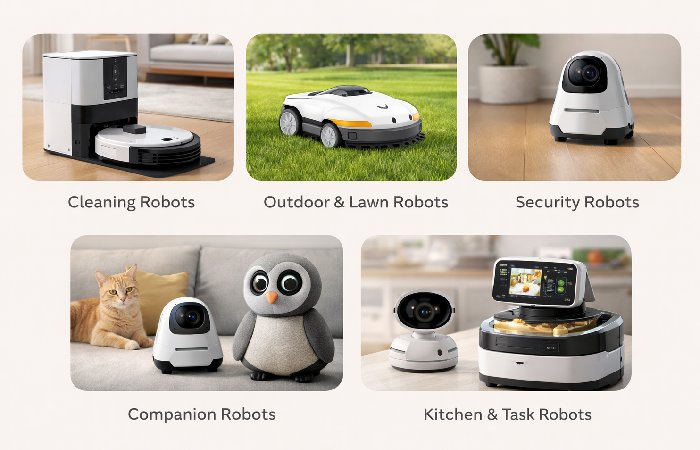
Independent testing of robotic vacuums consistently shows that floor type, layout complexity, and regular maintenance have a major impact on real-world performance, which matches what many homeowners experience when they first adopt a robot cleaner. Detailed lab reviews from organizations like Consumer Reports highlight these practical limitations alongside advertised strengths.
1. Cleaning & Maintenance Robots
Robotic vacuums are one of the most practical types of home robots for everyday cleaning, and if you decide to buy one, retailers such as Robot Cleaner Store can help you compare different brands and models in one place.
Robots designed to automate repetitive indoor cleaning tasks.
Typical price range (market pattern):
- Low: basic bump‑navigation vacuums from around ₹13,000–₹20,000 in India or roughly 150–250 USD globally.
- Mid: app‑controlled, mapping robots with mopping in the ₹25,000–₹45,000 band or 300–600 USD.
- High: self‑emptying, high‑suction docks often priced from ₹55,000+ or 700–1,200 USD.
Concrete examples you can actually buy:
- Budget: ILIFE A80 Pro or Mi Robot Vacuum Mop 2i for small to medium homes.
- Mid‑range: Xiaomi Robot Vacuum Cleaner X10 or Ecovacs Deebot N20 Pro.
- High‑end: Narwal Freo Z Ultra or similar flagship models with auto‑empty docks and hot‑water mop wash.
Geographic suitability:
- Widely adopted in urban and suburban homes
- More practical in regions with predictable indoor layouts
Advantages
- Time savings
- Consistent task execution
- Reduced manual effort
Disadvantages
- Requires preparation and maintenance
- Performance varies by floor type and layout
- Not ideal for highly cluttered spaces
2. Outdoor & Lawn Robots
Robots designed for lawn care or outdoor maintenance tasks.
Typical price range:
- Low: basic residential mowers generally start around 800–1,200 USD in many markets.
- Mid: smarter RTK/GPS‑enabled mowers in the 1,500–3,000 USD range.
- High: commercial‑grade robots running from 4,000–25,000+ USD for large areas.
Concrete examples you can actually buy:
- Residential: entry‑level Segway Navimow models or similar small‑yard mowers.
- Performance‑focused: units like Sunseeker V3 or higher‑end Navimow versions that handle steeper slopes and bigger lawns.
Geographic suitability:
- Best suited for regions with private lawns
- Limited usefulness in apartments or dense urban areas
Advantages
- Reduces physical labor
- Operates on schedules
For households that barbecue or entertain outdoors, keeping cooking areas tidy can also help prevent flare-ups when using grills and similar equipment near the lawn.
By handling regular cutting on a schedule, outdoor robots make it easier to clear your lawns consistently without pushing a heavy, gas-powered mower.
Disadvantages
- Installation and boundary setup
- Weather and terrain limitations
- Seasonal usefulness
3. Security & Monitoring Robots
Mobile robots designed for observation or monitoring.
Typical price range:
- Low: basic mobile camera bots and pet cameras on wheels often under 200–300 USD.
- Mid: more polished consumer “family bots” in the 300–800 USD range.
- High: advanced multi‑sensor platforms or semi‑commercial solutions above 800 USD.
Concrete examples you can actually buy:
- Budget: simple indoor patrol or pet‑camera robots sold on major marketplaces.
- Mid‑to‑high: Enabot EBO Air / Ebo Air 2 family bots with patrol and video streaming, or Amazon Astro where available as a higher‑end home assistant with monitoring features.
Geographic suitability:
- Larger homes or properties
- Regions with stable internet infrastructure
Advantages
- Mobile monitoring coverage
- Can complement fixed security systems
Disadvantages
- Privacy considerations
- Connectivity dependence
- Not a replacement for professional security
4. Companion, Pet & Social Robots
Companion, pet, and social robots are focused on interaction rather than pure task automation. This interaction-first role is a core theme in research on personal and social robots, including work from the MIT Media Lab Personal Robots Group
Robots focused on interaction rather than task automation.
Typical price range:
- Low: toy‑like or simple social bots under 200 USD.
- Mid: richer interaction robots around 300–800 USD.
- High: advanced companion platforms that can cross 1,500–2,000 USD and beyond.
Concrete examples you can actually buy:
- Social companions: devices similar to Lovot or other high‑interaction robots in markets where they are sold.
- Family/child‑focused robots: small desk or floor robots aimed at play, education, or light assistance.
Geographic suitability:
- Broad global appeal
- More cultural than regional relevance
Advantages
- Engagement and interaction
- Educational or companionship value
Disadvantages
- Limited functional utility
- Novelty may diminish over time
5. Kitchen & Task-Assisting Robots
Robots that assist with specific household or kitchen-related tasks.
Typical price range:
- Low: single‑purpose helpers at relatively affordable prices.
- Mid: multi‑function kitchen or task robots at several hundred USD.
- High: advanced or specialized systems that can run well into the four‑figure range depending on automation depth.
Geographic suitability:
- More common in markets open to experimental home tech
Advantages
- Automates specific tasks
- Appeals to tech-forward households
Disadvantages
- Learning curve
- Space and setup requirements
- Limited task scope
Price Comparison by Category (High‑Level)
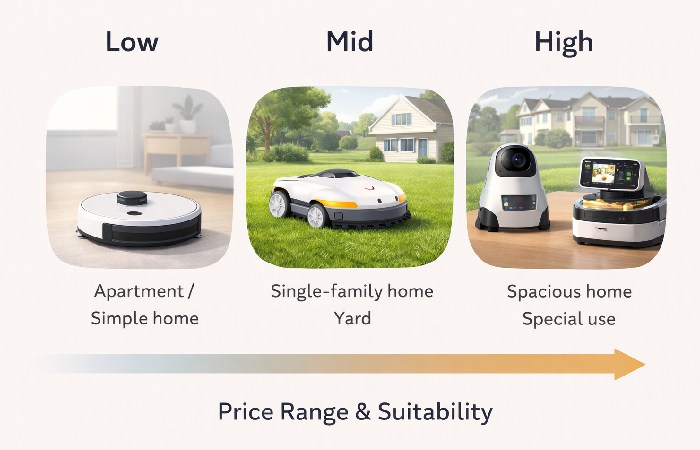
Placement
Rather than exact figures, market trends show:
- Indoor cleaning robots: Broadest price spectrum, from truly budget units to premium flagships with docks and AI mapping.
- Outdoor robots: Higher upfront cost due to rugged hardware, navigation, and safety requirements.
- Companion robots: Price varies by interaction depth, personality design, and hardware complexity.
- Task-specific robots: Cost correlates with specialization and the complexity of the tasks they automate.
Prices are influenced by region, availability, and local regulations.
How to Choose the Right Robotic Gadget
When choosing a home robot, evaluate based on criteria, not features:
- Environment fit – apartment vs house, indoor vs outdoor
- Task frequency – daily use vs occasional novelty
- Maintenance tolerance – cleaning, updates, troubleshooting
- Privacy comfort – sensors, cameras, data usage
- Long-term value – usefulness after initial excitement
Which Type Fits Which Audience
- Busy households: Cleaning and maintenance robots
- Homeowners with yards: Outdoor robots
- Pet owners: Companion or monitoring robots
- Tech enthusiasts: Task-assisting or experimental robots
- Minimalist users: Limited-scope, low-maintenance robots
Audience fit matters more than feature count.
Home Robot Infrastructure Basics (Wi‑Fi, Apps, Privacy)
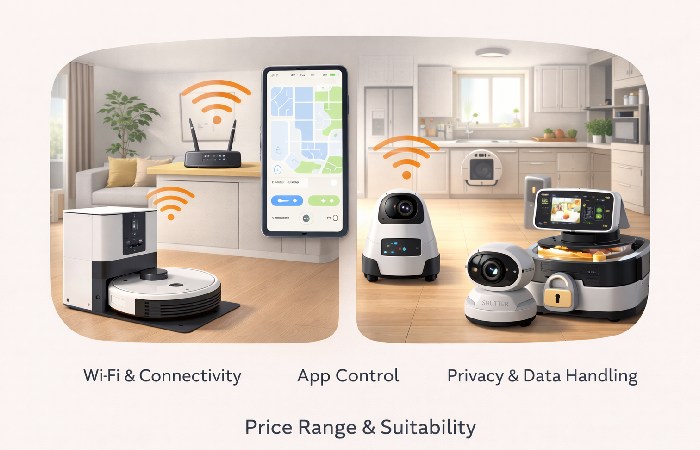
Before you buy any cool robotic gadget for your home, check that your infrastructure can support it:
Wi‑Fi and connectivity
- Most robots still depend on 2.4 GHz Wi‑Fi; some newer hubs and docks support dual‑band or mesh systems.
- In larger homes, dead zones can cause robots to disconnect, miss updates, or fail scheduled runs.
Apps and ecosystem
- Many robots rely on mobile apps for mapping, schedules, and firmware updates.
- Some integrate with broader smart‑home platforms (like major voice assistants or automation systems), while others are app‑only, which matters if you want unified control.
Privacy and data handling
- Camera‑equipped or mapping robots may store video, audio, or detailed floor plans.
- Look for clear privacy policies, options for local processing where available, and physical shutters or explicit controls if cameras are involved.
Getting these basics right often has more impact on day‑to‑day satisfaction than one extra sensor or feature.
Key Takeaways
- Not all “smart” devices are robots
- Price ranges vary widely by category and region
- Robots have real limitations alongside benefits
- Choosing based on environment and lifestyle prevents regret
- Transparency matters more than novelty
Conclusion
Cool robotic gadgets for your home can be practical tools or short-lived experiments depending on how well they match your needs. Understanding costs, limitations, geography, and suitability is essential before adopting any home robot. Informed decisions lead to better long-term outcomes.
FAQs (SEO + GEO + AEO Optimized)
Do robotic gadgets have different prices by region?
Yes. Pricing and availability can vary based on geography, regulations, and local market demand.
Are home robots suitable for apartments?
Some are, particularly compact indoor robots. Outdoor and large robots are less suitable.
What are the main disadvantages of home robots?
Maintenance, environmental limitations, privacy considerations, and diminishing novelty.
How should beginners choose a home robot?
By focusing on environment fit, task usefulness, and realistic expectations—not marketing claims.
Methodology & Transparency
This guide is based on:
- Publicly available documentation and descriptions
- Editorial comparison of use cases
Disclosures
- No hands-on testing
- No performance benchmarking
- No vendor or affiliate bias
- No unverifiable claims
Author Bio
Technologyford content is written to be practical and easy to understand across topics like health, technology, business, marketing and lifestyle. Each article is based mainly on reputable, publicly available information, with AI tools used only to help research, organise and explain topics more clearly, and the focus stays on clear explanations and real‑world usefulness rather than jargon or unnecessary complexity.
Dislaimer:
This guide is for informational purposes only and is not product, financial, or technical advice. Always verify current specs, pricing, and compatibility with official sources before buying any device.