
Table of Contents
Introduction — Problem, Agitation, Quick Solution
Problem
You know call center quality assurance matters, but your current scorecards are outdated, inconsistent, or missing entirely. QA reviews happen, yet agents don’t really understand what’s being measured or how to improve.
Agitation
Supervisors spend hours filling in clunky forms, different evaluators score the same call differently, and coaching turns into arguments about fairness instead of focused skill‑building.
New hires are confused about what “good” looks like, and leaders can’t tie QA scores to CSAT, FCR, or revenue. The result is a lot of QA activity with very little visible change in day‑to‑day behavior or customer outcomes.
Quick Solution
This playbook shows how to design call center quality assurance scorecards that are simple, fair, and outcome‑driven.
By defining clear criteria, weighting what truly matters, and using ready‑to‑adapt templates for roles and channels, you can standardize QA, reduce scoring bias, and turn every evaluation into a practical coaching plan.
Why Scorecards Are the Heart of QA
A call center QA scorecard is the tool that converts abstract “quality” into specific, observable behaviors and outcomes.
It breaks each interaction into components that evaluators can score consistently, which is essential for fair feedback and meaningful trend analysis.
External resources such as this overview of call center quality assurance further explain how structured QA programs support consistency, compliance, and customer satisfaction.
With a well‑designed scorecard, you can link call center quality assurance directly to FCR, CSAT, and compliance by scoring the behaviors that influence those metrics.
What a Call Center QA Scorecard Should Include
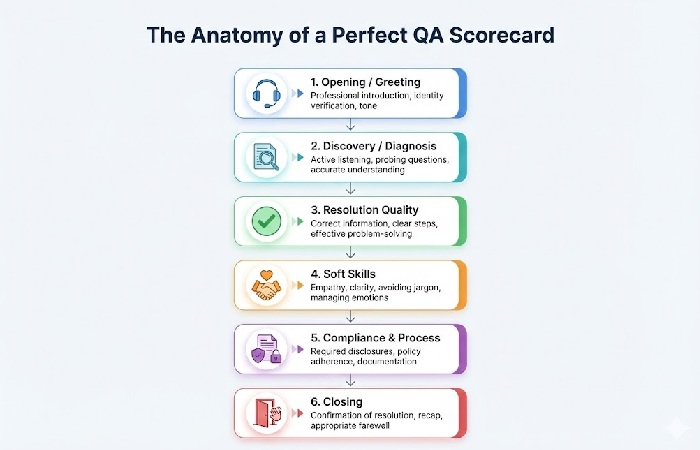
Most modern examples structure QA scorecards into a small number of sections that mirror the flow of a conversation. Common components include:
- Opening / Greeting: Professional introduction, identity verification, and tone setting.
- Discovery / Diagnosis: Active listening, probing questions, and accurate understanding of the issue.
- Resolution Quality: Correct information, clear steps, and effective problem‑solving.
- Soft Skills: Empathy, clarity, avoiding jargon, and managing difficult emotions.
- Compliance & Process: Required disclosures, policy adherence, documentation, and tagging.
- Closing: Confirmation of resolution, recap, and appropriate farewell.
Templates from vendors and CX platforms typically assign each of these categories a score and, in many cases, a weight, based on how critical they are to your brand and industry, similar to the examples in Zendesk’s QA scorecard guide.
Designing Scorecards from Business Goals
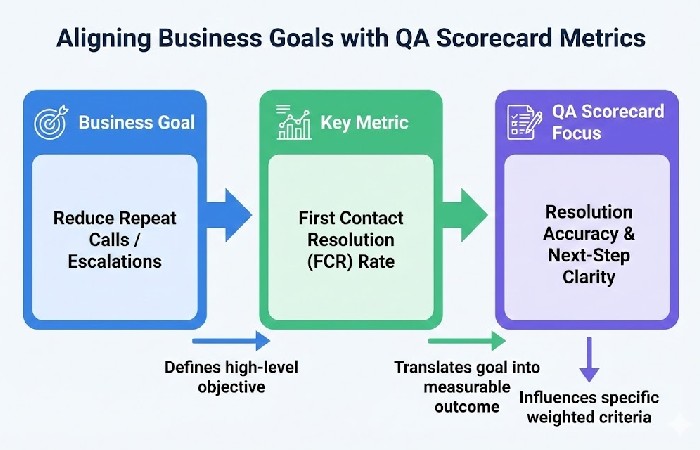
Guides on how to build QA scorecards all start at the same place: business outcomes. You define what your call center quality assurance program should change—fewer repeat contacts, better CSAT, higher sales conversions, or stronger compliance—and then pick criteria that directly impact those goals, following the principles outlined in [Calabrio’s QA scorecard best practices]
For example, if reducing repeat contacts and escalations is a priority, you might give more weight to resolution accuracy and next‑step clarity than to greeting polish.
If you operate in a highly regulated sector, compliance items become non‑negotiable, often scored as pass/fail, while soft skills use a richer scale.
Several 2025 resources recommend revisiting scorecard weights every 6–12 months to reflect changing priorities and customer expectations. This keeps call center quality assurance aligned with strategy instead of locked into legacy metrics.
Scoring Methods: Checklist, Weighted, or Hybrid
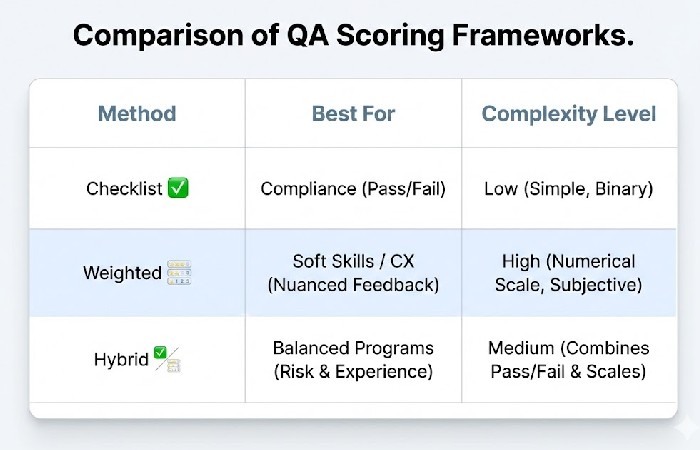
Most call center QA scorecards use one of three scoring approaches.
- Checklist (Yes/No): Simple pass/fail for must‑do actions such as compliance statements, ID checks, or mandatory disclosures.
- Weighted Scoring: Numerical scales (e.g., 1–5) with category weights, allowing nuanced assessment of empathy, problem‑solving, and communication.
- Hybrid Models: Pass/fail for compliance plus weighted scales for experience factors, combining risk control with CX focus.
Best‑practice articles highlight that whichever method you choose, each score should have a definition and examples so evaluators interpret the scale consistently. Short descriptors like “1 = major miss, 3 = meets expectations, 5 = excellent execution” reduce subjectivity and make feedback clearer to agents.
Role‑ and Channel‑Specific QA Scorecards
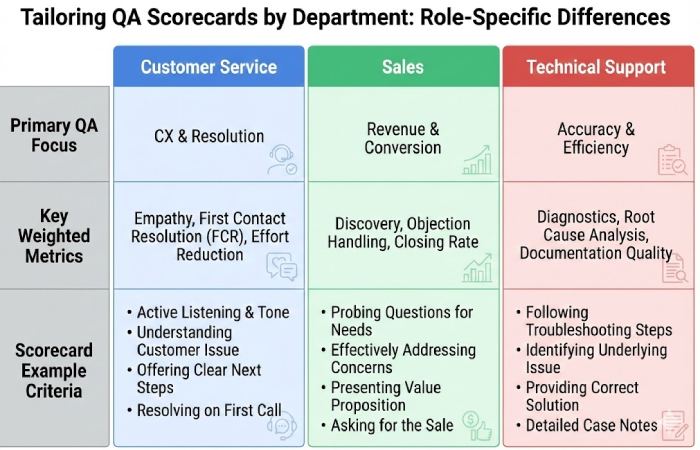
Template libraries now commonly provide different scorecards by role and channel, reflecting how expectations change across situations. Examples include:
- Customer service scorecards: Emphasize resolution accuracy, empathy, and effort reduction across voice, email, and chat.
- Sales and retention scorecards: Add criteria for discovery questions, objection handling, and conversion or save outcomes.
- Technical support scorecards: Focus more on diagnostic steps, troubleshooting accuracy, and documentation.
- Channel‑specific scorecards: Adjust weights and criteria for voice vs chat vs email, e.g., tone and pace on calls vs clarity and structure in written replies.
2025 best‑practice content recommends aligning all these variations under a shared framework so call center quality assurance stays coherent while still respecting role differences.
Multi‑Channel Scorecards for Omnichannel QA
As customer journeys span voice, chat, email, and messaging, QA scorecards are evolving from single‑channel checklists to multi‑channel frameworks. Guidance suggests:
- Using shared core themes (accuracy, empathy, compliance, resolution) across channels, with channel‑specific sub‑criteria.
- Adjusting weights based on what customers value most in each channel—for example, tone and pacing on calls, clarity and structure in chat or email.
- Ensuring your call center quality assurance reporting can roll up scores across channels, so leaders see an integrated view of CX.
This avoids the trap of having completely different definitions of “quality” depending on how the customer happens to contact you.
Calibration: Making Scorecards Fair and Reliable
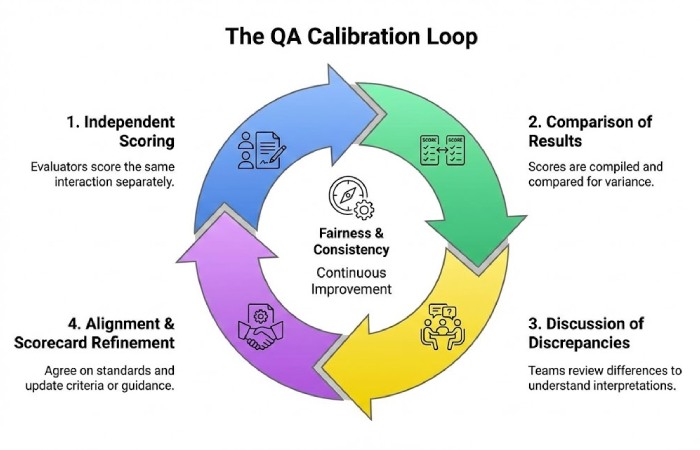
Calibration sessions are consistently cited as a critical part of effective QA scoring. In these sessions, two or more evaluators score the same interaction independently, then compare results and discuss differences.
Best‑practice guides recommend running calibration regularly (e.g., monthly) and whenever you update your scorecard. Goals include aligning interpretations of each criterion, adjusting wording where confusion arises, and spotting systematic scoring drift over time.
This process is one of the most effective ways to keep call center quality assurance fair, reduce agent complaints about inconsistency, and maintain trust in QA data, as emphasized in this call calibration best‑practice guide.
Turning Scorecards into Coaching Plans
Scorecards only create value when they inform coaching and development, not just reports. Recent resources recommend a few patterns:
- Use QA results to identify each agent’s top 1–2 focus areas rather than trying to fix everything at once.
- Combine numeric scores with brief notes and concrete examples, so agents understand the “why” behind each rating.
- Track before‑and‑after scores on targeted behaviors to see whether coaching and training are working.
Some tools now offer agent dashboards where individuals can see their call center quality assurance scores over time, compare against team averages, and access targeted learning resources.
Practical Scorecard Templates You Can Adapt
Open‑source and vendor‑provided templates give you a fast starting point.
- General call center QA scorecards: Basic templates for greeting, problem‑solving, soft skills, and compliance.
- Sales and retention templates: Scorecards focusing on qualification, needs analysis, objection handling, and close.
- Technical support templates: Criteria for diagnostic steps, root‑cause analysis, and documentation quality.
- Outcome‑based scorecards: Tables linking metrics like FCR, CSAT, and escalation rate to explicit targets (e.g., FCR ≥ 80%, CSAT ≥ 90%).
These resources are designed to be customized with your own weights, metrics, and language so they align with your call center quality assurance strategy.
Conclusion
A well‑designed QA scorecard is the engine of call center quality assurance: it defines what “good” looks like, makes evaluations consistent, and turns every interaction into a chance to learn.
When you ground your scorecards in business goals, calibrate them regularly, tailor them to roles and channels, and connect them directly to coaching, QA stops being a form‑filling exercise and becomes a reliable driver of better CX, stronger performance, and lower risk.
Short FAQs about QA Scorecards
What is a QA scorecard in a call center?
A QA scorecard is a structured form that scores agent interactions on criteria like accuracy, empathy, process adherence, and compliance.
How many items should a QA scorecard have?
Many guides recommend 3–4 sections with 2–5 questions each as a practical range, not a fixed standard, to keep evaluations focused and usable.
Should all criteria have the same weight?
No, weights should reflect what matters most—such as resolution and compliance for regulated or high‑stakes calls.
How often should scorecards be updated?
Typically every 6–12 months, or when business goals, products, or regulations change.
Can one scorecard work for all channels?
You can share core themes across channels but should adapt criteria and weights for voice, chat, and email.
Disclosure:
This guide may reference third‑party tools and resources for illustrative and educational purposes only. It is not sponsored, and no endorsement or commercial relationship is implied.
About the Author
Abdul Rahman is a professional content creator and blogger with over four years of experience writing about technology, health, marketing, productivity, and everyday consumer products. He focuses on turning complex topics into clear, practical guides that help readers make informed decisions and improve their digital and daily lives.