

No referral or affiliate links shown on this page. All linked-to external sites are only government agencies, the WHO, and registered charities.
“Link gacor” is present everywhere – within the Whatsapps group, Gojek driver updates, TikTok posts and search results. Indonesians on the internet have come across this term hundreds of times, but for most of them, no one has ever told them directly what it is (and whether or not they should use it).
This page explains all of it: what “apa itu link gacor” means, how the referral economy behind it works, the legal status of online gambling in Indonesia, who is at risk, and what to do if you or someone you know is already affected.
The Ministry of Communication and Informatics of Indonesia (Kominfo) continually personifies internet gambling as a problem of a national scale, and has urged the citizens to report illegal content by using its dedicated Aduan Konten reporting system and noting other chosen official complaint channels listed on its website.
Table of Contents
Quick Answers
- What is a gacor link? A tracked referral URL used to recruit online gamblers — not a reliable indicator of a slot machine’s payout rate.
- Is online gambling legal in Indonesia? No. It is banned under many laws, with possible criminal liability for both operators and users.
- What are the key dangers? Monetary loss, liability, clinically recognized gambling addiction.
- How do sites target users? Via social media algorithms, SEO‑optimized pages, messaging apps, and influencer referral networks.
- What to do if affected? Report illegal sites to Kominfo via aduankonten.id and seek addiction support through recognized mental health and psychosocial services.
What Is a Gacor Link? (Full Definition)
Definition (58 words — featured snippet optimized):
A “gacor link” (link gacor) is a commission‑based referral URL distributed by affiliates of online gambling sites targeting Indonesian users. The word “gacor” — used in Indonesian slang to mean “noisy, chattering, very active” and repurposed in gambling circles to imply “easy to win” — is a marketing claim suggesting a slot game is paying at a high rate. This claim is unverifiable and is not a factual game state.
In practice, “gacor” is just a marketing label, not a verified game condition. Sites use it to create a sense of urgency — implying users must act before a supposed “hot” period ends. Slot outcomes are governed by Random Number Generators (RNGs), which are designed so that each spin is independent; no slot is in a permanently favorable state.
How “Link Gacor” Works as a Referral System
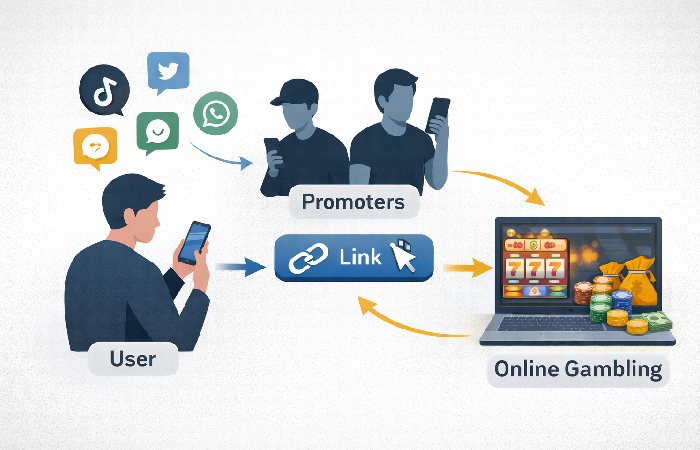
When you see terms like “link gacor [site name]”, you are usually looking at a referral URL — a tracked link that credits a promoter when a new user registers or deposits via that link.
This is the underlying economy:
- Site operators run affiliate or referral programs that reward promoters based on user deposits or losses.
- Promoters (individuals, social media accounts, even “educational” blogs) distribute referral links in groups, comments, and content.
- The term “gacor” is added to make the link more attractive and urgent.
- The system is designed to grow through social sharing and referrals, not through any provable increase in win rate.
Understanding this structure helps you see that most “link gacor” content online is monetized referral traffic, not neutral or objective information.
Why “Gacor” Sites Are Particularly Risky

Unregulated platforms that market themselves using “gacor” terminology typically share several risk characteristics:
- No clear, verifiable operator identity — often registered offshore, with no Indonesian regulatory oversight. Kominfo’s own announcements note that many gambling domains they block are operated from other countries but localized for Indonesian users.
- No independent RNG audits published — players cannot verify game fairness or payout percentages.
- Withdrawal delays or refusals — users commonly report deposits being accepted quickly while withdrawals are blocked or stalled.
- No effective consumer protection — there is no accessible dispute resolution body for Indonesian users if something goes wrong.
Is Online Gambling Legal in Indonesia?
Online gambling is illegal in Indonesia, and this applies to both operators and users.
The main legal framework includes:
Full legal texts and consolidations can be accessed through Indonesia’s official legal documentation network (JDIH), for example via the Kominfo legal documentation page at JDIH Komdigi (Kominfo), which links to the ITE Law and related regulations.
Penalties for Users
Many people assume that only site operators face legal consequences. This is incorrect.
Under provisions such as Article 303bis of the Criminal Code, individuals who participate in gambling, including online gambling, can face imprisonment and/or fines, with severity influenced by factors like frequency and scale of participation. Public communications by Kominfo and law‑enforcement agencies consistently underline that participating in online gambling remains an illegal act, even when done via foreign websites.
Does Using a VPN Protect You?
No. This is a common and dangerous misconception.
Using a VPN to access blocked gambling sites does not:
- Make online gambling legal in Indonesia.
- Hide all financial transactions from monitoring systems.
- Remove your potential liability under Indonesian law.
A VPN mainly conceals your traffic from your internet provider and changes your apparent IP location. It does not change the legal status of what you are doing or how payment providers and financial‑intelligence bodies view your transactions.
How Unregulated Gambling Sites Operate
Understanding how these platforms are set up helps explain why the risks go beyond ordinary gambling losses.
The Business Model
Unregulated Indonesian‑facing gambling sites commonly follow this pattern:
- Registered offshore — in jurisdictions where online gambling is allowed, putting them outside direct Indonesian legal reach.
- Indonesian‑language interface — designed specifically for Indonesian users despite offshore registration, a pattern Kominfo has highlighted when explaining its blocking actions against foreign‑hosted gambling sites.
- Payment via e‑wallets or crypto — using methods such as local e‑wallets or cryptocurrency to avoid traditional banking scrutiny.
- Affiliate referral network — large numbers of social media users are paid to recruit players using referral links.
- Bonus manipulation — “high value” welcome bonuses paired with restrictive terms that make withdrawing winnings extremely difficult.
Why Unregulated Differs from Licensed
In countries where gambling is legal and licensed (such as parts of Europe or Australia), operators are generally required to:
- Submit to independent RNG and fairness auditing.
- Offer responsible gambling tools (self‑exclusion, deposit limits, reality checks).
- Maintain documented, verifiable withdrawal processes.
- Report suspicious transactions and comply with anti‑money‑laundering rules.
By contrast, sites that illegally target Indonesia operate without local licenses or consumer protection frameworks. Kominfo’s public reports of blocking hundreds of thousands of gambling‑related URLs — often echoed by major news outlets — illustrate the scale of this enforcement battle and the lack of voluntary compliance from operators.
If you are cheated, if a withdrawal is refused, or if the site disappears, you effectively have no practical recourse.
How Online Gambling Sites Target Indonesian Users
The reach of online gambling marketing in Indonesia is the result of deliberate, sophisticated strategies.
Social Media Algorithm Exploitation
Gambling platforms and their affiliates use social media to reach Indonesian users through:
- Interest‑based signals — users engaging with finance, gaming, or sports content may be profiled as potential gamblers.
- Lookalike audiences — characteristics of existing gamblers are used to find similar users.
- Short‑form videos — TikTok and Instagram Reels are used to share “win compilation” clips that normalize gambling and make it look easy.
Formal ad policies may restrict gambling ads, but affiliate content posted as “personal” or organic often slips through moderation.
SEO Manipulation and Gateway Pages
A large share of gambling promotion uses SEO‑driven doorway pages:
- Sites publish articles that appear educational or informational.
- These pages are optimized for search queries gambling‑interested users type, including awareness queries.
- Once a user lands, the content gradually funnels them toward referral or “link gacor” URLs.
Genuine awareness content that does not push people to sign up plays a public‑interest role by occupying this same search space with safer information.
Messaging App Distribution
WhatsApp and Telegram groups are major distribution channels:
- Group administrators share “link gacor” and promotion codes regularly.
- Some users are added to groups without clear consent.
- The informal, social nature of chat groups makes messages feel more trustworthy than they are.
Influencer and Micro‑Referral Networks
Small and mid‑tier influencers — sometimes only a few thousand followers — are recruited as affiliates. Their earnings often depend on the number of depositing users they bring in, turning ordinary social media accounts into a distributed marketing system for illegal platforms.
Online Gambling Risks: The Full Picture

Financial Risks
The financial risks of using unregulated platforms include:
- Unverifiable house edge — without independent audits, odds and payout rates can be changed without notice.
- Withdrawal refusals — deposits may be processed instantly, while withdrawals are rejected or endlessly “under review.”
- Bonus traps — high “welcome bonuses” tied to wagering requirements that can be dozens of times the bonus amount, effectively locking your funds.
- Loss‑chasing patterns — the variable rewards of slot‑style games are known from addiction research to encourage increasing bets after losses.
Indonesia’s Financial Transaction Reports and Analysis Center (PPATK) has publicly reported large flows of online gambling funds and traced shifts in how deposits are made, including the use of QRIS, in press briefings such as this update on PPATK’s findings on QRIS‑based online gambling deposits.
Law‑enforcement summaries of PPATK’s work on online gambling money flows are also available, for example in this Indonesian National Police article on how PPATK suppressed the circulation of online gambling money in the first quarter.
Legal Risks
Beyond financial losses, users may face:
- Criminal investigation or prosecution under gambling‑related provisions.
- Transaction monitoring flags — unusual inflows and outflows involving gambling sites can attract scrutiny from PPATK and other authorities tasked with enforcing anti‑money‑laundering rules.
- Reputational and employment consequences if a case leads to a criminal record or public exposure.
Psychological and Social Risks
Gambling disorder is classified by the World Health Organization in ICD‑11 (code 6C50) – Gambling disorder as a recognized behavioral addiction with impaired control, priority given to gambling, and continuation despite negative consequences. A more detailed breakdown of the ICD‑11 criteria for gambling disorder is available in clinical summaries such as this overview of the ICD‑11 criteria for gambling disorder.
Documented consequences include:
- Strained family relationships and conflict over money.
- Withdrawal from work, school, and social responsibilities.
- Increased anxiety, depression, and sleep problems.
- In severe cases, thoughts of self‑harm linked to financial stress.
How to Recognize Gambling Addiction
Problem gambling often develops gradually. Many people — and their families — do not recognize it as an addiction until the situation becomes serious.
Early Warning Signs
- Losing track of time during gambling sessions.
- Hiding gambling activity from family or friends.
- Increasing bet size or frequency after losing, to “win back” what was lost.
- Borrowing money without explaining the real reason.
- Irritability, restlessness, or tension when unable to gamble.
Behavioral Changes to Watch For
| Behavioral Change | What It May Indicate |
|---|---|
| Unexplained financial shortfalls | Undisclosed gambling losses |
| Increased screen time on unfamiliar apps | Active gambling or betting activity |
| Withdrawing from family or social activities | Shame, secrecy, or time spent gambling |
| Mood highs and lows tied to phone use | Emotional swings based on wins/losses |
| Selling personal items or frequent borrowing | Financial pressure from gambling losses |
When to Seek Help
If multiple signs from the lists above are present over a sustained period, it is wise to seek a professional assessment.
A commonly used screening question is:
“Have you ever felt the need to bet more and more money to get the same feeling of excitement?”
An honest “yes” can be an important indicator that gambling is becoming problematic, consistent with screening approaches derived from ICD‑based criteria.
What to Do If You or Someone You Know Is Affected
Reporting Illegal Gambling Sites in Indonesia
The Ministry of Communication and Informatics (Kominfo) operates reporting channels for illegal online content, including gambling sites:
- Official reporting portal: the Ministry of Communication and Informatics (Kominfo) provides Aduan Konten for reporting illegal online content, including gambling sites. Additional complaint instructions are provided in Kominfo’s own Layanan Aduan Konten infographics and service standards. Kominfo also explains step‑by‑step how to report illegal content, including gambling sites, in its official Layanan Aduan Konten infographic on the Komdigi legal documentation portal.
Reports can usually be made without disclosing your identity. Each reported URL helps authorities identify and block illegal services, even though new domains may appear over time.
Getting Help for Gambling Addiction in Indonesia
Several organizations and institutions can help with mental health and gambling‑related issues, including:
- Into The Light Indonesia — mental health awareness and referrals to counseling services
- Yayasan Pulih — psychosocial support and counseling
- Regional psychiatric hospitals (RSJ) — many state hospitals list addiction‑related services on their official websites.
If you are a family member or friend, consider speaking with a professional first about how to approach the person safely and constructively, since the way you raise the issue can strongly influence outcomes.
Common Mistakes People Make About Online Gambling
- “It’s just a game, I can stop anytime.”
Slot‑style games use variable reward schedules that are known from clinical research to make stopping harder than people expect. The feeling of control often does not match actual behavior. - “Using a VPN makes it safe and legal.”
A VPN may hide traffic from your internet provider but does not change Indonesian law or how payment providers see your transactions. - “If the site looks professional, it must be legitimate.”
Visual design is cheap. Many illegal gambling sites aimed at Indonesia look polished while offering no real consumer protection. - “I can win back what I lost if I just try once more.”
This “loss‑chasing” mindset is one of the biggest drivers of harm. Each spin or bet is statistically independent; past losses do not make a future win more likely. - “Only the operator can get in trouble, not me.”
Laws targeting gambling participation mean individual users can also face legal consequences, not just site owners.
Who This Information Is For
Best suited for:
- Indonesian internet users who have encountered “link gacor” or gambling promotions and want accurate, non‑promotional information.
- Family members concerned about someone’s gambling behavior.
- Educators, community leaders, or parents seeking reliable material to share.
- Journalists or researchers covering digital gambling in Indonesia.
Not intended for:
- Promoting, recommending, or directing readers to any gambling platform.
- Providing formal legal defense advice — for that, consult a qualified Indonesian legal professional.
- Replacing clinical assessment — for diagnosis or treatment, speak to a licensed mental health professional.
Final Verdict
Online gambling in Indonesia is illegal, psychologically risky, and financially dangerous — especially on unregulated offshore platforms that actively target Indonesian users.
The “gacor” concept is a marketing construct, not a technical feature of slot machines. It exists to drive clicks and deposits through referral links, not to provide a genuine signal of higher win rates.
If you have encountered online gambling content or “link gacor” promotions, the most effective protection is understanding the system behind them and choosing not to participate. If you or someone you know is already affected, seeking help early generally leads to better outcomes than waiting until the situation becomes a crisis.
About Technologyford
Technologyford.com provides useful, accessible information about health, technology, business, marketing and lifestyle. Most of the articles are based on reliable publicly available sources, with the inclusion of AI tools only to aid in researching, structuring and presenting the information more simply so that the utility in the real world remains the emphasis.
Disclaimer
The information provided here is based on publicly available sources on Google and other online platforms and is intended for general informational purposes only. We do not guarantee the accuracy, completeness, or timeliness of this information, and it may change without notice. You are solely responsible for how you use or interpret this content, and we accept no liability for any loss or damage arising from reliance on it.