
AI search engines don’t read your content the way humans do.
They don’t sit with nuance. They don’t weigh context. They don’t ask follow-up questions.
They extract.
And what they extract is rarely the full story.
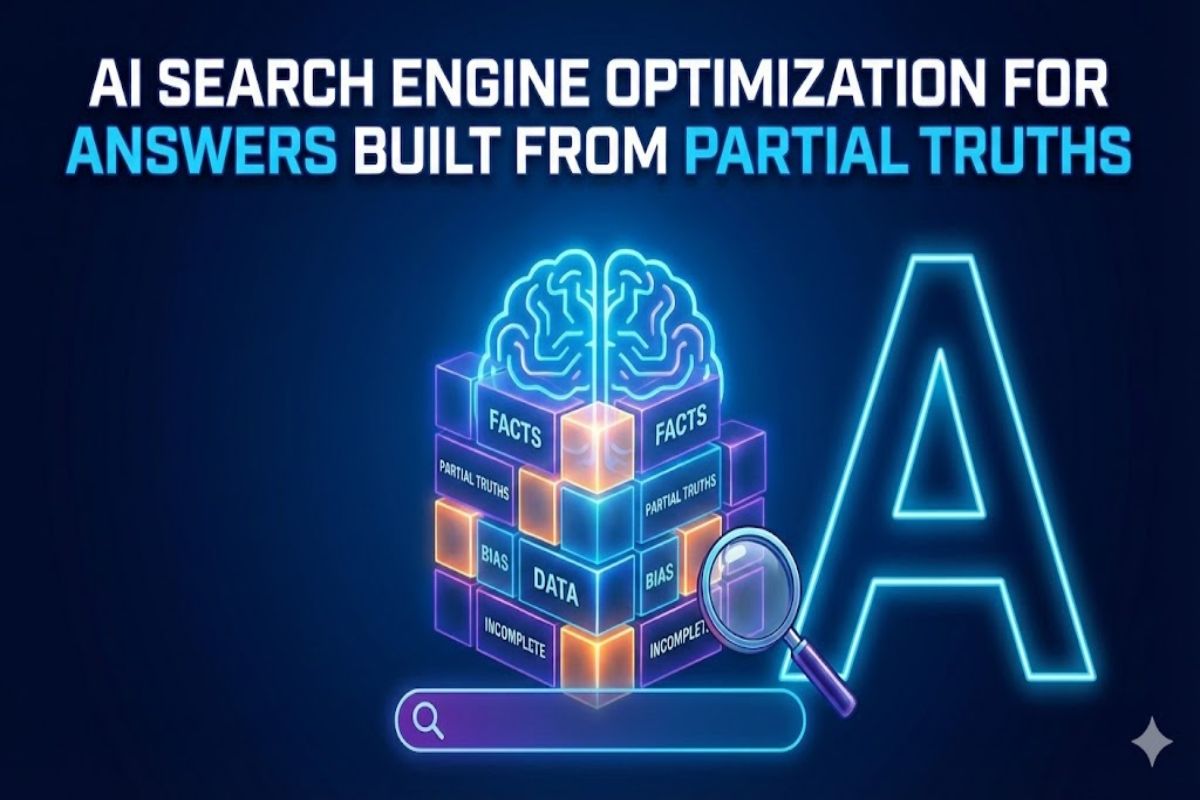
Most AI answers today are built from partial truths. Not lies. Not misinformation. Just fragments that sound complete enough to satisfy a question quickly.
If you want visibility in AI search, you need to understand how that works. That’s where AI search engine optimization begins.
Table of Contents
The Reality of AI Answers
When someone searches today, they often never reach a website.
Google AI Overviews, ChatGPT Search, Perplexity, and Gemini assemble answers directly on the results page. These answers are stitched together from multiple sources, typically using short, confident statements rather than full explanations.
The system favors content that is:
- clear immediately
- easy to extract
- structurally simple
- confident in tone
Not necessarily the content that is most complete.
That distinction matters.
Because AI engines reward answerable sentences, not comprehensive essays.
If your content cannot stand alone in fragments, it rarely gets chosen.
What “Partial Truths” Actually Mean
A partial truth isn’t deception. It’s compression.
It’s technically correct, but it lacks context.
You see this everywhere:
- “Coffee improves focus.”
- “Remote work increases productivity.”
- “AI is replacing jobs.”
Each statement contains truth. Each also requires context.
AI systems prefer these because they fit neatly into answer boxes and token limits. Long explanations often get ignored.
So the question isn’t whether partial truths exist.
They already dominate AI search.
The real question is whether your content is structured so that AI can safely extract from it.
Why AI Engines Prefer Incomplete Answers
Large language models are built for efficiency, not completeness.
They optimize for usefulness per token. That creates predictable behavior:
- Brevity wins.
Short statements are easier to rank and reuse. - Confidence signals authority.
Hedged language (“it depends,” “sometimes,” “in certain scenarios”) gets skipped. - Context gets trimmed.
AI removes qualifiers when assembling summaries.
This isn’t malicious design. It’s math.
The system selects text with the highest semantic match and lowest processing cost.
If your explanation requires three paragraphs to understand, AI will likely quote someone else who said it in one sentence.
AI Search Engine Optimization Starts With Extractability
Traditional SEO asked: Can Google crawl this page?
AI search asks something different:
Can this sentence survive on its own?
When I audit content for AI visibility, I look for extractable moments—lines that can become answers without compromising accuracy.
Here’s the shift:
| Traditional SEO | AI Search Engine Optimization |
| Optimize pages | Optimize answer units |
| Rank positions | Appear in generated answers |
| Drive clicks | Become the source |
| Keyword density | Meaning clarity |
You are no longer writing only for readers.
You’re writing for assembly systems.
How Partial Answers Get Built
AI engines typically follow a pattern:
- Retrieve multiple sources.
- Pull short factual fragments.
- Merge overlapping statements.
- Present a unified answer.
Your content doesn’t need to explain everything.
It needs to supply reliable building blocks.
That means writing in modular clarity.
Instead of: Reputation damage can result from complex interactions among algorithms, perception, and evolving digital ecosystems…
Write: Search engines often treat the first available information as the most trustworthy signal.
That sentence can stand alone. AI can use it safely.
And it still tells the truth.
The Right Way to Structure Content for AI Extraction
You don’t manipulate AI. You guide it.
Here’s what consistently works.
Write Complete Thoughts in Short Bursts
Aim for 15–25-word statements that fully express one idea.
Not fragments. Not slogans. Finished thoughts.
Place Context After the Core Idea
Lead with the usable answer, then expand on it.
Example: Online reputation issues rarely start with a crisis. They start with outdated or incomplete information and rank first.
Then explain why.
AI extracts the first line. Humans keep reading.
Both win.
Reduce Dependency Between Sentences
If meaning relies heavily on prior sentences, extraction breaks occur.
Each key statement should make sense independently.
Headlines Matter More Than Ever
AI models lean heavily on headings to understand intent.
Vague titles disappear. Direct ones get reused.
Strong examples:
- How AI Search Chooses Which Sources to Trust
- Why First Impressions Dominate AI Answers
- What AI Search Engine Optimization Actually Requires
Weak examples:
- Exploring the Future of Search Innovation
Specific beats clever every time.
Strategic Omission vs. Misleading Content
This is where many marketers get it wrong.
You are not hiding the truth.
You are sequencing information.
Lead with the accurate core insight. Add nuance afterward.
Bad approach:
- exaggerate claims
- remove necessary context
- chase clicks
Good approach:
- state verified facts clearly
- expand deeper in the article
- preserve credibility
At NetReputation, this distinction matters constantly. Reputation recovery fails when content appears exaggerated because AI systems downgrade sources perceived as unreliable over time.
Authority compounds. So does distrust.
Technical Signals Still Matter
AI systems rely heavily on structure.
Clean formatting helps machines interpret meaning more quickly.
Focus on:
- FAQ schema for direct questions
- clear subheadings
- entity clarity (people, brands, concepts)
- consistent terminology
You’re no longer adding markup for Google.
You’re helping AI identify what your page knows.
Measuring Success in AI Search
Clicks alone no longer tell the story.
AI search introduces new visibility signals.
Watch for:
- appearances inside AI summaries
- branded mentions in generated answers
- increases in assisted traffic
- query impressions without clicks
You may lose clicks while gaining influence.
That’s not failure. That’s AI visibility working.
Many NetReputation clients notice reputation improvement before traffic increases because AI answers begin reflecting corrected narratives first.
Search perception changes before behavior does.
The Real Risk of Partial Truths
Here’s the uncomfortable reality:
If you don’t supply clear, accurate fragments, AI will pull them from someone else.
That version may lack the context you care about.
AI doesn’t wait for perfect explanations. It answers with what’s available.
That’s why AI search engine optimization isn’t optional anymore.
It’s reputation management at the information layer.
What AI SEO Really Demands
You don’t need louder content.
You need clearer thinking.
Write statements that are:
- true without explanation
- confident without exaggeration
- short without being shallow
When your content consistently produces reliable answer fragments, AI systems begin treating you as a stable source.
That’s the long game.
And in AI search, stability beats volume every time.