
Table of Contents
Introduction — Problem, Agitation, Quick Solution
Problem
You need better CX, retention, and efficiency, but your call center quality assurance framework is a patchwork of spreadsheets, ad‑hoc audits, and tribal knowledge. Everyone agrees quality is important; no one agrees on how to measure or improve it.
Agitation
Agents feel judged on a handful of random call reviews, supervisors juggle inconsistent reports, and leaders only see lagging indicators like churn or negative reviews. New hires ramp slowly because “what good looks like” lives in the heads of a few top performers, not in a documented system. Over time, gaps in coaching, process, and training compound into inconsistent experiences, higher operating costs, and missed revenue.
Quick Solution
A clear call center quality assurance framework brings everything together: well‑defined goals and metrics, practical scorecards and templates, and a step‑by‑step implementation checklist. With this playbook, you can move from isolated QA checks to a consistent, data‑driven rhythm that systematically improves customer experience, agent performance, and business outcomes.
What a Call Center Quality Assurance Framework Is
A call center quality assurance framework is the overall structure that defines how you measure, monitor, and improve quality across all customer interactions. It combines your goals, metrics, scorecards, review cadence, coaching approach, and supporting tools into a cohesive program, similar to the structured models described in this call center quality assurance framework overview.
Unlike standalone scorecards or one‑off audits, a framework explains who does what, when, and why, so QA is predictable and repeatable. It gives agents, supervisors, QA specialists, and leaders a shared playbook for what quality means and how to move it.
Core Components of an Effective QA Framework
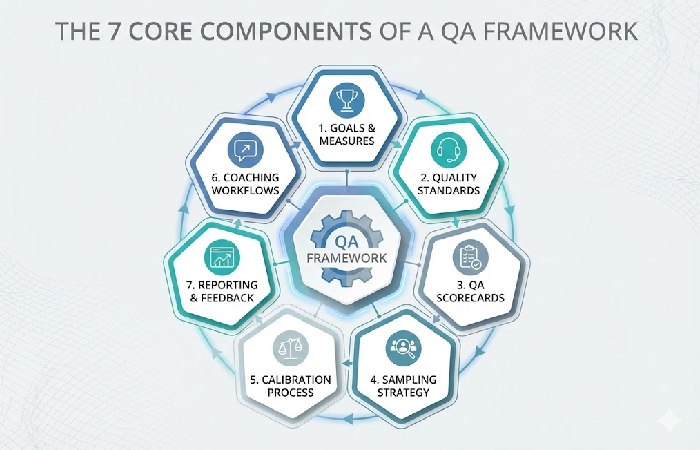
A practical call center quality assurance framework usually includes these components:
- Goals and success measures: Clear targets for CSAT, FCR, NPS, compliance, and operational efficiency.
- Quality standards: Written definitions of what “good” interactions look like by channel and use case.
- QA scorecards: Structured forms to score behaviors and outcomes in each interaction.
- Sampling strategy: Rules for how many interactions to review, by whom, and at what cadence.
- Calibration process: A way to keep evaluators aligned on scoring.
- Coaching workflows: How results feed into 1:1s, training, and performance reviews.
- Reporting and feedback loops: Dashboards and routines that push insights to stakeholders and drive changes in process and content.
When these pieces are explicitly designed and documented, QA becomes a system instead of a collection of separate tasks.
Setting Goals and Choosing QA Metrics
Your call center quality assurance framework should start with business goals, not forms. Decide what you want to change: fewer repeat contacts, higher satisfaction, increased revenue per contact, or fewer compliance incidents.
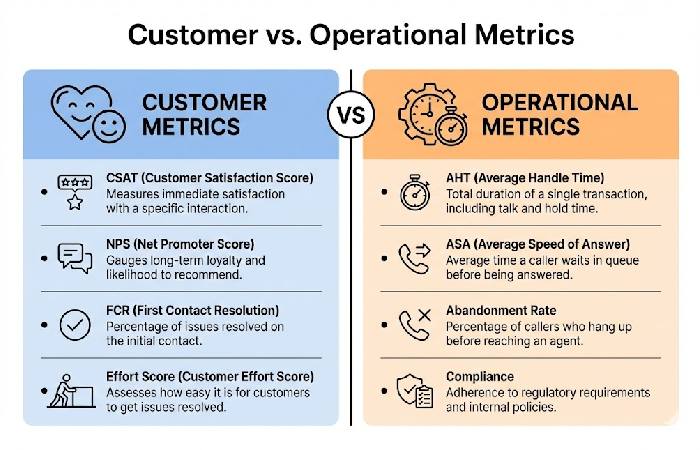
From there, select a balanced set of metrics: Customer‑level metrics such as FCR, CSAT, NPS, and Customer Effort Score to see the impact on experience and loyalty, in line with common QA KPIs outlined in this guide to call center QA metrics.
Operational metrics such as AHT, ASA, and abandonment rate to understand capacity and responsiveness. Quality metrics such as QA score, error rates, and compliance flags to assess how well standards are being followed.
Each metric should have a clear definition, formula, owner, and target range. This prevents confusion and helps everyone understand how their role contributes to the bigger picture.
Building Scorecards Inside the Framework
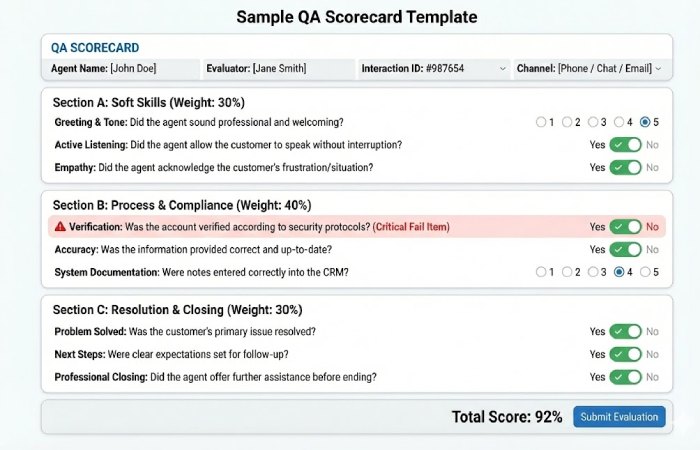
In the framework, QA scorecards are the instruments you use to collect data on real interactions. They should be designed to reflect your goals and metrics, not just generic checklists.
A strong scorecard typically contains:
- Sections that mirror the interaction flow (opening, discovery, resolution, closing).
- Separate sections for soft skills (empathy, clarity) and compliance items.
- Clear descriptions for each item and a simple scoring scale.
- Weightings that emphasize the behaviors most strongly linked to your goals.
By embedding these scorecards into the framework—defining who uses them, how often, and for which channels—you ensure they are part of daily operations, not just a document in a shared drive.
Templates You Can Use in Your QA Framework
To speed rollout, your call center quality assurance framework can include ready‑to‑adapt templates. Useful examples are:
- General QA scorecard template: For core service interactions across channels.
- Sales and retention scorecard template: With criteria for discovery, needs analysis, and conversion or save outcomes.
- Technical support scorecard template: Emphasizing diagnosis steps, solution accuracy, and documentation.
- QA checklist template: Covering objectives, sampling rules, calibration cadence, and coaching steps.
- QA report template: Standardized views for weekly, monthly, and quarterly summaries at agent, team, and topic level.
These templates create consistency across teams and make the framework easier to adopt and maintain.
Implementation Checklist: Rolling Out the QA Framework
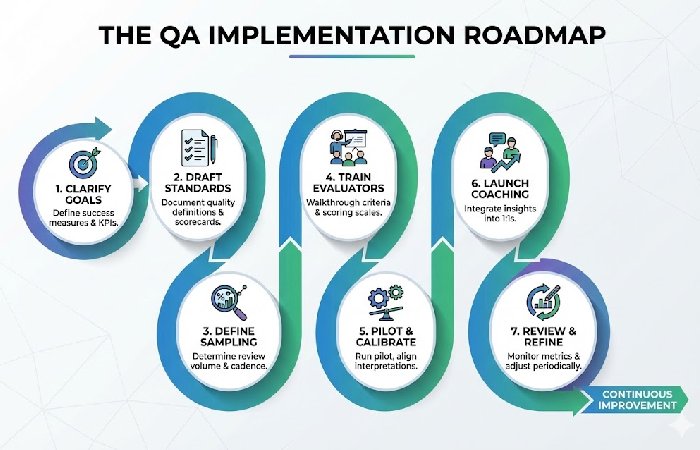
A call center quality assurance framework becomes real when you implement it step by step. A practical rollout sequence is:
| Phase | Key Actions | Primary Owner | Timeline |
| 1. Planning | Define business goals (e.g., reduce churn) and select core metrics (CSAT, FCR). | Operations Leader | Week 1 |
| 2. Design | Draft quality standards and build weighted scorecards for each channel. | QA Specialist | Weeks 2–3 |
| 3. Logistics | Set sampling rules (e.g., 5 calls/agent/month) and define review cadence. | QA Lead | Week 4 |
| 4. Enablement | Conduct training for evaluators and supervisors on scoring and criteria. | Training Manager | Week 5 |
| 5. Pilot | Run a 2-week pilot with one team; hold calibration sessions to align scores. | QA Team | Weeks 6–8 |
| 6. Launch | Full rollout across all teams; integrate QA results into weekly 1:1 coaching. | Supervisors | Week 9 |
| 7. Optimize | Review data against business goals; adjust weights or criteria based on feedback. | Stakeholder Group | Quarterly |
Documenting this checklist in the framework ensures the program is repeatable for new teams, sites, or outsourcers.
Embedding QA into Coaching and Performance
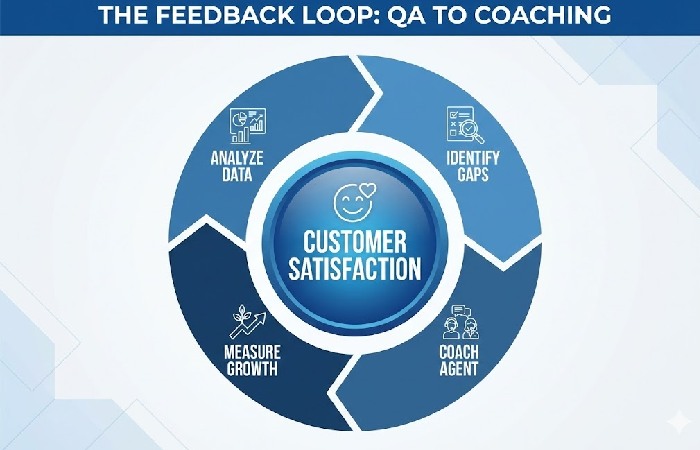
A core purpose of the call center quality assurance framework is to make coaching deliberate and evidence‑based, reflecting best practices from modern call center coaching frameworks. That means:
- Using QA data to identify top 1–2 focus areas per agent, rather than overwhelming them with a long list.
- Bringing specific interaction examples into coaching sessions so feedback is concrete.
- Setting small, time‑bound improvement goals (e.g., greeting consistency, probing questions) and tracking score changes.
- Recognizing high performance and improvement, not only flagging issues.
When agents see QA as a path to growth and recognition, they are more likely to engage with the framework and contribute suggestions for improvements.
Governance: Ownership, Reviews, and Adjustments
To keep a call center quality assurance framework healthy, assign clear ownership and review rhythms:
- Framework owner: Usually a QA or operations leader who steers updates and alignment.
- Stakeholder group: Supervisors, QA specialists, training, and sometimes product or compliance to provide input.
- Review cadence: Regular reviews (e.g., quarterly) to assess whether criteria, weights, and metrics still reflect priorities.
Governance prevents the framework from drifting or becoming outdated, and it gives you a clear path for handling disputes or change requests.
Conclusion
A call center quality assurance framework is the blueprint that turns quality from a vague aspiration into a repeatable system, extending the foundations of your existing call center quality assurance program.
By defining goals and metrics, embedding well‑designed scorecards and templates, and following a step‑by‑step implementation and coaching plan, QA stops being random call listening and becomes a predictable driver of better CX, more confident agents, and stronger business results.
Short FAQs about the QA Framework
What is a call center quality assurance framework?
It’s the overall structure that defines how you set goals, measure quality, review interactions, and coach agents in a consistent way.
How is a framework different from a scorecard?
The framework is the system; scorecards are one tool inside it used to evaluate individual interactions.
Who should design the QA framework?
A small cross‑functional group—QA, operations, team leads, and training—should design it together.
How long does it take to implement a basic framework?
A focused team can usually pilot and refine a minimal framework in 1–3 months.
How often should the QA framework be reviewed?
At least annually, and more often if your products, regulations, or CX strategy change significantly.
Disclosure:
This guide may reference third‑party tools and resources for educational purposes only. It is not sponsored, and no endorsement or commercial relationship is implied. Parts of this content were created and refined with the assistance of AI tools, and all recommendations have been reviewed for accuracy and relevance.
About the Author:
Abdul Rahman is a professional content creator and blogger with over four years of experience writing about technology, health, marketing, productivity, and everyday consumer products. He focuses on turning complex topics into clear, practical guides that help readers make informed decisions and improve their digital and daily lives.