
Unlocking the mechanics, evolution, and future of automated trading.
Trading bots are specialized software programs designed to automatically execute trading strategies based on pre-defined rules. They operate by:
- Data Consumption: Devouring market information such as prices, volumes, news feeds, and technical indicators.
- Algorithmic Processing: Analyzing this data through programmed rules to identify trading opportunities.
- Instant Execution: Executing trades in milliseconds when opportunities meet programmed parameters.
Table of Contents
Key Advantages of Trading Bots:
- Continuous Operation: Trade around the clock, capturing opportunities without human rest.
- High Speed: Execute trades at speeds unattainable by human traders.
- Emotional Detachment: Operate objectively without human emotions like fear or greed influencing decisions.
- Complex Strategy Handling: Capable of executing intricate tactics like arbitrage and market-making.
- Portfolio Management: Can manage multiple accounts and diversify across various assets.
Historical Evolution of Trading Bots:
- Early Stages (1970s-80s): Automation began with systems like the NYSE’s DOT system and the rise of “program trading,” pioneered by individuals like David Shaw.
- Speed and Efficiency (1990s-Early 2000s): Electronic Communication Networks (ECNs) like Instinet and Island facilitated High-Frequency Trading (HFT). By 2009, bots reportedly accounted for 70% of US securities market trades.
- AI Integration (2010s-Present): Artificial Intelligence (AI) and Machine Learning (ML) have enabled adaptive, learning bots capable of sophisticated decision-making, with increased accessibility for individual traders, especially in cryptocurrency markets.
Current Perspectives on Trading Bots:
- Proponents (“Informed Traders”): View bots as powerful tools for executing proven strategies, enhancing expertise and efficiency, with AI/ML as decision-making augmentations.
- Skeptics (“Beginners & Skeptics”): Warn against the allure of passive income, express skepticism about publicly available bots, and emphasize the risks of over-reliance and lack of market understanding.
Benefits of Bots:
- Intricate Data Analysis: Ability to identify patterns and correlations in vast datasets.
- Backtesting: Simulating strategy performance on historical data for profitability and risk assessment.
- Automated Risk Management: Implementing controls like stop-loss orders and position sizing.
Using Trading Bots for Efficient Crypto Trading
Ease and Efficiency of Trading Bots
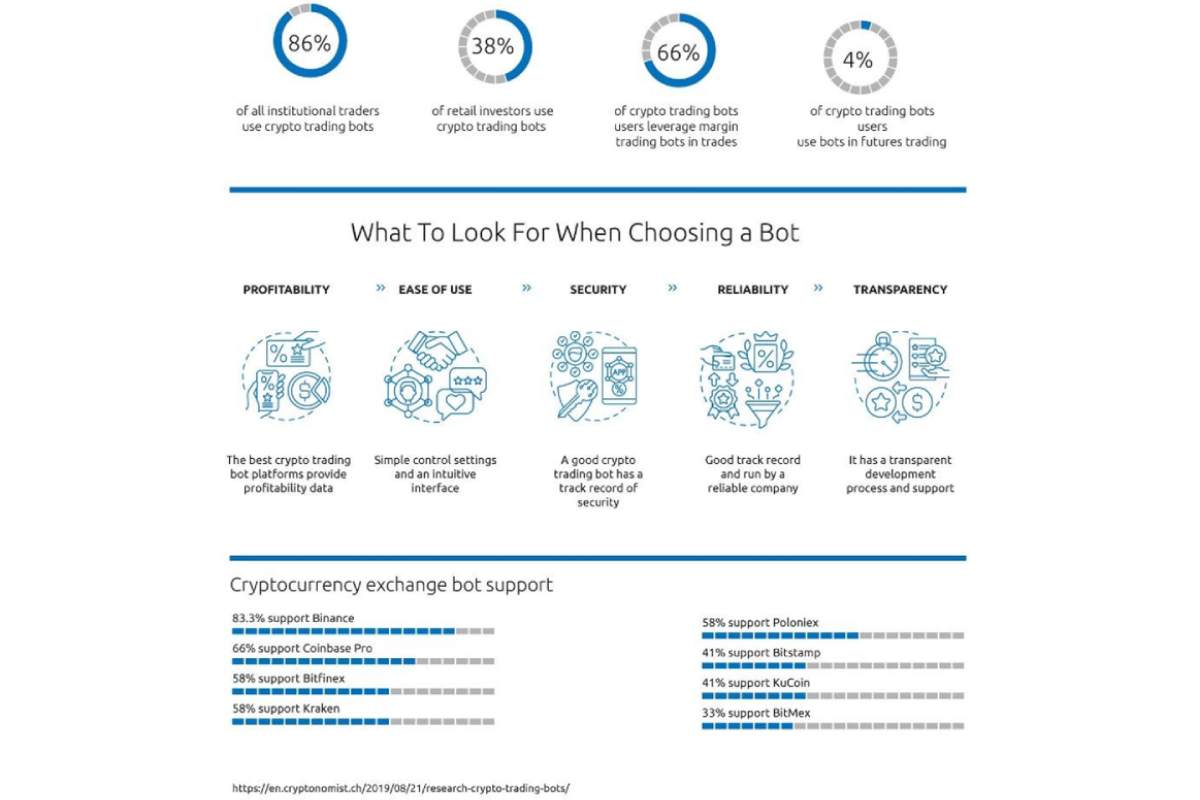
With the use of trading bots, placing orders is easier and quicker. This also helps traders avoid missing opportunities. However, choosing the right bot is important. It’s important to read reviews of the different types of bots to determine which one is best for your needs.
Types and Selection of Trading Bots
There are a variety of trading bots to choose from. Some are free, while others cost a fee. Before using a bot, it’s important to research its reliability, functionality, and reputation. Also, make sure it has a good support team.
Features of Coinbase Pro Trading Bots
A good Coinbase Pro trading bot will allow you to place multiple trades simultaneously. The software will automatically open and close positions based on your defined rules. These can be set to open a long position when the price rises or a short position when the price falls. You can also specify the amount to allocate to each strategy.
Additional Platform Support
In addition to automated trading, many platforms offer tutorials to help you get started. Traders can also access a community forum for trading tips. Users can sign up for a Telegram subscription to communicate with fellow users and share trading ideas.
Automated Market Analysis
Trading bots are designed to analyze the market conditions of several cryptocurrencies and then make decisions based on those results. These bots do not require human interaction so you can focus on your trading strategy. They can also run in real-time, allowing you to take advantage of large-volume transactions.
Advantages of Coinbase Pro
Coinbase Pro is a premium exchange that is reliable and secure. The platform has a great team of traders and experts and offers an industry-leading API. Plus, the FDIC insures its digital assets.
Liquidity and Advanced Features
One of the main advantages of Coinbase Pro is its ample liquidity. This allows traders to benefit from a wide range of fiat and crypto pairs and margin trading. Moreover, users can benefit from various advanced features, such as the industry-leading API and advanced trading tools.
3Commas Trading Bot
The 3Commas trading bot is one of the most cutting-edge trading bots on the market. It offers a slew of features that are unmatched by other trading bots. It provides a comprehensive management interface for all of your crypto trading strategies. The bot is also compatible with most major exchanges. Whether you want to trade a long or short position, the software’s robust order types can accommodate you.
Flexibility of Coinbase Pro Trading Bot
Another excellent feature of the Coinbase Pro trading bot is its flexibility. It can open deals in tough-to-enter markets. This is a great tool for newbies in the crypto market. The software will keep track of your entry price, position size, and Take Profit. If your entry price drops, the bot will adjust your Take Profit. Similarly, if your position size grows, the bot will increase your Buy Orders.
Considerations for Using Trading Bots
Using trading bots is not for everyone. People who do not have the patience or technical skill to handle a complex program are better off avoiding bots. However, for sophisticated investors, trading bots are an essential part of the trading process.
Risks and Challenges Associated with Trading Bots:
- Technical Issues: Bugs, code errors, or connectivity problems can lead to significant financial losses, requiring constant monitoring.
- “Curve-Fitting”: Bots over-optimized to past data may fail in unpredictable real-world markets due to a lack of adaptability.
- Cost: High-quality bots can be expensive, and setup requires significant time and effort.
- Security: Granting API access to accounts carries inherent security risks, necessitating the use of reputable providers.
- Unpredictability: Bots cannot predict “black swan” events, and flawed strategies executed efficiently can be disastrous.
- “Black Box” Opacity: The decision-making processes of many AI bots are unclear, hindering understanding and debugging.
- Skill Atrophy: Over-reliance on bots can impede the development of human trading knowledge and skills.
Ethical and Societal Concerns:
- Market Volatility: Algorithmic trading can exacerbate market volatility, as seen in the 2010 “Flash Crash” and Knight Capital’s 2012 loss. Crypto bots have been implicated in losses during events like the Mt. Gox collapse and Compound platform issues.
- Market Manipulation: Bots can be programmed for manipulative tactics like pump-and-dump schemes and wash trading.
- Algorithmic Bias: Bots trained on flawed data can perpetuate market biases.
- Accountability: The “black box” nature of AI raises complex questions about responsibility for bot-induced harm.
- Unfair Advantage: Concerns exist about institutional investors with superior technology having an advantage over retail traders.
- Data Exploitation: Handling of sensitive data raises concerns about exploitation, cyber threats, and insider trading.
- Job Displacement: The potential for robots to render human traders obsolete.
Regulatory Landscape:
Governments are struggling to keep pace with rapid technological advancements.
Existing laws often lag behind, creating challenges for regulators (e.g., SEC, CFTC, MiFID II) in ensuring transparency, preventing manipulation, and maintaining stability. Regulators emphasize the critical need for human oversight, stating that no bot should operate entirely autonomously.
Future of Trading Bots:
- Enhanced Capabilities: Expect deep learning to enable more sophisticated data analysis (including news and sentiment via Natural Language Processing – NLP) for accurate price forecasting.
- Integration: Potential integration with blockchain technology for enhanced security, transparency, and efficiency.
- Personalization: Bots will increasingly offer strategies tailored to individual risk tolerance and financial goals.
- Dynamic Adaptation: Bots will become more dynamic, adjusting position sizing, stop-loss/take-profit thresholds, and reacting to real-time liquidity changes.
- Democratization: The ongoing question of whether advanced bots will become accessible to all, leveling the playing field.
- Increased Regulation: Expect tighter regulations, particularly for AI-driven systems and crypto trading bots, with compliance remaining a challenge.
Conclusion:
Trading bots are powerful tools offering speed, efficiency, and emotional discipline, but they are not guaranteed profit generators. They carry significant risks, complex ethical dilemmas, and operate within an evolving regulatory framework. The future of trading is increasingly automated, but human intelligence, vigilant oversight, and ethical design are paramount.